A second night of Sibelius symphonies at the Proms, packed to the rafters just like its predecessor. Exit Thomas Dausgaard, the tuba needed for the first two symphonies but not for the Third or – surprising given its pervasive darkness – the Fourth, and the air that had billowed around supremely supple performances. Enter Ilan Volkov to bring too much dark earth and inorganic point-making at first, though the BBC Scottish Symphony Orchestra, its strings sounding tougher if less inward from a different point in the hall, was still on world-class form.
The programme was identical to the second instalment of Rattle’s Sibelius cycle earlier this year with the Berlin Philharmonic, though it had an extra dimension in a newly-commissioned “portrait” of Sibelius, Janne, by Michael Finnissy. It began with exactly the same misconception. You can tell from the opening bars of the Third Symphony whether the conductor “gets” it or not. As with Rattle, what should be lightly-sprung repeated notes from cellos and basses, piano, were far too dour and heavy; the ideal here remains how Sakari Oramo kicked off the symphony in his very first concert with the BBC Symphony Orchestra back in 2011.
 Oramo also made sense of the enigmatic central movement, con moto but utterly hypnotic as a kind of Valse semitriste. Volkov was way too slow here, and mismanaged what should be a slightly faster tempo for the woodwind flurries, the only break in the gentle swaying; Dausgaard the night before may have had one or two co-ordination problems, and his conducting style is less elegant than Volkov's, but his faster speeds always seemed justified, to me at any rate. In the finale, the noble theme that drives us to a very assertive C major should emerge imperceptibly and proceed naturally. It was too flagged up, the song of a nation rather than that of a proud individual who’s overcome troubles.
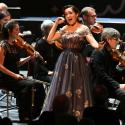
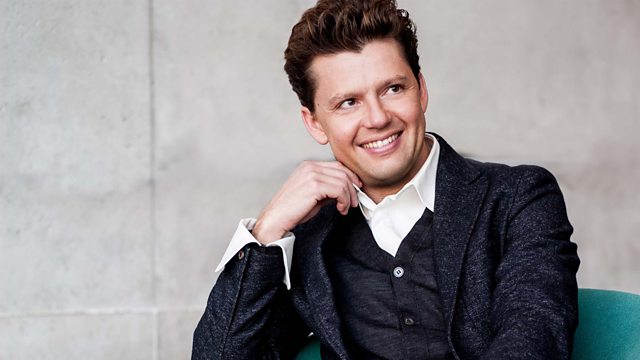
What the real identity of the Violin Concerto was in this performance I’ve no idea. It wouldn’t have mattered that Julian Rachlin (pictured above) had a few intonation problems – the flights in the finale fox all but a handful of violinists – if there had been more give and take between soloist and orchestra. Again there's a benchmark Proms performance: Lisa Batiashvili with Oramo and the BBC Symphony Orchestra. All that remained here was the beauty of tone, the majesty of double-stopping: impressive, but still not enough. And having produced the finest orchestral sequence up to that point in the dark swell at the heart of the slow movement, Volkov killed the finale by failing to project the supporting polonaise rhythm. It’s odd that a conductor with such a firm rhythmic sense for the many new pieces he champions doesn’t like to dance. Rachlin’s encore, Ysaÿe's Third "Ballade" Sonata, didn't add up either, brilliantly executed though it was .
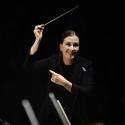
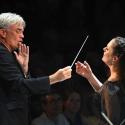
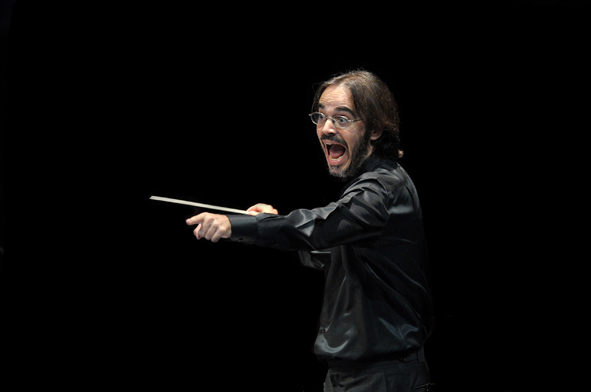 Volkov (pictured left by Chris Christodoulou) seemed, at any rate, to have done a fine job on Finnissy’s character study, its name the one the Frenchified Jean was called as a child. Sibelius transformed in the opening bassoon solo and the familiar woodwind thirds soon gave way to very thick, Bergian textures; towards the end there seemed to be an interloper from the deceptively childlike world of Nielsen’s last symphony, and it carried the day, but it was leader Laurel Samuel’s eloquent, speaking violin solo that left the greatest impression. One wonders what the concerto might have been like if she’d been the soloist; we would at least have had a true dialogue with fellow players.
The craggy peak of the evening had to be the austere – but, for me, not depressing – Fourth Symphony. Since Volkov’s element, like Rattle’s, seems to be earth and not air, the anchored sound was more apt in this special case among Sibelius’s orchestral works. Revelations came from the horns in all their eerie stopped music, which from where I was sitting, projected like I’ve only heard it on a handful of recordings: snarling ahead of the rest of the orchestra in the horrifying tritonal sweep which obliterates the brief merriment of the Scherzo and undermining the light of the finale throughout. Volkov sealed his credentials as a deep and serious conductor in the crucial Largo, finding the right line and undercurrents as the fragments of desolation piece themselves together into a great, brief cry from the heart and recede. But the real heroes here were the players, bowing out from the Proms as a world-class orchestra after four magnificently executed concerts.
- Listen to this Prom for the next month on the BBC iPlayer
- Listen to David Nice's BBC Radio 3 Building a Library programme on Sibelius's Fourth Symphony
- David Nice writes for theartsdesk on the Building a Library experience
Read theartsdesk's reviews of other concerts from the BBC Proms