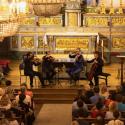
There’s an intimacy, an interiority, to music for viol consort that even the string quartet can’t match. The physical placement of the three members of Phantasm who opened this concert of music by Gibbons, Purcell, Locke and Lawes was telling. Occupying three sides of a square, facing one another directly, theirs was a private musical conversation the audience was permitted to overhear. Fortunately it was one full of eccentric, charming episodes, as well as some moments of glorious darkness.
This was the first of two concerts built around Purcell’s viol consorts – anachronistic works that had little place in the musical landscape of 1680, but whose harmonic language is bolder and more elegantly anarchic than anything before it (Gesualdo’s madrigals, perhaps, excepted). Setting their extremities into relief was sunnier, more lyrical consort music by Gibbons and Lawes, as well as the more angular, exploratory works of Matthew Locke, precursor to Purcell’s own style.
Phantasm plunged mid-stream into these emotive miniatures
It’s hard to construct a full-length concert out of miniatures. Barely any of these works, even the more extended suites by any other name, are longer than ten minutes, and with the inevitable tuning and re-tuning demanded by temperamental gut strings under concert-hall lights, dramatic tension is all but impossible to maintain. Quietly and undemonstratively going about their business however, Phantasm guided us through this stop-start programme, plunging mid-stream into these emotive miniatures and communicating with the unworked directness that sets viols apart – and, arguably ahead – of their contemporary instrumental descendants. These are instruments that show their working, whether that’s in the rasping start to a note or the sudden end-stop of its close, with little of a modern violin or cello masking resonance.
The result is a textural transparency and clarity that allows the ear to penetrate right through even five-part textures, bringing out the contrapuntal detail of fancies by John Ward and Matthew Locke’s consorts in all their angular unlikeliness. Where Phantasm came into its own, however, was in Purcell’s extraordinary music, taking his rhetorical gestures and amplifying them in delicate rhythmic and harmonic interplay. The chromatic colouring that peppers the fantasias can too easily leap out of the texture, distracting the ear from the unfolding emotional and melodic flow of the music, but here each unexpected colour was integrated into the whole.
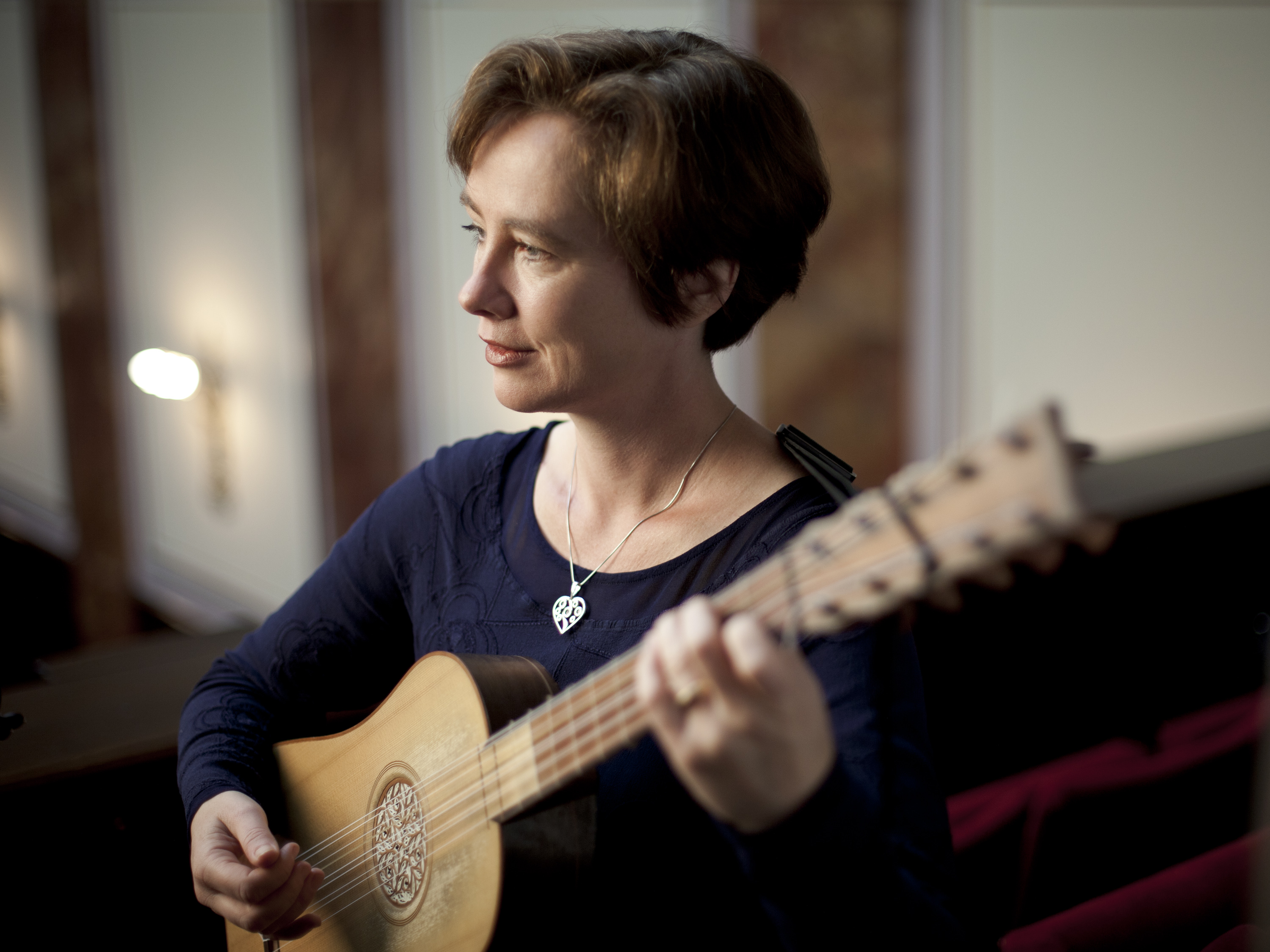 Phantasm’s latest disc is of music by William Lawes, represented here by his immensely attractive Royal Consort No. 5 in D with its seven dance-based movements. After the quick-fire thematic bait and switch of Purcell, Lawes’ more leisurely way with his melodies was a relief, a chance to settle into the music that little else in this demanding programme allowed. The addition of Elizabeth Kenny’s theorbo (Kenny pictured right) was also a welcome one, softening the sonic edges ever so slightly and filling out the texture with elegant embellishment.
Phantasm are not the most physically demonstrative of groups, but in a small venue like the Wigmore it’s an understatement that carries and makes sense of music that needs little by way of performative PR. In a city like London that’s all about the hard sell, it’s a welcome contrast.