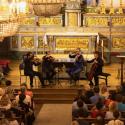
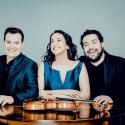
There is nothing quite like Fretwork at their best. When the viol consort put themselves through their paces in the music of the late 16th and the 17th centuries, with music by Byrd, Dowland, Lawes and Purcell, the results are infallibly and unvaryingly stunning. The mutual listening, the sense of pacing, the balance, the homogeneity of sound, the results they reach are joyous.
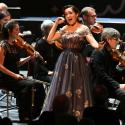
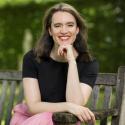
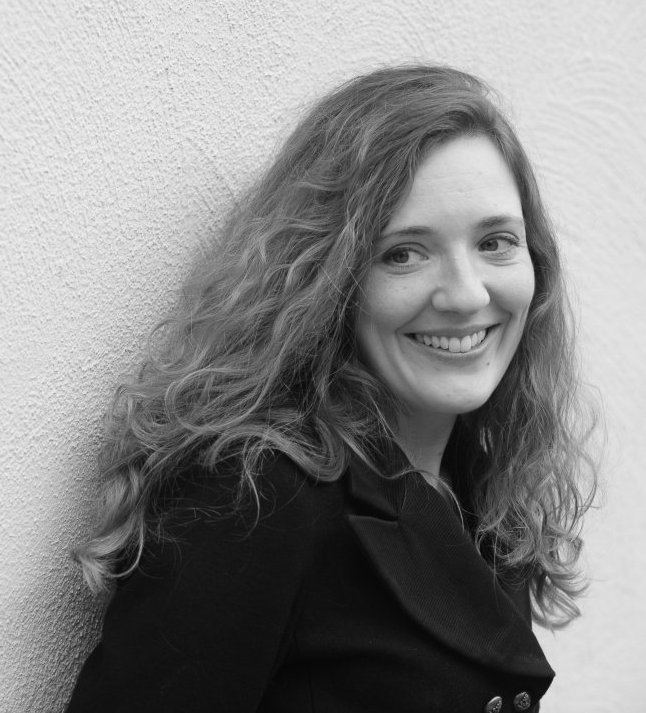
Joined by the light-voiced, highly intelligent mezzo-soprano Clare Wilkinson (pictured below left, by Stefan Schweiger), a regular collaborator, their performances of Dowland's “In Darkness Let Me Dwell” or the last musical item, Purcell's “An Evening Hymn” were items to treasure. Wilkinson's voice in this context blended in, worked with the harmonies; these were well-judged performances, exquisitely worked, and thought right through.
The theme of the winter solstice has led to the commissioning of new works
However, This Year's Midnight, performed in near-darkness, and billed as a meditation of songs, poetry and instrumental music for the winter solstice, is more ambitious and ranges more widely across the centuries. While in the context of Christmas beset with Messiah, or imprisoned by “Baby, It's Cold Outside”, it was a relief to find an imaginative take on a different theme, this was an evening which, taken as a whole, left more mixed impressions. The show has had previous London outings, notably at Kings Place in 2011, with the actor Tom Courtenay reciting the poems.
The theme of the winter solstice – the title is from the John Donne poem, “A Nocturnal on St. Lucy's Day" – has led to the commissioning of new works. It is an unusual facet of the British music scene that the links which tie the worlds of pre-classical music performance to contemporary composition are quite so close. Fretwork have been active in commissioning new pieces from figures who inhabit both worlds, such as Duncan Druce, and from other contemporary composers, in this programme John Woolrich, Tan Dun, Stephen Wilkinson and Andrew Keeling.
 These pieces range from a short poem setting which wandered a bit aimlessly and Finzi-ishly (Wilkinson) to more ambitious structures (Keeling), to a ferociously complex score (Tan Dun), but whether they had the heft to hold listeners' attention is an open question. The Tan Dun did elicit spontaneous applause, but it felt like the plaudit was being given more for the assault course that the players had endured, not just the tricky work, but also for having competed with a loud police car siren, rather than artistic merit.
Reciter Simon Callow's strengths in this context are his musical instincts and his instinctive understanding of the form of a music and poetry evening. Unlike some actors who jump in too early, as if they can't wait for the music to end, Callow always left space for the music to ebb away and be reflected upon in listeners' minds. He brought a wide range of characters to mind, sometimes with the ironizing voice of a Harold Pinter; his grumpy-old-man “The Journey of the Magi" found humour in TS Eliot, and he was at his best in “The Darkling Thrush”, a reading which brought out the vividness of Thomas Hardy with musicality and rhythmic propulsion.
What stayed in the memory above all was a yearning to have dwelt longer in the company of the earlier works, not just with the composers, but also with Donne and Shakespeare, from whom one poem apiece just didn't seem enough.