All five finalists in the Leeds International Piano Competition, at which Pavel Kolesnikov was one of the jurors, should have been given tickets, transport and accommodation to hear his Wigmore recital the evening after the prizegiving. Not that supreme imagination can be taught, but to witness the degree of physical ease (and freeflowing concert wear) that allows all the miracles to happen would be a good lesson to so many tension-racked pianists, including some of Kolesnikov’s peers.
As always, the connections he made in his programme were surprising, though obvious once you thought about it. Both Chopin and Schubert lived with the immediate spectre of mortality, and it often rises to make terrifying shapes just when you think serenity has been achieved. The Chopin selection, ordered otherwise than the advertised programme since as Kolesnikov remarked in the first of his engaging commentaries having played the first two pieces, needs must on different days, featured two profound Nocturnes as its centrepiece. Kolesnikov talked about colour mastery, but in terms of expression Op. 15 No. 1 in F major disrupts a radiant vision with a near obliterating storm and Op. 48 No. 1 in C minor, pure tragedy in its outer sections, gave rise to one of the most extraordinary long term crescendos I've ever heard in a piano recital; Kolesnikov's technique gives him total mastery and control over the extremes of loud and soft, always put to expressive ends.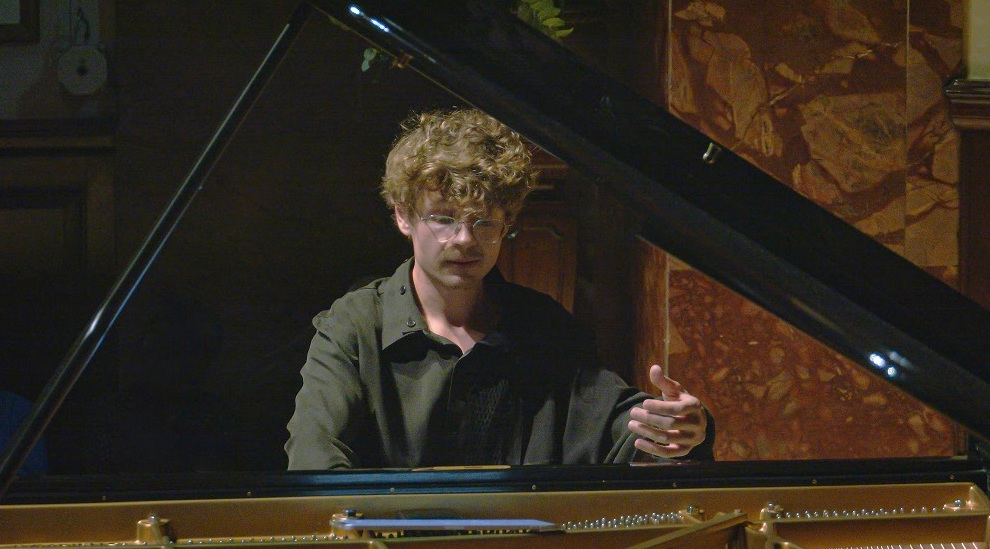 Flanking the central diptych, three Mazurkas and four Waltzes allowed for more robustness, playfulness even. Kolesnikov told us how he'd once thought of the Waltzes as not equal to the greatest Chopin, but changed his mind when he heard Emanuel Ax play Op. 34 No. 2 in A minor, conjuring a picture he thought he'd never be able to match now he was ready to try. The familiar C sharp minor Waltz, Op. 4 No. 2, sounded like it was burning itself up in flight. I'm sure Kolesnikov has played it differently before, and I know that's the case with the radical Mazurka in A minor, Op. 17 No. 4, sounding so much fuller in its anguish at times than on his superb Hyperion recording. Typical of this pianist to end his first half with those questioning chords which Bernstein, in his Harvard lectures, used as an example of harmonic ambiguity (and, for that matter, incorporated them, with a resolution, in "Maria" from West Side Story).
The Chopin journey told its own story, but in choosing Schubert's last Sonata, the D flat, D9x0, for the second half, Kolesnikov set us up for a sustained, epic struggle between serenity and high spirits on the one hand, supreme sadness and death hauntings on the other. Long paragraphs of song flowed hypnotically, in the first movement, but the lower register rumble followed by what felt like infinite silences in which no one in the hall stirred warned us of the skull beneath the skin, and when the blows fell in the loud chords towards the end of the exposition, we felt physically struck. Usually the argument for including the repeat is to hear the rumble become a gaping abyss in the link back, but every extra note which the Brendel school never lets us here struck home. In any case, Kolesnikov's mentor Elisabeth Leonskaja recalled to me her own inspiration Richter's words to any pianist who didn't go back: "What? You don't love Schubert's music?" The love here was never excessive, always controlled, but deep indeed.
Schubert's most grief stricken slow movement also had its radical side here, the left hand notes struck around the melody ending in the most discreet raindrop above the harmonies. Inevitably it made me think of Chopin's D flat major Prelude, Op. 28, penned as George Sand tells us on a rainy day in Valdemossa, Mallorca, again shattering serenity with a juggernaut of ominous fate. No surprise that Kolesnikov made that his encore, a perfect full circle since the third and fourth movements of the Schubert Sonata keep the intrusions of mortality more successfully at bay.