

The key of C minor threw a dark shadow over music long before it became the tonality for Beethoven to express the struggle of one against many in the Fifth Symphony and the Third Piano Concerto. Mozart was a feted teenager and Beethoven a babe in arms when Haydn wrote his C minor Piano Sonata in 1771, 60 years before Schumann began to make his own inner turmoil into music in the wake of Beethoven. Yet through silence as much as sound, Paul Lewis made something personal and almost confessional from the Sonata’s slow introduction, placing the full tonal weight of the Wigmore’s Steinway at the service of music probably conceived for the slender resources of a clavichord.
His measured, patient approach drew out every note of restrained pathos from Haydn’s falling phrases without disturbing their formal contours. In the ornamentation of the central Andante, too, Lewis evoked a Baroque world of fantasy in the embroidered melodic line, picking out top notes like snowdrops. Springy articulation preserved a lightness of being even in those sequences of the finale where Haydn most nearly approaches the pathos of C minor Mozart.
Rather than the conventional sunny-side-up major-key ending, Haydn closes out the sonata with another simple dying fall. Lewis made from it a marvellously apt prelude to the work that raises a “life must go on” philosophy to sublime heights, the Diabelli Variations of Beethoven. He got straight to work with Diabelli’s funny little waltz, and ignored the invitation of the initial march to raise the curtain with swagger and brilliance in favour of a sturdy momentum, playing a long game through the twists of the 33-variation sequence. Thus the more arcane harmonies of Variation 3 ushered in the poky inquisitions of the fourth, articulated like an over-attentive waiter with Beethoven’s impatient response. The cosmic humour of the trills in Variation 6 turned naturally into the vaulting leaps of the seventh, answered in turn by the right-hand consoling chorale voices of No 8. 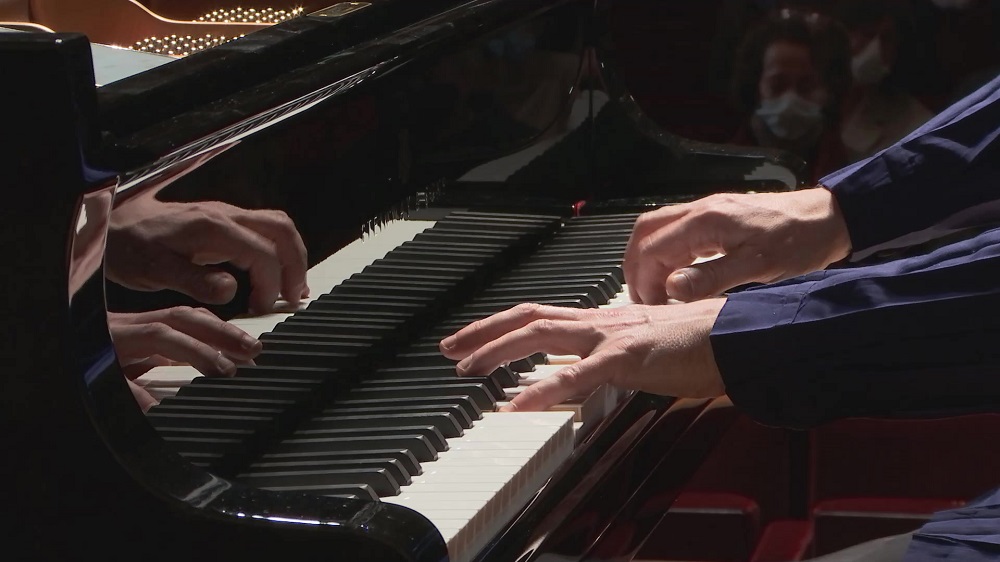 All of human life was here, in C major – absurd, profound, resigned and furious. Pausing before the Allegretto of No 10 introduced a welcome structural caesura as well as a measure of reflection before the cycle’s first full point of stillness in the space-becoming-silence of No 14, Grave e maestoso as marked but sprung and feather-blown by the sure and serious touch of Lewis’s Haydn. As in the sonata’s finale, a few scrambled semiquavers hardly obscured the clarity of his vision for the piece. The composition of the Diabellis bookended Beethoven’s four-year labour over the Missa solemnis, and both works collapse past, present and future into a single span. The meditation of Variation 20 brings some of his most speculative harmonies, and Lewis accordingly treated them like late Liszt, adrift on some mystic gondola – before No 21 broke the spell as if an eavesdropping army of servants, rooted to the spot, had been barked to attention and promptly dropped all the dishes.
In this metaphysic play – the Diabellis as a story of performance – Lewis brought first Mozart (Leporello, in Variation 22) and then Bach (the Goldbergs’ “Black Pearl” refracted through No 31) on to the stage without rolling out the red carpet. Even the extraordinary bridge from climactic fugue to concluding minuet was handled with love but also the sense of a beating pulse: life really does go on. The audience, readmitted to the hall for the first time in some weeks, applauded Lewis as if in grateful recognition.




Add comment