Russians can often get away with murder in concert. It's so ingrained within our Western psyche to believe that the Slav has culture, musicality, an innate aesthetic sensitivity pouring out of every toe that you could get a Russian to do the chicken dance and we'd all be ooh-ing and ah-ing about the passion of each wing flap, the brooding darkness of each wiggle, the searing, sarcastic quality of each clap. Not all Russians have a Russian soul. And some, like pianist Nikolai Lugansky at last night's Prom, display little sign of any soul at all.
That's not to say that last night's performance of Rachmaninov's Rhapsody on a Theme of Paganini was a dud. It wasn't quite that. Technical polish, pearliness and bouts of oomph prevented it from being unpleasant on the ear.
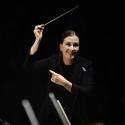
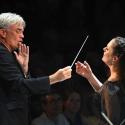
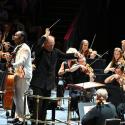
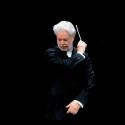
And the playfulness with which Lugansky dealt with those staccato cluster jumps - the chords as tightly and neatly scrunched as a little girl's pigtails - prevented it from completely fading to black and white. But I was very aware of the Russian National Orchestra - under the clever, careful, interventionist watch of Andrey Boreyko - bailing Lugansky out in the big emotional moments and scene changes.
The broken chords of Variation Eleven are like a new dawn breaking on this strange Road Runner-like day and should be filled with a new scent, a new tug, not, as last night, just treated as another flourish. The ever-popular D flat major melody that streams in like fresh morning sun, on the other hand, should not feel like a stand-alone showpiece. It should feel connected to all the other pearls in this chain. Even the note-perfect technical flights came across as a random tangle of lines rather than a delicate weave. I couldn't help but think that an Earl Wild - or even the man who was meant to be conducting, Mikhail Pletnev - would have put in more warp and weft.
Luckily the orchestra came to the rescue. The trumpets dazzled with a Broadway brightness. The bassoon trudged trustily with a stolid Lugansky in Variation Seven. And the sunlight of the middle variations suddenly rose up with the swell of the orchestra. Lugansky's encore - Rachmaninov's Prelude in G sharp minor - was more of the same but worse.
The orchestral activity of the first half - including a performance of Beethoven's Coriolan Overture that was memorable for its soft passages - boded well for the pastoral scenes of Tchaikovsky's Suite No 3 in G major, Op 55, a profoundly strange fish, that has little if anything to do with the model of the Baroque suite that the first two Tchaikovsky suites are very loosly based on and seems, at first glance, to have a lot more to do with a modern symphony, yet, also, doesn't.
What it resembles most to me is Tchaikovsky's piano cycle, The Seasons. Both appear clay-made, possessing this unique freshness, naivity and structural and melodic simplicity that is utterly charming and completely direct. Both were also composed in a few weeks. Both also lack the muscle or rhetoric of the sonata or the symphony. And both get sidelined as a result. So it was a joy to hear Boreyko evoke these rarely seen but intensely atmospheric images: the horn-capped string meadow that emerges from over a mighty timpani roll in the opening Élégie or the headless beetling of flute, oboe and clarinet in the Valse mélancolique.
It could almost be seen as the equivalent of British light music, were it not for a couple of pregnant moments in the first two movements. One, the octave leaps in the Valse - such a simple idea, yet so effective in transforming the lovely two-dimensional shapes into something spectacularly three dimensional - are marked with a sforzando and a crescendo and I would have liked to have heard both. The Theme and Variation finale was like looking through a View-Master, full of simple wonders, delightful woodwind chorales, an admirable fugue - which struck me as rather a unique venture from Tchaikovsky - and, all in all, a lively, colourful display, finished with a delightful solo stint from the orchestral leader, Alexei Bruni. Some Russians really do have Russian souls.
- Listen to this concert on BBC iPlayer for the next six days
- Read theartsdesk's recommendation's for the 2010 BBC Proms
- Full listings for the 2010 BBC Proms
- Buy the Russian National Orchestra's recording of Tchaikovsky's Suite No 3