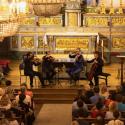
“They should have trance nights here,” I heard a young man say to his girlfriend as we entered the domed, craggy splendour of Islington’s Union Chapel. Still a working church, this Victorian Gothic monster is an architectural Escher fantasy of arches and angles, its octagonal layout concealing as much as it reveals on first glance. Add a central stage where you might expect the altar, glowing red under the lights, to a programme of some of Monteverdi’s most erotic madrigals, and it didn’t take a degree in semiotics to realise what was going on. With sacred and secular rubbing up against one another with blatant, teenage determination, it was left to Les Arts Florissants to provide a suitable soundtrack to the encounter.
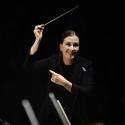
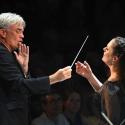
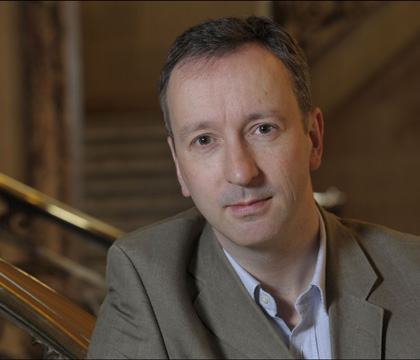
The beginning of a two-year project to perform all of Monteverdi’s madrigals (too bad I Fagiolini got in first with the title The Full Monteverdi), the concert saw the group reduced to just six singers. While the chamber intimacy of the music was duly honoured in the single voices, it was hard not to feel that the earthy informality of the works was sacrificed in this space. In an acoustic which blotted all of director Paul Agnew’s (pictured below) speech into incomprehension (I still have no idea what the encore was) words were lost, and with them just some of the ideas trapped in the amber of Monteverdi’s glowing settings. The emotions, however, that even Tasso and Strozzi couldn’t fully articulate, were crisp.
For prolonged and endlessly deferred gratification Monteverdi surpasses all his predecessorsAlthough we would build to rather more worldly heights in Monteverdi’s complete First Book of Madrigals, for five voices, it was with the austere beauty of the composer’s "Lapidabant Stephanum" that we opened. Incongruous among all the ardour and overwrought angst, this meditation on the death of St Stephen (by stoning, we are not allowed to forget) is music flayed to its core, harmonic sinews flexed and stretched to their limit before us. Exposing the control of the ensemble, this exercise in vocal purity and conviction laid down a marker against which each subsequent work, whether an affected courtly love conceit or pastoral romance, was measured.
Love was sought, spurned, celebrated in all manner of miniatures as the programme moved from the music of Monteverdi’s predecessors and his own teenage works (he published the First Book of Madrigals at a precocious 15 years old) to his great cycle. Most interesting were the three different settings – four, including encore – of the poems Ardo, si, ma non t’amo and Ardi o gela a tua voglia.
 Although “I burn, yes, but do not love you” sounds like the aftermath of a particularly unfortunate romantic encounter, Guarini’s plaint by a bruised lover makes vivid listening in the settings of Orazio Vecchi and Marc’Antonio Ingegneri, and of course Monteverdi himself. Dominated by the squabbling, wrestling imitations of the two soprano parts (sung by Miriam Allen and the exquisite Hannah Morrison) Vecchi’s tempestuous approach finds more contemplative foil in Ingegneri’s music, but for prolonged and endlessly deferred gratification it is Monteverdi’s take on the text – the climax of the First Book – that surpasses both.
For poise and complete authority over the material it would be hard to imagine a more accomplished group. Nothing in their style is overdone, and if the result arguably sounds more calculated than the likes of I Fagiolini it also allows the listener more space to get in amongst Monteverdi’s episodes and make them their own. While tuning was dazzlingly, ear-achingly spot on, scrubbing the indecent writhings of the composer’s modulations till they come up naked and raw-clean, balance was a bit of an issue. Mezzo Marie Gautrot didn’t seem to be having the best of nights, smudged beneath the sopranos during the women’s voices numbers, and failing to make her mark within the full ensemble, but Agnew together with Sean Clayton and bass Lisandro Abadie drove the music dramatically, ever sensitive to the dance rhythms sublimated in the music.
While not a space I’d have chosen, there’s no denying that the Union Chapel added a certain frisson to the evening that no concert hall could have produced. Framed in the dark arches of the church, love songs giving way to gorgeous melodic arabesques of grief, the result was a meditation, a musical communion that took us all somewhere the composer couldn’t have intended. I hope the young man gets his trance evening, but I think for many of us that atmospheric, pulsing musical energy found itself a different beat last night, leaving us every bit as high and blissed out.