It’s not often that the most bittersweet moment in a rich concert comes in the encore. Elisabeth Leonskaja had already played the generous extra in question, the Dumka movement of Dvořák’s A major Piano Quintet, with the Staatskapelle Quartet only a fortnight earlier. Here, fine-tuned with the Jerusalems, that moment when the joyfully flowing episode turns dark and the piano seems to call from a dark wood proved sheer magic.
There wasn’t a moment in this concert where anyone in the audience could (or should) have lost concentration, The Jerusalems’ art is flexible, almost improvisatory in feel, quivering, shining, not unlike the Borodin Quartet’s then-unique qualities in its heyday. It owes a lot to the committed underpinning, verging on genius, of cellist Kiril Zlotnikov, placed not to the right but directly facing the audience, and the seemingly free soaring of first violinist Alexander Pavlovsky, but the golden sound also extends to the second, Sergei Bresler, and viola-player Ori Kam, whose joyous singing at the start of Dvořák’s “American” Quartet was also golden.
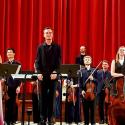
At a casual glance the programme seemed a bit too on the crowd-pleasing side – Shostakovich’s Piano Quintet, after all, is surely his most direct and at times simple chamber work, a masterpiece all the same, and this isn't the first time Leonskaja (pictured below) and the Jerusalems have played it at the Wigmore – but that was to reckon without the serious intent in Haydn’s F minor Quartet, Op. 20 No. 5, the intensity of its opening movement matched by the brief but profound two-voice fugue in the finale. Nor was the Dvořák pure sunshine; the Jerusalems’ febrile approach may not be exactly Bohemian – the native strains here are hard to distinguish from the American aspect – and the constant vibrato was a matter of choice and taste, but again everything shimmered and delighted. 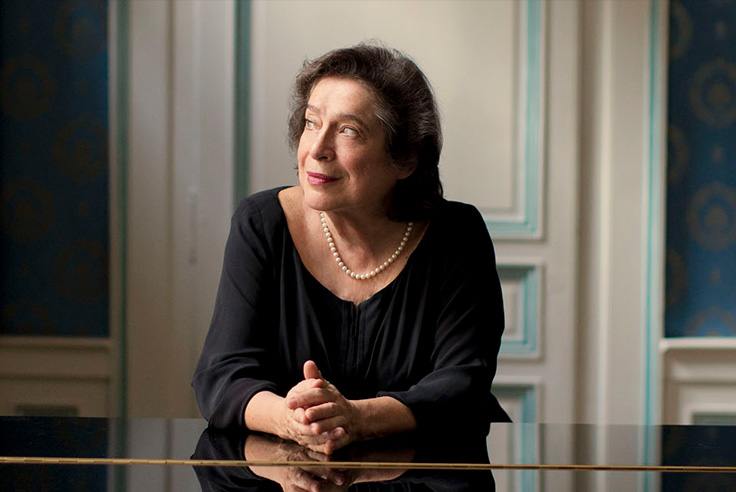 Cannily, Shostakovich wrote a piano role for himself which has maximum impact through relatively simple means. The octaves crowned by ringing bell sounds and the powerful bass had stunning impact in Leonskaja’s sound – so physically strong from a pianist in her late 70s – while the sheer concentration on another, this time more sustained Fugue, starting with focused non vibrato from Pavlovsky, contrasted with the ambiguous but still thrilling high jinks of the scherzo.
The finale, too, is simple only on the surface; to achieve that unbearable lightness of being in the final bars takes supreme mastery, and that was there at every point last night. Here's a hope for a future visit, though: the Jerusalems’ two violinists are Ukrainian born – Zlotnikov is from Belarus, Kam was born in America – and while the Shostakovich gave us full scope to mourn and meditate on the horrors of the past year in Ukraine (and Israel), there are some fine quartets by Ukrainian composer Lyatoshinsky: could they include at least one in a forthcoming programme?