
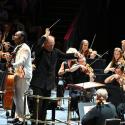
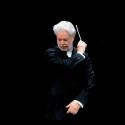
The occasion demanded a substantial figure to command the podium, and who better than Bernard Haitink, who has been declaring himself obsolete and over the hill for years, yet still keeps bouncing back to deliver performances fit to rival the all-time greats. Haitink has virtually made himself an honorary Englishman through his stints at Covent Garden, Glyndebourne and the LPO, but this week he's in town with the Chicago Symphony Orchestra, with whom he's currently Principal Conductor.
Now 80, Haitink doesn't do frivolous. He strode onstage mere seconds after the 7.30pm start time, projecting an air of stoical determination which would brook no interruption from latecomers, and whisked the orchestra into the brisk declamatory chords that open Mozart's Symphony No 41 (Jupiter). The music was immediately taut and poised, the violins playing with crystalline articulation. Haitink doesn't do Bach either, but you wouldn't have guessed it from the almost abstract mathematical rigour he brought to the performance.
Naturally Haitink wasn't after a sugar-spun, wedding cake Mozart, but instead plunged into the symphony's internal architecture with the nerveless confidence of a great surgeon. In the second movement, he teased out the score's waltz-like implications with fibre-optic precision, and persuaded the violins to play as though etching vapour trails in rarefied air. In the ensuing Minuetto, Allegretto, he leveraged dramatic changes of mood from tiny shifts of rhythmic emphasis. For the concluding Molto allegro, he sent the band hurtling round hairpins and right-angle bends with almost reckless bravado.
After the interval, we fast-forwarded almost a century to Brahms' Symphony No 1. Apparently it took the composer 15 years to complete it, so daunted did he feel by being labelled the heir to Beethoven, and at times it feels as though Brahms was lugging round an unwieldy portmanteau of ideas that he was determined to cram in as proof of his musical vision and high seriousness. The way the pseudo-Beethoven's Ninth theme suddenly leaps out of the final movement (though it's a stirring enough tune in its own right) sounds more like a pre-determined special effect than the result of organic development.
But there's still much to admire, especially in the bold and free-ranging first movement. Haitink had the orchestra leaping out of the trenches with fixed bayonets from the opening bar, the timpanist hammering out the baleful "Fate" motif while the ensemble (at least twice the size of the group who'd played the Mozart) evoked a gripping sense of epic events about to unfold. Even their slightly lumbering syncopations helped to lend weight and power. As the symphony developed, it resembled a panorama of 19th century German music, looking back to Beethoven's Pastoral Symphony while also hearing the giant footsteps of Wagner. Not bad for a first symphony. Pretty good for a season opener, too.
Haitink and the CSO play Haydn and Bruckner at the RFH tonight (September 24) at 7.30pm




Add comment