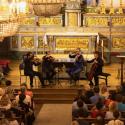
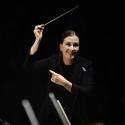
Milton Court, like its parent Barbican Hall, disconcertingly inflates the sound of larger ensembles and voices. Had there been a conductor for all four pieces in the Britten Sinfonia’s programme - Michael Papadopoulos was there for the two most recent works – the approach might have been more nimble and nuanced. Though Mozart in masterpiece form could have been a gambit to entice warier punters, a fourth British work would have rounded out the overall picture better.
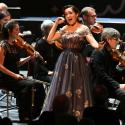
That all sounds grudging, especially as the senselessly ACE-defunded Britten Sinfonia needs all the help it can get right now, and so much was right, or nearly right. Hearing Nicky Spence with Ben Goldscheider in Britten's ever-astounding Serenade (pictured below) was fascinating. Spence's lyric-heroic tenor is well on the road to Tristan now, which meant the pretty runs of Ben Jonson's hymn to the moon as set in Mozart horn-concerto pastiche style somewhat floored him, and the true inscaping of the evening-to-night trajectory now belongs definitively to Allan Clayton. Interestingly, Ben Goldscheider gave the heroic cue with the unaccompanied horn summons, beginning forte rather than piano - a golden, rounded sound, of course, but not exactly the preface to the dying of the light.
Where forthrightness was called for - and it is, frequently - Spence's tone, too, was peerlessly full-throttle, and he is a master of characterisation, so each setting of great poetry had its special atmosphere. We even got a Scottish tinge for the "purple glens" of Tennyson's "Nocturne" as well, of course, as the mounting terrors of "This ae nighte". No chance of concentration lapsing with two such artists. Even so, I can't help feeling that Papadopoulos might have been called in for a bit more orchestral fine-tuning. 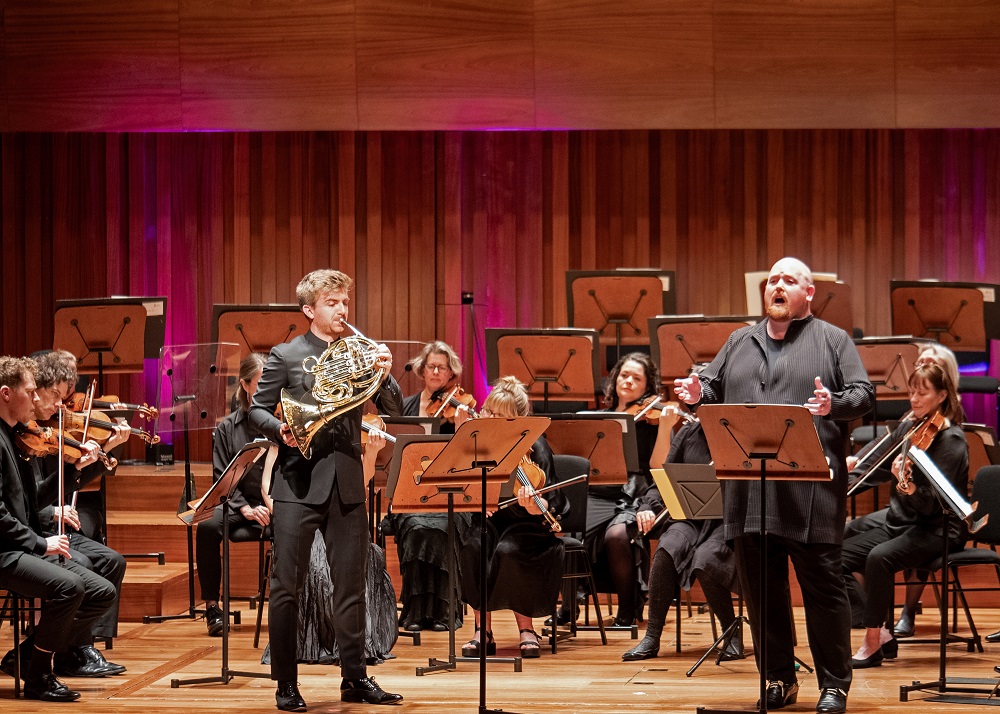 Judith Weir's Heroic Strokes of the Bow sounded the metal of the Britten Sinfonia strings. Those treacherous pregnant silences caught just a few string hairs out of place, though. And though there are two strong ideas here, the repetitiousness didn't seem entirely felicitous, evoking a rusty old engine running out of steam (it turns out the title is also that of a Paul Klee painting with violin bows and pegs against a blue background, so the deconstruction was not inappropriate).
Huw Watkins' new concerto for Goldscheider is gratefully written for the horn and its outer movements feature healthy interplay wth the orchestral brass. The central movement also spotlights the Britten Sinfonia's great oboist Nicholas Daniel. Yet despite a few piquant twists for woodwind, it all feels a bit too comfortable - audience-friendly is no bad thing, but a bit more grit in the oyster, such as resonates in so many of Watkins' marvellous chamber works, wouldn't have gone amiss.
Weir and Watkins seemed to refract two aspects - the later stop-start style in the former, the rhythmic ebullience of earlier works in the latter - of a master who might have featured in the programme, Michael Tippett; curiously, his superb Second Symphony was being conducted over at the Royal Festival Hall last night, too. To end with Mozart certainly sent everyone out with a smile, but felt not quite right, especially as leader Max Baillie's lively direction wasn't quite enough; apart from the inner string parts in the Andante's econd theme, intensified on the repeat, a true conductor's nuances could have enriched the experience. Lively, certainly, with the upper strings standing; but again, that Milton Court environment made it sound almost bullish.