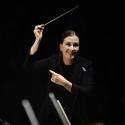
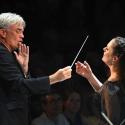
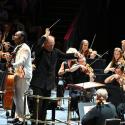
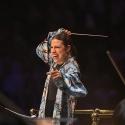
Is it a bird? Is it a plane? No, it’s Valery Gergiev shimmying his way through Ravel’s Daphnis and Chloe. There he was, London’s loosest-limbed maestro, back on the Barbican podium (just about) with the London Symphony Orchestra, after a summer flogging his chaotic Ring Cycle around the globe, returning to more favourable ground, an all-French programme of Debussy, Dutilleux and Ravel that had his dancing juices flowing and his legs a-leaping. Certainly, there’s no gainsaying his moves. The question is were they being put to good musical effect?
Whenever the moment took him, the answer was surely, yes. As his flickering hands turned to liquid and his arms began impatiently to swing, those climactic waves of sound in Daphnis would surge up with unique urgency, breaking with a jerky bang of the head. The result was a visceral punch.
These ruptures were of the modern, not the natural, world: skids, collisions and body blows of a forceful, relentless, machine-derived character. There was a brutality to the way the choir burst in with their consonantless calls in the finale, an acidity to the clarinet figures and a forbidding lack of swing in the timpani and snare drum pulsations. Were these the orgiastic sounds of love or war? A sympathetic thought went out to Mrs Gergiev at this point.
But his moments of leggy, froggy rapture were intermittent. Most of the rest of the time Gergiev took on a careful, almost prissy, approach, his head buried in the score, his movement restricted to an upright, academic beating of time. He spent an age waiting for an appropriate silence before the first liminal notes of each piece – unusual for the impetuous Gergiev but maybe the result of a diktat from the LSO Live label who seemed to be recording the event. There was a seriousness of purpose that was sucking the music dry of its French flexibility and elegance.
One could see what he was trying to do. He was attempting a scientific colourism. Every fleeting timbre and texture was being weighted to perfection. The sunny outlooks of the start of the first movement of La Mer - woodwind born aloft by pizzicato strings - arrived with surprise and realism, as did the cymbal-derived sea spray at the end. It was a musical pointillism that, like its post-impressionistic cousin, had a fussiness to it. Gergiev rarely seemed to want to follow his instincts, his eyes still glued to the score, and the charged swoops and slides suffered from this strictness as a result.
There was one piece where this meticulousness was helpful: Henri Dutilleux’s Violin Concerto, L’Arbre des Songes or Tree of Dreams. It’s always beneficial to hear contemporary music in a clear form, devoid of interpretive accretions, and with no work more so than this, which seems to have everything that’s necessary for aural satisfaction within its pages.
It still amazes me that Henri Dutilleux isn’t better known. His lyrical, colourful style is one of the most attractive of the late 20th century. The LSO deserves high praise for programming a series of his finest compositions among the regular fare of the season. The Violin Concerto exemplifies the very best of it. Structures are simple and engaging, colours luminous, moods supple.
Throughout there are strange games of hide-and-seek, the orchestra bursting through the soloist Kavakos’s chatter, then slipping back into hazy, trilled comas. The two finally meet in the fourth, a communion that seems to take both parties by surprise, orchestra and violinist stuck in trilled unison. “What are you doing here?” they seem to ask each other quizzically.
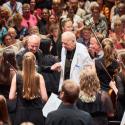
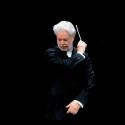
A far less awkward sense of wonderment greeted the appearance of the dapper, but shrunken, 93-year-old figure of Dutilleux, who gave a heartfelt bow from his seat in the stalls. The warmth that radiated from the audience - with heads craning forward from the balcony trying to get a glimpse of the great man - suggests that the the boldness of this programming from the LSO will be repaid handsomely.