

Some performances evolve so naturally, so inevitably, that they feel... bespoke. Andrew Davis has a long history with both the BBC Symphony Orchestra (who gave him his first big break) and Elgar’s The Dream of Gerontius and from that moment in the Prelude where the cellos intimate some eternal lullaby to the ebbing arpeggios which waft across the strings in the final page, as if Wagner had for a moment contributed to the scoring of it, this performance felt all of a piece - not so much operatic as symphonic to the nth degree. It was blessed, too, with exceptional soloists in Stuart Skelton and Sarah Connolly whose kinship in the most spiritually satisfying pages of the piece took us, as they can and must, to an entirely “other” place.
Skelton has the ideal Gerontius voice with a bigness - and beauty - of tone throughout the range allowing the words their full weight and presence. Indeed he thoughtfully weighs each one in such a way as to make an immediate distinction between oratorio and opera. It would be so easy for the greatest Peter Grimes of his generation to play up the drama - indeed the histrionics - of Cardinal Newman’s text and communicate it through “acting out” rather than simply feeling the import of the words. The deathly crisis in Part One of the piece is all in the words and music and where Elgar places it in the vocal line, from the “Sanctus fortis, Sanctus Deus” in its hushed reprise, Skelton negotiates the passaggio so seamlessly here, to the anguished “Some Angel, Jesu! Such as came to Thee in Thine own agony”, that the feeling was everything.
David Soar replaced Brindley Sherratt as the Priest which sets this Christian soul upon his journey and if he had issues (as some basses do) with the topmost notes of this marvellous passage the BBC Symphony Chorus sopranos most certainly did not, producing a gleaming halo of sound in the final moments of part one.
 But do we really need an interval in Gerontius? Surely not. A five-minute pause would suffice to establish the soul’s departure from this world to the next. It’s so rich in atmosphere, this piece, that to disrupt it for drinks and ice cream seems insensitive and unnecessary in the extreme.
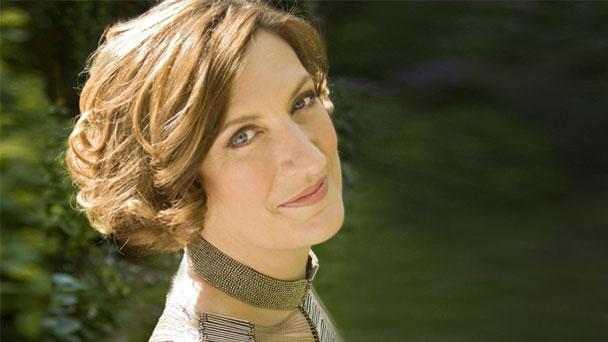
Yet once on the threshold of deliverance again there was Sarah Connolly (pictured above by Peter Warren), looking and sounding fabulous, amplifying and intensifying every line of text. The tremulous hush of her repeated Alleluias were so deeply reassuring and in marked contrast to the verbal terror she invoked with the arrival of the demons. The BBC Symphony Chorus sneered their way through that chorus with chilling relish but conserved their biggest blaze of light-affirming sound for “Praise to the Holiest”. Davis built to a pitch of swinging jubilance, the final moments of it lifting off like pealing bells towards that mighty tenuto and crescendo on the final note. Thrilling stuff.
As was Connolly’s final Alleluia - full of ecstasy - and Skelton’s cry of “Take me away” which was invested with a sustained rapture such as I’ve honestly never heard before. Of course, it comes off the back of a more literal than metaphorical lightning strike as the Almighty is glimpsed - but the shock and awe of that are as nothing compared to the Angel’s Farewell where Elgar and Connolly conspired in those glorious pages to have us all believing in something.


Add comment