

Director Bill Barclay’s new collaboration with the Gesualdo Six – commissioned by St Martin-In-The Fields for its 300th anniversary – brings an opulent intensity to its depiction of a man whose troubled existence was reflected in darkly ravishing music. Gesualdo’s life was in many ways the counterpoint to Christ’s – born into privilege, he allowed himself to be defined by lust and a murderous thirst for revenge. So it’s one of his many disturbing paradoxes that he identified so strongly with Jesus’s suffering. Part of the power of this production comes from the heretical frisson that in this alternative "Stations of the Cross" the life of a man denounced as a double murderer can be portrayed as Christ’s psychopathic doppelgänger.
It works, not least because – as Barclay points out in his eloquent programme note – Gesualdo’s delusional identification with Christ is reflected so strongly in his music, most notably his Tenebrae Responsoria of 1611. The evening opens with the chromaticised, gently hallucinatory dissonances of “O vos omnes”, the lament which in its original form exhorts passers-by to contemplate Jesus’s sorrow as he is taken to be crucified. For some time before the singing starts, we have been surveying the corpse of Gesualdo lying in state on a raised platform, while a woman keeps vigil with a candle. There’s an eery sound of low, almost inaudible, wailing, then the candle goes out, and – as we sit in darkness – the music begins.
The template for this production is the tableau vivant style which first became popular in the late eighteenth century, and more recently has seen a resurgence in popularity, not least online. If you’ve seen, for instance, the Italian theatre company Ludovica Rambelli Teatro’s recreations of Caravaggio paintings with live models set to Mozart’s Requiem, you’ll have some sense of the visual effects being portrayed here. The Gesualdo Six themselves are dressed in a wittily low-key interpretation of seventeenth-century costume, with silvered ruffs around the neckline of loose black shirts and eye makeup that makes it look as if they’ve been weeping tears of pitch. A cast of six actors, headed up by Markus Weinfurter as Gesualdo, takes us through the composer’s life from boyhood and his discovery of music, through to his murder of his first wife and her lover, his second marriage, and subsequent spiral into despair.
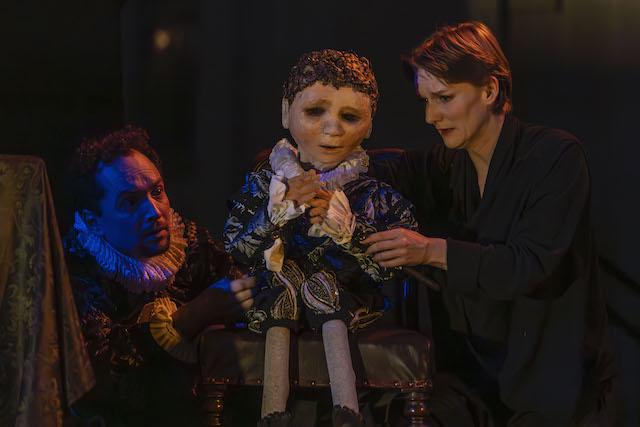
Barclay has assembled a fantastic team for this production and it shows. Renowned choreographer Will Tuckett has overseen the movement, transforming the mess and rage of Gesualdo’s life into a series of powerful, dynamically elegant interactions between the characters. Puppetry designer Janni Younge – a former director of the South African Handspring Company (most famous for War Horse) – has created a simple, affecting puppet version of Gesualdo’s boyhood self (pictured above), which rises up from Gesualdo’s corpse like his spirit as his life story. The jewel-like colours of Arthur Oliver’s costumes lend themselves beautifully to being illuminated like a series of Old Master paintings. Barclay himself has added a very personal touch to the lighting design, in which the performers themselves carry mobile-phone sized “tablets” that emit a golden glow, allowing them quite literally to highlight telling details of the story.
One slight drawback to this ravishing – but necessarily elliptical – depiction of Gesualdo’s blood-stained progression from cradle to grave is that his story is inevitably not as well-known as that of the Messiah on whom he modelled himself. Aficionados of Baroque music will be well-versed in his sensational sins, but a broader audience – and I have no doubt this will attract many beyond the usual Gesualdo-seekers – might be a little confused by later scenes which struggle to capture the complexity of, for example, his courtesans being accused of witchcraft. Still, maybe it’s healthy that people will be driven to find out more. What’s in no doubt is the intrigue of the world into which Gesualdo emerged and his own enduring ability to bewitch through his music.
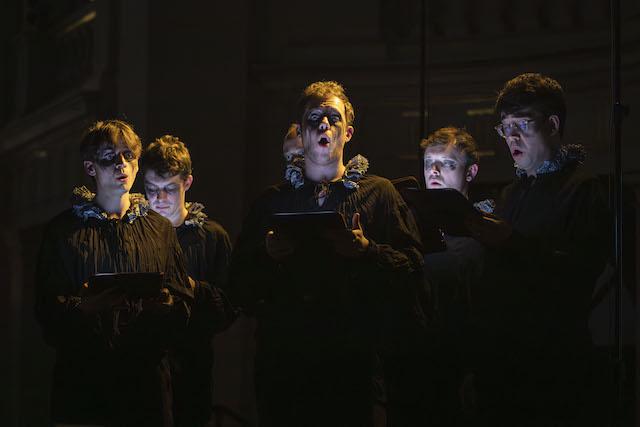
The power of that music sets the seal on an evening that is ultimately a compelling guide through the labyrinth of the composer’s tortured genius. Owain Park – who, as well as directing the Gesualdo Six (pictured above) is Guest Conductor of the BBC Singers – coaxes the singers to extract every atom of anguish and exquisite melancholy from the composer’s work. The production combines Gesualdo’s religious compositions with some of his later madrigals, alternating darker passages – in which the plangent harmonies are like bloody gashes of sound – with passages as full of life and movement as a springtime sea. Their performance of Moro, lasso, al mio duolo is utterly beguiling in its shadowy sonority.
This, then – following their immersive production Secret Byrd – is another fantastically thought-provoking experiment from the Gesualdo Six, that will no doubt expand audiences for their namesake’s shocking, otherworldly vision. A dark treat for sombre times.



Add comment