

In one sense it was a New Year’s Day “nearly”, just stopping short of giving us the already great Irish lyric-dramatic soprano Jennifer Davis in the music of the man she was born to sing, Richard Strauss. Berlin will witness her Arabella shortly, but the one Bavarian intruder in the otherwise all-Viennese carnival yesterday afternoon, the Moonlight Music from Capriccio, stopped before the Countess’s final scene.
Yet that slice of heaven still served as a breath from another planet in a glittering programme: did the audience realise it was getting one of the world's best horn players, Alec Frank-Gemmill, to sound Strauss's last tribute to his father's instrument? And Davis raised Viennese operetta to the heights, characterising each of her heroines to perfection. The warm heroic glint of the world's current Elsa of choice - by all accounts she was a magnificent Leonore at the Royal Opera, too, but I couldn't face Tobias Kratzer's production again - made small gems shine.
You wouldn't want to sit through an entire operetta of this sort - I can't even face The Merry Widow in its entirety - but each aria showed the craftsmanship of the composer concerned. Lehár glitters, of course, and there was bittersweetness shining in "Einer wird kommen" from Der Zarewitsch, a worthy companion to Arabella's "Aber der Richtige" or Gershwin's "The Man I Love" in more than just the theme. An announcement was made that Davis had fallen sick overnight and begged our indulgence, but none was necessary from the minute she launched lustrously into Millöcker's "Ich schenk' mein Herz" from Die Dubarry, with its gorgeous portamentos.
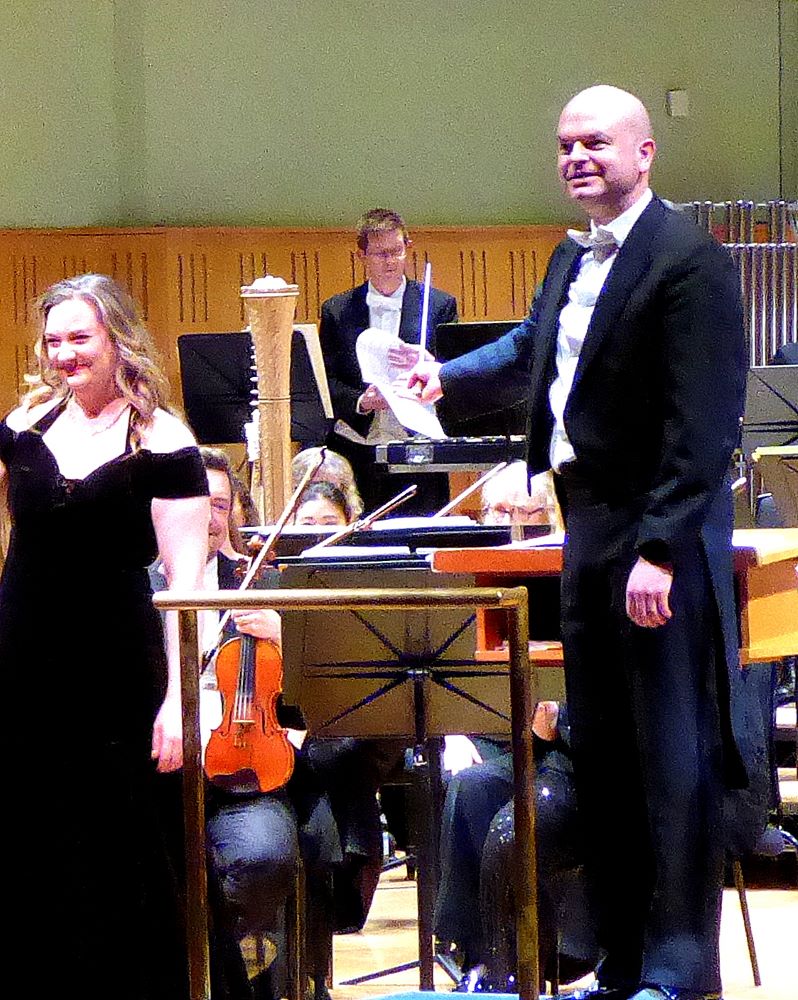 While white may not have suited the saucy maid enticing a young man to join her "Im chambre separee" from Heuberger's Der Openball, drawing the audience into a quieter confidence, a change of dress for part two came with black mask for Rosalinde's Hungarian impersonation in Die Fledermaus. What a bravura parody of Magyar magnificence this is, and how the heroic Wagnerian stature came into play. We got more dance and further volume in "Meine Lippen sie kussen so heiss" from Lehár's Giuditta, and further audience participation in the full-throttle encore, “Höre Ich Zigeunergeigen” from Kálmán's Gräfin Mariza, its augmented-second exoticism and the lustre of the voice against full orchestra conjuring for a while Strauss's Salome.
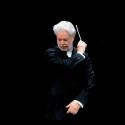
But this was no mere operetta gala with bits in between. It kicked off Ireland's celebrations of Johann Strauss II's 200th anniversary with a very carefully chosen programme. Maybe the opening tziganery didn't quite manage the required panache. But that blossomed in the Persian March and the Thousand and One Nights Waltz. It soon became apparent that conductor Gavin Maloney (pictured above with Davis) had the true waltz lilt, the hesitations, the rubato necessary. That steered us across the dance floor again in the Fledermaus Overture's waltz (rollicking double-basses in support) and a misty-eyed On the Beautiful Blue Danube. It was a shame this had to be separated from the Capriccio Moonlight Music by RTÉ lyric fm chat, because those two had clearly been conceived as a pair - same key to start with (A major), same lovely horn colouring. An unbroken link should be thought of for future programming.
The racier numbers got more and more exuberant - quite a surprise to hear Josef Hellmesberger II's Danse diabolique, a real collector's item - and it was a joy to see the two kids in the balcony especially enthusiastic with their clapping-along to the Radetzky March. But it was still Davis's afternoon, and here's a hope for Irish National Opera's 2025-6 season - either Daphne or Arabella as Bruno Ravella's third Richard Strauss production here, please, as this radiant soprano is made for both leading roles.



Add comment