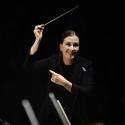
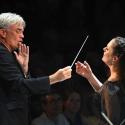
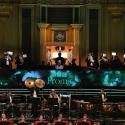
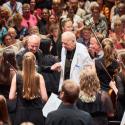
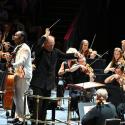
Visiting conductor Mark Wigglesworth is a good match for the Royal Philharmonic. The orchestra’s repertoire is usually at the popular end of the spectrum, so they know how to make the most of a good tune. Wigglesworth gives the players the space to phrase and shape the music, but his approach is more about drama and discipline. That’s a great musical virtue, but it’s hardly glamorous. Fortunately, pianist Khatia Buniatishvili was on hand to provide charisma and pizzazz in an electric performance of the Liszt Second Piano Concerto.
To begin, Walton’s Portsmouth Point Overture. It’s a great opener, a busy six-minute scherzo, all snappy rhythms and scurrying string lines. Wigglesworth kept the energy high, the tempo never flagging, the textures clear and light. Some precision was sacrificed for sheer propulsion, especially in the busy woodwind textures, but it didn’t matter. And Wigglesworth was typically brusque with the ending, only slowing at the last possible moment, and closing efficiently, without pomp or grandeur.
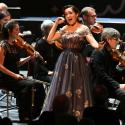
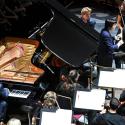
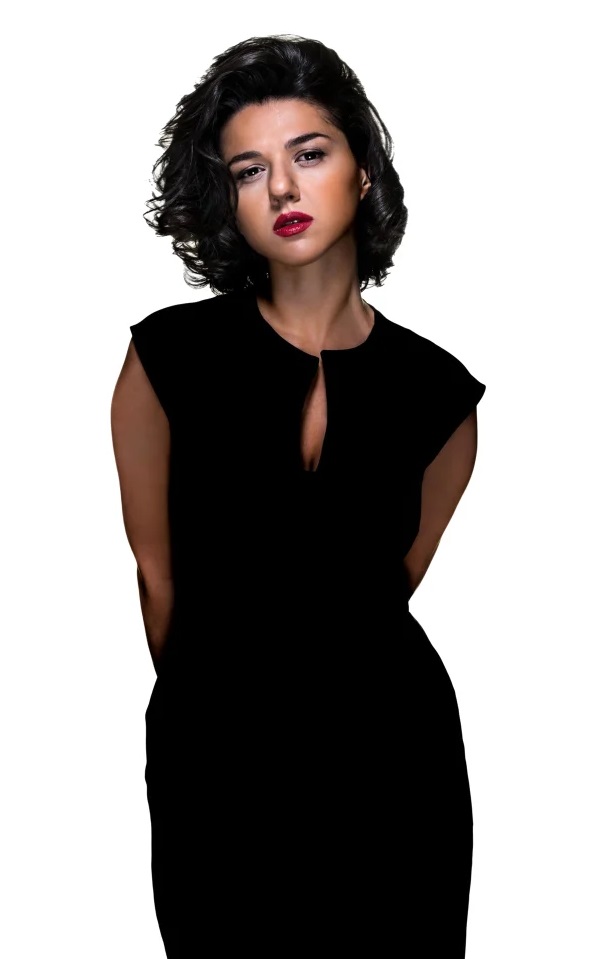 Khatia Buniatishvili (pictured right by Gavin Evans) takes a distinctive approach to Liszt. On record, her performances of Liszt’s solo music are wayward, with constantly shifting tempos and a magical sense of atmosphere and intimacy. Fortunately for Wigglesworth, her tempos in the Second Concerto were more disciplined, but the magic remained, with the pianist drawing a dark, luminous tone for the Festival Hall’s Steinway and blending effortlessly with the Royal Philharmonic strings. Buniatishvili can play with thundering force, but here she always kept something in reserve, even in Liszt’s most flamboyant virtuoso roulades. Her smooth, even touch allows her to glide across the keys, often seeming more to suggest a theme or idea than to actually state it.
She is a master of mood and atmosphere, and even the loudest passages sound beguiling and multifaceted under her fingers. But best of all were the many moments of stillness. In one transition, a busy texture suddenly dissipates at the top of the keyboard, then after a silence, a gentler melody appears mid-range. Buniatishvili had the hall in the palm of her hand as she held the silence. Then she seamlessly introduced the new theme, without breaking the spell. All of which made Debussy’s Clair de lune a fitting encore; yet another moment of magic.
Wigglesworth again took a disciplined approach to “Mars” at the opening of Holst’s The Planets. The tempo was brisk and steady, but with the drama unfolding through extreme dynamics, quiet strings then weighty brass. That sense of efficiency surfaced in the transitions, with Wigglesworth always pressing forward, rather than dwelling on the moment. The ending of the movement, too, was emphatically accented, but with the last note abruptly cut off. The suite gives every section of the orchestra a chance to shine, and there were very attractive solos, the horn solo from Diego Incertis Sánchez at the opening of “Venus” a particular highlight. But the orchestra also excelled in Holst’s ensemble textures, the quiet, luminous chords from the lower woodwinds, the glassy echoes from the harps and celesta.
The melody eventually matched to the words "I Vow to Thee My Country" as a hymn was played with a reserved intensity, but without any undue sentiment or nostalgia. “Saturn” was particularly impressive, for the unbroken mood as the music gradually builds. In “Neptune”, the dark sonorities of the woodwinds were answered by an equally precise and atmospheric coda from the Holst Singers, Wigglesworth again maintaining that sense of focussed intensity, even as the last strains of the chorus gradually died away.