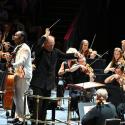
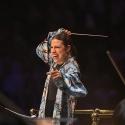
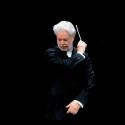
Thomas Adès and the Britten Sinfonia are embarking on a three-year project, coupling the symphonies of Beethoven with works by contemporary Irish composer Gerald Barry. Adès is keen to highlight the radical vision of the two composers, so expect stark juxtapositions and uncompromising readings. The project began on a more modest scale, however, with this recital of chamber works, given excellent performances and full of intriguing surprises.
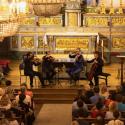
Opening the cycle with Beethoven’s Septet, Op. 20, suggests a path from the conventional to the revolutionary. But this early, elegant and classically formal work inspired some beautiful playing from the reduced Britten Sinfonia. Most of the movements are based on dance forms, expressed here with light and buoyant rhythms, the phrasing supple but always measured. Beethoven employs three winds and four strings, but the solo violin is the dominant voice throughout, and Thomas Gould rose to the occasion, his nimble fingerwork and varied, sprightly tone setting the mood and unifying the mixed ensemble.
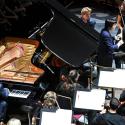
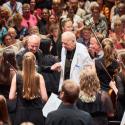
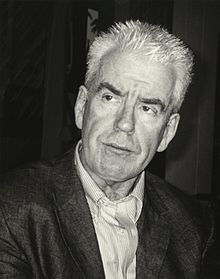 Thomas Adès was joined by Gerald Barry himself (pictured left) for Five Chorales from The Intelligence Park, a two-piano arrangement of excepts from his opera from the mid-1980s. The work was an ideal taster for the larger Barry scores ahead, a series of short movements, each presenting a single idea, and letting it play out to an indeterminate length, before stopping abruptly without development or elaboration. Hearing these experts just a few weeks after Adès’s The Exterminating Angel at Covent Garden, it is easy to understand the affinity between the two composers. Both write in bold, uncompromising styles, with incisive rhythmic patterns and biting, though rarely aggressive, dissonances. They project a similar humour too, a Ligeti-like tendency to the absurd, with hectoring rhythmic ideas gradually spinning out of control and then stopping at a seemingly random point. The two composers gave a spirited reading, suitably percussive throughout. There seemed to be a few moments of poor co-ordination between the pianos, but I can’t swear that it isn’t written into the score.
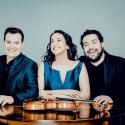
When the Beethoven Op. 70 No. 2 Piano Trio began in the second half, it seemed that the Barry was still at the forefront of Adès’s mind. The difference between the early period Beethoven of the Septet and the middle period of the Piano Trio could hardly have been more marked. Formal principles were here subsumed into a nebulous world of unpredictable and impulsive expressions. Themes would appear, and sing out, but then return into the evolving textures from which they had come. There was plenty of lyricism, especially from violinist Thomas Gould and cellist Caroline Dearnley, but the melodies were always presented as part of a more complex textural argument. The first movement ended with complete surprise, just as in the Barry, and the variations in the second movement seemed to float free of any grounding structural principles.
There were a few flaws: Adès was heavy-handed in the quiet introduction to the first movement, and in the finale seemed intent on making bold thematic statements, even at the expense of balance and continuity of line. But that boldness was the defining feature of this performance. It augers well for the symphony cycle, which begins at the Barbican on Friday, also broadcast live on BBC Radio 3. Tune in for fresh and subtly iconoclastic readings, with vitality, humour and plenty of surprises along the way.