A happy, lucid and bright pianist, a forbidding Everest among piano sonatas: would Boris Giltburg follow a bewitching, ceaselessly engaging first half by rising to the challenge of Beethoven’s “Hammerklavier” - a title he suggests, in his series of first-rate online essays about the sonatas, might be replaced more appropriately with “Titanic”?
Absolutely; the focus and stamina were such that a sinking would have been impossible. Any difficulties rest with us, and I confess I have a problem with the biggest movements. Like much in late Beethoven, the material sometimes seems to elude easy grasp, above all in the long Adagio sostenuto, though its seamless interchange between desolation and serenity is clear enough. The secret is perhaps to live intensely in the moment: Giltburg did just that, and enabled us to share his concentration down to the quietest dynamics and an ethereal upper register. 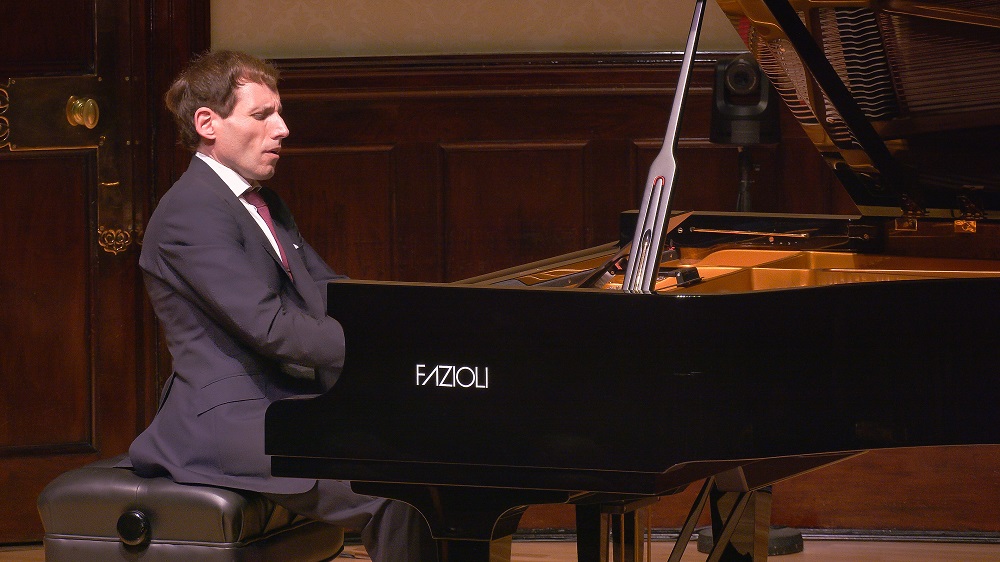 The double-fugue finale gleamed and thundered on the perfect instrument for Beethoven’s and Giltburg’s range, the pianist’s favoured Fazioli, so rich in the lower register. Some have problems with an occasional speeding that threatens to spiral out of control but never does; there was none of that here, and it was engaged with absolute licence in both the driven, tempestuous fourth-movement Prestissimo of Op. 2 No. 1 and the vivacious tarantella of the E flat major Sonata, Op. 31 No. 3 – Presto, con fuoco, indeed. A habit of the occasional missed note didn't surface in the "Hammerklavier".
Although Beethoven’s first published sonata is in F minor, Giltburg graced it with his clearly-articulated nuance to heighten its originality and, yes, its charm, even more abundant in the so-called “Hunt” Sonata. Interestingly, he has little to say about this in his online essay – the first movement as he interprets it could still take a long paragraph in itself – but elsewhere he brings so much perception to bear that any more from me here on the works themselves would be redundant. You have his films, too, so I recommend a visit before each instalment of this wondrous cycle. We had a generous, perfect encore: Schumann's Arabeske, a return to human scale and graspable, ineffable melody. The new Wigmore season is already the brighter for the promise of further instalments.