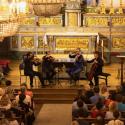
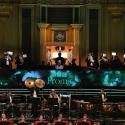
Milton Court’s new concert hall is a mighty small space, but the BBC Singers under their chief conductor David Hill were determined to launch their residency there with a musical epic of world events from Genesis to the post-nuclear era. And they carried it off triumphantly, if with some ear-singeing resonances, in American works from the last 66 years ringing with bright tonalities. The real surprise was to find Nevadan choral guru Eric Whitacre reaching for the stars as confidently, if not as consistently, as Steve Reich in his 1984 masterpiece The Desert Music.
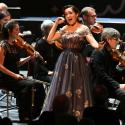
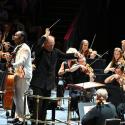
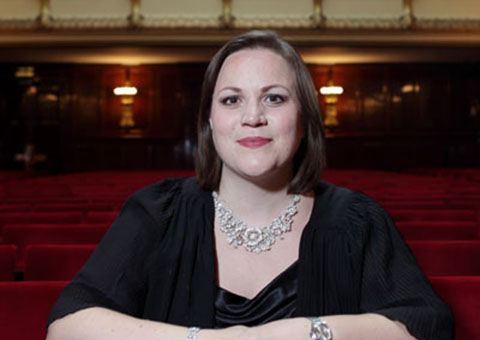
Copland did well by this company too, with his In the Beginning. Singing in an Edinburgh performance some 30 years ago, I found its repeated “And God said”s musically banal. Not so here, especially as launched by the majestic mezzo timbre of an already well established former BBC Young Artist, Jennifer Johnston (pictured below). The only problem was that in her authoritative compass, she sounded like the greatest of gospel singers, which begged a not-irrelevant question - bearing in mind the ingenious programme's brave New World – why not a single non-white face among the singers?
 That and the very English vowels reminded us that we weren't exactly being steeped in authentic Americana. But at least this packing-in of Genesis 1 and 2 verses 1-7 bowled along towards the fecundity of the Sixth Day, where if I’m not mistaken – and I need to see a score – our phenomenal mezzo broke out into 12-tone rows, adding to the rhythmic roughing-up of potentially placid vocal writing.
Placidity was never the tenor of Whitacre’s Three Songs of Faith. The big generalities of happiness here have the edge of E E Cummings's special diction. The choral women created magical overlapping waves in “i will wade out”; full multipart juicy chords wrought the necessary ecstasy in “hope, faith, life, love”, and the third setting realized with Scriabin-like superhuman zeal the “true blue dream of sky”.
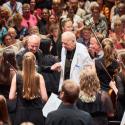
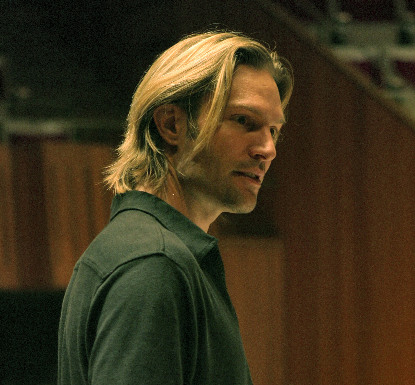
I was less taken with the earlier Water Night, perhaps because here Octavio Paz’s lyrics grated (“Night brings its wetness to beaches in your soul”: not my kind of poetry). But it was surprising to learn from Martin Handley’s presentation – which had to get over some gooey Whitacre autobiography (the composer pictured below) – that Sleep was a parody in the original sense, an adaptation of existing music composed for a Robert Frost text which turned out to be under copyright. Maybe its even setting of seven out of the eight syllables per line helped alternative words by Charles Anthony Silvestri to fit, but there must have been some rewriting for the magical final retreat into oblivion.
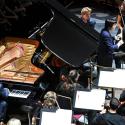
 Our 600-seater hall had just about accommodated voices alone – good that Johnston was set back with the chorus when Sally Matthews at the official opening had felt and sounded too close to the front stalls – but it was once again crammed to performance capacity and resonating on the cusp of ear-split when the 31 players of Endymion joined the mix. And this was only the reduced version of Reich’s colossal William Carlos Williams anthology, with no brass and only four flutes – three doubling piccolos – of the original quadruple woodwind. Still, we had star players among the reduced strings (Krysia Osostowicz and Jacqueline Shave among the first violins, for starters) to just about cut through marimbaphone domination and to project the wailing sirens (violas) when Reich reprises Williams’s nuclear warning.
The Desert Music is a score which contains multitudes, taking off from the savannah of early minimalism almost immediately, rich in its harmonic progressions and stunning in its vast arch shape, never quite as symmetrical as it looks from the texts and as Wagnerian in its ambition as anything in the equally great big scores of 1980s John Adams. Above all it’s not lazy-listening trance music like Glass’s: as Williams writes, “I am wide awake. The mind is listening.” That seemed to go, too, for the schoolchildren in the audience, wildly enthusiastic in their reception, especially for the percussionists, and earlier to be heard in the foyer with their version of the “principle of music” central section. This is vibrant, thrilling music for everyone, one of the few towering works of the 1980s, and it’s destined to last.
- Listen to this concert for the next six days on the BBC Radio 3 iPlayer
- The BBC Singers in two concerts on 26 October: Les Six at Six and the BBC Symphony Orchestra Barbican programme
- Read David Nice's blog, I'll Think of Something Later