

If you’re going to bash a tam-tam for six, the Albert Hall is the perfect place to do it. The reverberation lasts for ages; and everyone in the audience can see you bashing. That must explain in part why Messiaen’s hieratic, gong-crazy Et expecto resurrectionem mortuorum has notched up 10 Prom performances in 45 years. Sunday’s was the first, though, to be performed by the historic and wonderful Leipzig Gewandhaus Orchestra, an outfit previously associated more with Bach and Mendelssohn than Messiaen’s idiosyncratic altar cloths in sound.
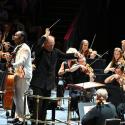
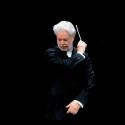
But times have changed since Riccardo Chailly arrived in Leipzig as Music Director in 2005. This is a man who loves to live dangerously on the podium, programming the unexpected, or conducting the expected in unexpected ways. Here, you only had to listen to the burnished brass, the piquant winds, or the fierce ensemble precision to know that Gewandhaus traditions, under Chailly, are being rigorously upheld. At the same time, he’s added extra ingredients, like a singing line and Italianate warmth: not required in the Messiaen, admittedly, but a definite feature in the slow movement of Messiaen’s concert companion, Mahler’s Sixth Symphony.
The wooden box looked like a Bauhaus washing machine
A strange companion? On the face of things, perhaps. But things that are hit colour Mahler’s orchestration too. There are gongs and cowbells; plus the finale’s famous hammer blows, wielded here by a wooden mallet, hurled down with titanic force onto a large wooden box with an inbuilt resonator. It looked like a Bauhaus washing machine. And the two works both featured movements separated by giant pauses, leaving ample time for the music's monumentality sink in, for Chailly to mop up sweat and pat down his hair, and for us to cough or contemplate life, death, or the obituaries of Max Bygraves.
Et expecto was commissioned by Charles de Gaulle’s government in 1963 as a musical commemoration of the victims of two world wars, though Chailly followed Messiaen’s lead, looking beyond mankind’s grubby follies to the more uplifting verities of birdsong, colour, blood-red brass and shivering percussion. In no mood to hurry, he let the second section’s instrumental solos span out too long in the Albert Hall’s vast spaces, enough for a little of the piece’s power to evaporate. Even so, the work still reverberated in my head long after the last note sounded.
Life and death returned for contemplation in Mahler’s Sixth, the composer's most chiselled and forceful symphony. Following Mahler’s second thoughts, Chailly missed out the finale’s third hammer blow. It didn’t matter: the devastating shriek of the final chord told us all we needed to know about the final outcome of the composer’s struggles with fate.
At the same time Chailly, the sunny Italian, did everything he could to variegate the symphony’s conflicts. Speeds in the first movement and the scherzo were fleet, possibly too fleet; the rhythms were crisp, the textures light, the sense of forward motion infectious. In the slow movement (placed second), the Leipzig strings offered a leaner version of the Berlin Philharmonic’s plush velvet. Nostalgia ruled, though Chailly made it clear enough than Mahler was in bitter-sweet mood, conjuring a lost paradise.
As in the Messiaen, the Albert Hall didn’t always play ball. The offstage cowbells, somewhere in the nether regions, clattered like celestial tea-cups, too remote to have much positive effect. But there was no disguising the virile Gewandhaus brass, singing out from the orchestra’s rear, or Chailly’s characteristic delight in the score’s more experimental corners.
A "tragic" symphony? That’s sometimes been its name-tag. Hard to make it fit, though, with this conductor’s exuberance, the orchestra’s magnificence, and Mahler’s instrumental cornucopia. After tumultuous applause, and no encore, we left the building not tragic at all, but refreshed and uplifted, ready for anything life could throw at us, even another tam-tam.




Add comment