La Belle Sauvage, the first instalment of Philip Pullman’s eagerly-awaited new trilogy The Book of Dust, opens in the Trout, a rambling Thames-side pub on the outskirts of Port Meadow, north of Oxford. Here all kinds drink: scholars, labourers, watermen; gossip and taunts are exchanged over the bar; peacocks stalk the river terrace, haranguing customers to privilege them with snacks.
Our hero is Malcolm, son of Mr and Mrs Polstead who run the inn. He helps with the food service, eavesdrops scholarly (and non-scholarly) conversations, and nurses a long-running feud frozen to silence with the caustic dishwasher, Alice. He turns hand and head to mechanical conundrums, lavishes love on his canoe (which gives the novel its title), and frequents the priory of St Rosamund on the opposite bank to help with chores. It’s a life as comfortable as it is predictable until one winter’s evening three distinguished gentlemen arrive on the hunt for a sanctuary suitable for a baby. The baby, of course, is the heroine of the His Dark Materials trilogy, Lyra Belacqua.
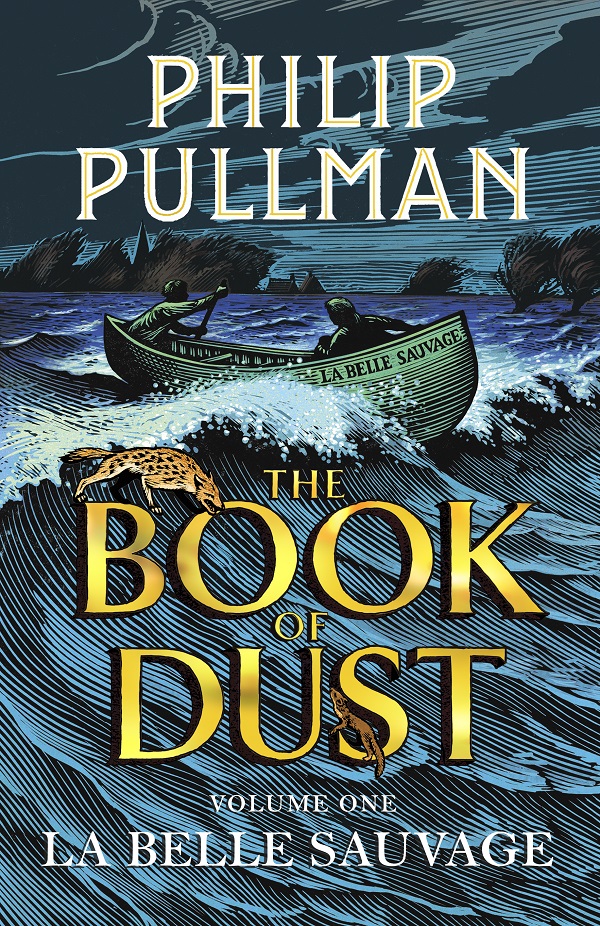 Pullman describes The Book of Dust as an "equel" to His Dark Materials, the idea being that each trilogy can be read on its own. However, as La Belle Sauvage charts the first few tumultuous months of Lyra’s life it is — at least chronologically — a prequel, and comparisons with Northern Lights are natural. It doesn’t fare so well in the reckoning.
While Northern Lights jettisoned readers into a world of Tokay, trepanning, murder, smokeleaf and naphtha, La Belle Sauvage feels distinctly suburban, and puffy for it. Without a doubt, Northern Lights is Lyra’s story, but the writing in La Belle Sauvage roves between characters and plots, dissipating narrative drive as we wait impatiently for descriptions of Malcolm’s comings and goings and suppers to cease, and the story really begin.
It suffers too for its cast of characters. Lyra’s adventures — in Oxford, in London, in Bolvangar, even among the Gyptians, and later in Cittàgazze — are packed with people, many of them children. This populous cast gives body to the worlds she passes through, yet aside from the flourishing of the sinister League of St Alexander in Malcolm’s school, and the shadowy presence of agents from the Constitutional Court of Discipline, Malcolm and Alice exist in a less social world, and it’s harder to care for characters in a vacuum.
Familiar faces emerge. Farder Coram makes an early appearance; Lord Asriel and Mrs Coulter too. We learn more about dæmons, and political machinations promise interesting material for subsequent volumes. But this one feels muddied, an uneasy blend of allegory, spy thriller and dystopia. If His Dark Materials glittered with a kind of Miltonic grandeur, the lustre here is quieter, less pronounced. Echoes of Spenser and Blake and Marvell ring through the prose, and even the voyage taken by Malcolm and Alice down the Thames feels less epic than fairytale.
For its younger audience, the language and subjects are daring — Pullman will never speak down to his readers — but it’s a more conventional book than expected, less breathtaking than it is compulsive; obligatory reading nevertheless.