

Blues singer Bessie Smith (1894-1937) had much more than an astonishingly powerful voice. It may already be almost a hundred years since she made her most significant recordings – she is from an era before amplification – and yet her unfailing capacity to hold the listener’s attention, to tell stories that sound deeply rooted in her own personal experience still hits home every time.
In this time when grieving is all around us, we can sometimes lose any sense of what is real and what is dreamt, and the immediacy of a song like “Graveyard Dream Blues” in which Bessie Smith imagines she is asking a gravedigger to bring her man back is just overwhelming:
“I wrung my hands and I wanted to scream / But when I woke up I found it was only a dream.”
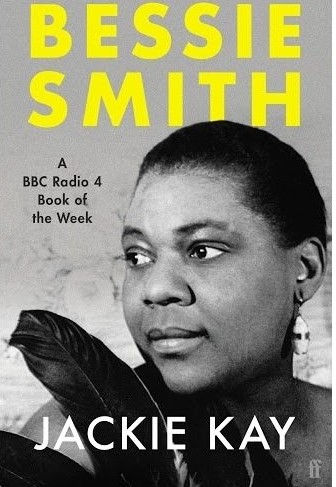 There she stood at Columbia’s studio in New York to record this song in September 1923. She and pianist Jimmy Jones would have been in front of a large tapered acoustic horn. The sounds she has left us have lost nothing of their power to stir the emotions. The constant touring, the recording of about 160 songs over the next decade...it is an irreplaceable and astonishing legacy. Another compelling primary source is the short film St. Louis Blues from 1929. It needs be seen – and to be seen again: Mark Kermode recently did exactly that: he bookended the music episode of his Secrets of Cinema series by contemplating, twice, the sheer irresistible presence of Smith portraying herself on film.
Bessie Smith has particularly strong personal resonances for African-Scottish poet Jackie Kay, and Faber are re-issuing her fascinating and evocative 1997 book today. Jazz trumpeter and writer/biographer Ian Carr (1933-2009), not one to be swayed easily, described this book when first published as “the most vivid evocation of Bessie Smith I have ever read.”
Kay explains her empathy, her fascination, her identification with the blueswoman:
“When I was a young girl, Bessie Smith comforted me, told me I was not alone. Kept me company. I could imagine her life as I invented my own.”
The 2021 edition of the book has a new six-page introduction, but changes to the original text are minimal. As she explained to one interviewer: “I didn’t really rewrite it at all, because I didn’t want to censor my younger self. I got rid of some repetitions that I could easily lose without damaging the music of the book.”
And there is indeed a strong sense of the music and the flow in the way Kay draws the reader into the personal parallels she feels with Bessie Smith.
Almost unavoidably, Kay draws extensively on Chris Albertson’s definitive biography of Bessie Smith, and even quotes substantial chunks from it. She got to know the book in its earlier editions (it first appeared in the early 1970’s) rather than Albertson's substantially expanded and final edition published in 2003.
The extensive interviews which Albertson did with Ruby Walker (Smith), Bessie Smith’s niece by marriage, who was the blues singer’s touring companion over fifteen action-packed years, her confidante, admirer, fellow performer, are a particularly rich seam for Kay to project admiration and to speculate...
“I like to imagine that Bessie’s great love of her life was Ruby Walker. I like to think that Ruby on the road was in love with Bessie all along.”
Bessie Smith died in a car accident in 1937. Through interviewing a doctor who was at the scene, Albertson was able to dispel some of the convenient myth-making that had surrounded it for decades. Kay uses that material, explores the old myths that Albertson was able to debunk, but above all describes the scene of the tragedy evocatively:
“You don’t see your own death coming; you hear it. It’s not just one loud noise; it’s a whole gang of shouting, barrel-housing, cussing, crashing, cutting piano, stomping, snare-drumming, car-screeching, glass-shattering, tyres-screaming, car-weeping noise. Death is loud.”
Like Bessie Smith’s music, Jackie Kay’s vivid, poetic writing has a timeless quality.











Add comment