Alice Childress’s Wedding Band has arrived at the Lyric Hammersmith like an incendiary bomb, a weapon that casts a bright light over its target even as it ferociously burns it.
It’s a piece about conflict – between racial groups, but also within them. The date is 1918, as the US is settling into its role as a combatant in the First World War. But it’s also the story of other wars hotting up in the year the play was written, 1962, a violent decade for Americans both in southeast Asia and, increasingly, on the home front. In both arenas, Blacks will be disproportionate participants, and victims.
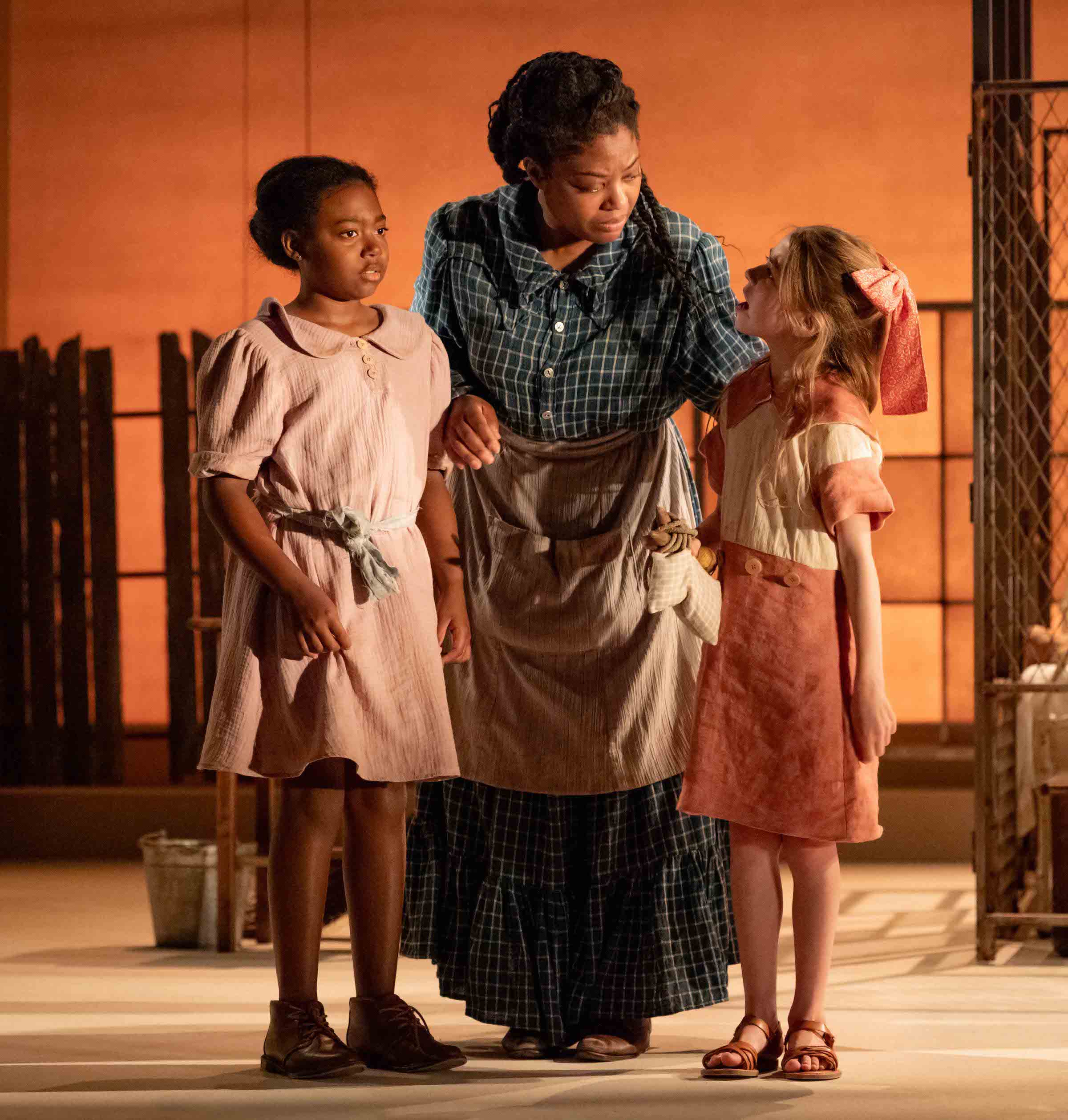
Childress chooses a simple plot and setting to play out these major dramas. The plot, at first sight, is expressed in the play’s subtitle: A Love/Hate Story in Black and White. A new occupant arrives at Fanny Johnson’s boarding house in South Carolina: Julie (Deborah Ayorinde), a beautiful seamstress in her mid-twenties. Her neighbours are Mattie (Bethan Mary-James, pictured below, centre), an illiterate confectionery maker with a young daughter, Teeta (Saskia Holness), a husband in the Merchant Marine and a white child she has taken in, Princess (Poppy Graham); and Lula (Diveen Henry), a God-fearing older woman with an adopted son, Nelson (Patrick Martins), who has enlisted in the US Army. These tenants live in a form of prison, reflected in a set (by Paul Wills) made of movable cages and the remains of a stockade.
 Julie stuns the house by revealing to the good ladies there that the gentleman friend who has been her lover for 10 years is a German baker called Herman (David Walmsley) – not just the enemy, but white. Worse, he has a grim, hate-filled mother, Thelma (Geraldine Alexander), and a shrill sister, Annabel (Poppy Gilbert), who is trying to marry him off to a widow so she in turn can get married.
This isn’t just a tale of star-crossed lovers on opposing sides of the racial divide, forbidden to marry by the South’s Jim Crow laws. Within this group, Childress presents us with cross-currents we might call intersectional today. Herman’s mother predictably hates Julie for being a descendant of slaves, but also for being poor: she is a social snob who tries to elevate her family’s status with the zeal of a Hyacinth Bucket. But Herman hates her for this “smallness” while Julie, in a spectacular spat, shows she hates her for being an ignorant “sharecropper". This is a class war, as well as a racial one.
It’s not restricted to the whites. Fanny (Lachele Carl) is as dedicated a snob as Thelma, though more entertainingly so, catty and witty. Her default excuse for her behaviour is that she is safeguarding "the race". When Herman is taken ill while visiting Julie, she sees him as a threat to the reputation of her business, not just for being white. Herman rants at Julie that her war is with the privileged rich whites who enslaved her people, but he isn’t one of them; he’s merely a low-class white man trying to better himself by working hard. Julie won’t make this distinction. And a damning sentence that comes out of his mouth when he’s defending her to his mother – “She’s not like all the others” – vindicates her. Inevitably, the divide leads to tragedy.
The miracle of this production is that it makes the material sing and charm, as well as sting and shock. Director Monique Touko has punched up all the humour and fire in the text, drawing a rich tonality from her excellent cast. The characters could have emerged as types, but register instead as memorable individuals. Sad untutored Mattie is another strong performance from Mary-James (who shone in the Orange Tree’s Meetings and the Donmar’s Trouble in Butetown). Carl is scintillating as conniving Fanny, an older vamp who’s not above trying to seduce strapping Nelson into working for her – a scene that is a triumph of timing, as Nelson bends down in slo-mo, apparently to kiss her. Martins captures Nelson’s cloddishness along with his raffishness, while not short-changing his decency. We watch him go off to the war with great regret.
 As his mother, upright Lula, Diveen Henry can wrinkle her face into a moue of disgust yet strut like a chicken in a dance that reveals her suppressed vivacity; she also delivers a moving speech about rescuing Nelson from a chain gang made even more poignant by Touko positioning Nelson, unseen, in the background, hearing this story seemingly for the first time. When the white pedlar known as the Bell Man (a sprightly, sinister Owen Whitelaw) cuts off Lula’s credit, it’s a minor but painful event. Money, here, is a conduit to dignity. No surprise that Childress was an actress before becoming a writer. These are peachy roles for women. Even the two girls are given zingers to deliver, as well as terrific dance routines.
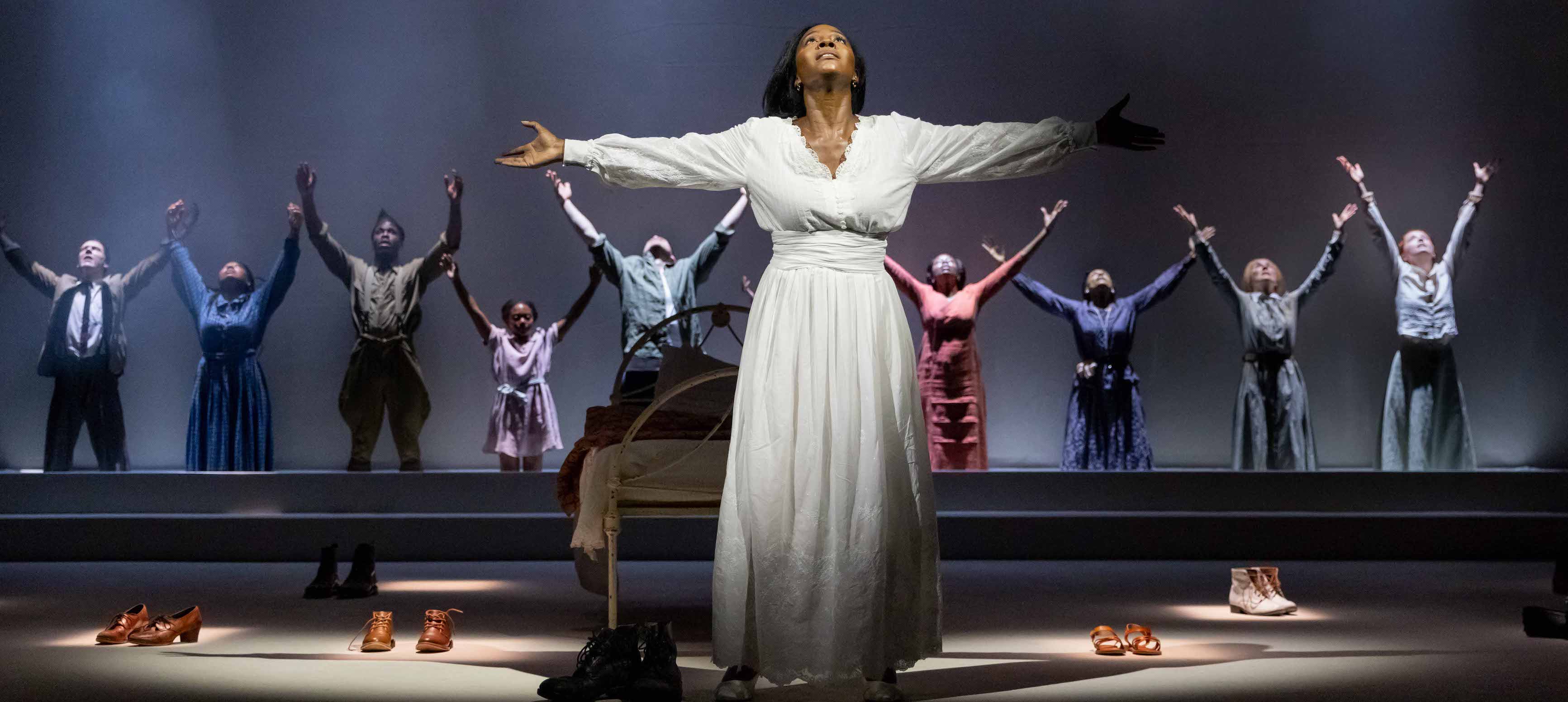
The white characters are slightly less engaging. Shrewish Annabel is too snappily delivered by Gilbert at first, though she relaxes as her character softens; and Thelma verges on caricature, saved by Alexander’s forceful playing. The two leads are also slightly imbalanced. Walmsley is a likeable Herman, a solid man whose desire to protect Julie is evident. But Julie is such a blazing role that she almost eclipses him. Ayorinde moves with ease between hope and despair. She roars like a tiger in her anger at Herman but is poignant as the dreamer who can see a future where No Coloreds signs have disappeared, relying on the Black servicemen who are helping win the war to secure the peace. Her final speech, a rousing call for resistance and progress, is staged as a beautiful tableau (pictured above), water reflecting on the back wall as the cast paddle in a hidden trough of it, like worshippers in the river Jordan. It’s a potent battle cry to the civil rights movement.
Bravo to the Lyric for staging this classic. It should be taken up by other houses now too.
- Wedding Band at the Lyric Hammersmith until June 29
- More theatre reviews on theartsdesk