At the press night curtain call for Richard III, about eleven-and-a half hours after the beginning of this anniversary three-play production, Trevor Nunn stepped in front of his impressively large cast. Not usually a man of few words, this time he uttered only five: "Peter Hall and John Barton".
The duo's adaptation of Henry VI parts One, Two and Three and Richard III into a trilogy was a landmark in the development of the new Royal Shakespeare Company in 1963 and had a profound effect on theatregoers, including a young Trevor Nunn. Hall, the RSC's 33-year-old artistic director, and academic Barton wanted to tell Shakespeare's story of the bloody clash between the Houses of York and Lancaster which ravaged England for the best part of 100 years up to the establishment of the Tudor dynasty. But they determined to make it clearer, to remove some of the repetition and to enable audiences to see parallels with the political upheavals of the mid-Twentieth Century. They cut over 12,000 lines, removed some characters, amalgamated battles and added more than 1,400 lines written by Barton. This seemed revolutionary at the time, but Shakespeare has always been adapted and scholars now regard collaboration between playwrights as normal for the period. Barton could be seen as a collaborator coming somewhat later to the table.
Yet, the trilogy has never been presented since, although there have been several memorable productions of Shakespeare's tetralogy, notably as part of Michael Boyd's eight-play History Cycle for the RSC in 2007 -2008. Is there a better reason than nostalgia for reviving The Wars of the Roses now? On this showing, it does stand up to the demands of an audience in 2015, an audience perhaps more accustomed to marathons (although it isn't obligatory to see all three plays in a day). But the effect is different. Not only are we more familiar with the Henry VI plays, but bubbling underneath this production is a familiarity with the ubiquitous Game of Thrones: even Professor Richard Wilson draws attention to it in his programme notes. If there is occasionally a cartoonish element in the playing, ultimately the excitement and speed of the storytelling, some terrific performances and outstandingly convincing and inventive fights (directed by Malcolm Ranson) carry the day.
The themes of the original Henry VI plays are intact and given proper space: a good man (here Henry VI) may be a bad politician and thus do terrible harm; warfare can only be understood at a personal level (the repetition of loss of child by parent, parent by child); traitors will turn and turn again.
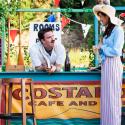
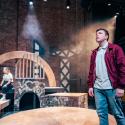
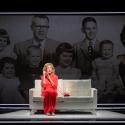
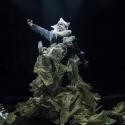
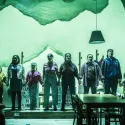
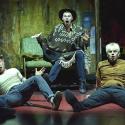
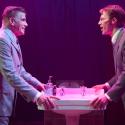
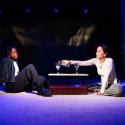
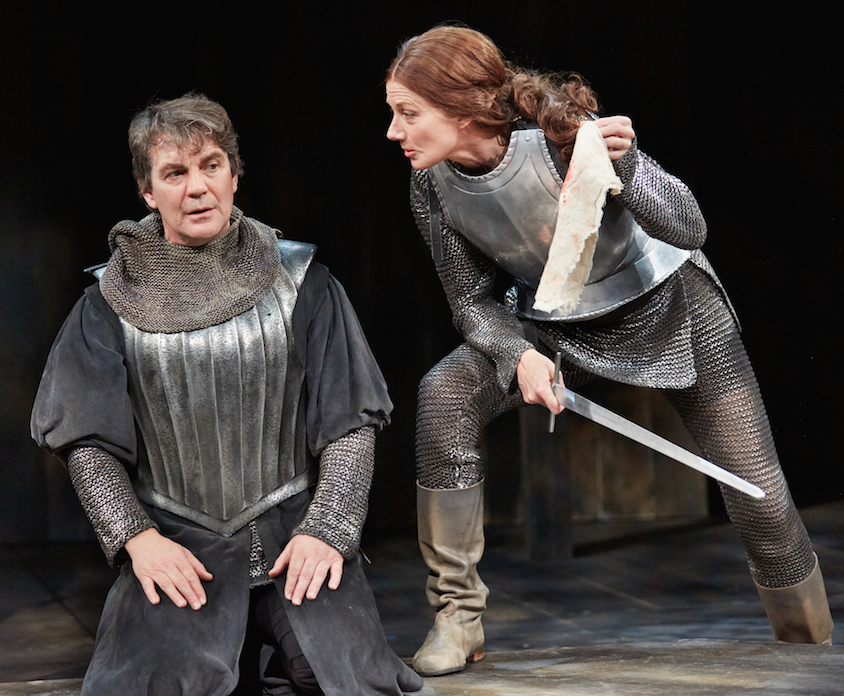
Favourite moments and characters stand out at as strongly as ever, with actors moving easily between roles. The not-so-pure Joan la Pucelle (an athletic Imogen Daines, later a demure Lady Anne), leads the French to victory and then burns in agony; beautiful Margaret (Joely Richardson) is wooed by the lusty Suffolk (Michael Xavier, later Clarence) and becomes queen to the boyish Henry VI (Alex Waldmann); the ambitious Cardinal Beaufort (Oliver Cotton doing sterling service here and elsewhere) rises and falls; the Jack Cade rebellion provides a necessary diversion ("Kill all the lawyers!"); Henry makes his speech upon a molehill, contemplating battle and peaceful anonymity: "Methinks it were a happy life/To be no better than a homely swain"; Warwick makes and unmakes kings. And then in Richard III Robert Sheehan (pictured below), wearing a distorted shoulder outsized enough to please any Tudor apologist, plays the wicked nephew murderer with gusto. He isn't as spine-chilling as Jonathan Slinger or as chucklingly manipulative as Mark Rylance, but his behaviour grows seamlessly out of the York family as presented here and he has the necessary roguish charisma.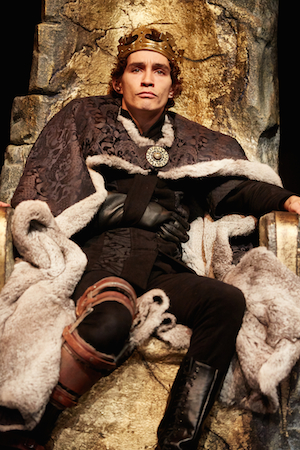 Joely Richardson as Queen Margaret (pictured above, with Alex Hanson as York) may well have felt the long shadow of Peggy Ashcroft, whose performance in this role was unforgettable. She begins winsomely but grows into the toughness of the she-wolf of France, albeit got up in a stunningly flattering suit of shining armour. She is sad rather than vicious as the old, snow-haired queen in Richard III. As Henry, Alex Waldmann is a touching, wide-eyed innocent, risibly ill-matched with the willowy, clever Margaret. In the pivotal role of Warwick, Timothy Walker lacks the expected ruggedness and steely purpose, but Alex Hanson brings toughness and depth to both York and Buckingham (despite a dodgy wig in the latter case). Among other notable performances, Kåre Conradi as Edward IV and Alexandra Gilbreath as his queen and mother of the doomed princes are excellent, both glamorous and then out of their depth.
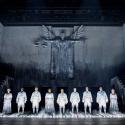
The first performances of the three Henry VI plays and Richard III took place at the Bankside Rose. Trevor Nunn says in a programme interview that he likes to think they have come home, to another Rose Theatre, inspired by the first. His production makes the most of its similar wide, thrust stage but also of the modern advantages of atmospheric lighting (by Paul Pyant) and flexible set design (by John Napier and Mark Friend). He has served Hall and Barton well.
MORE GREAT SHAKESPEARE CYCLES
Globe to Globe. Shakespeare's Globe stages 37 plays in 37 languages. The Arts Desk reviewed them all
Kings of War, Toneelgroep Amsterdam. Ivo van Hove's lucid, searing distillation of five Shakespeare history plays
Shakespeare Trilogy, Donmar at King's Cross. Phyllida Lloyd's ambitious Shakespeare all-female cycle comprises Julius Caesar, Henry IV and The Tempest
The Hollow Crown. The BBC's four-year project to tell the history of Shakespeare's English kings