

The erotic life of puppets – we discover in this show – is filled with intriguing possibilities that are denied to mere flesh and blood lovers. They can float up into the air when they kiss, glide backwards if they’re upset, and perform acrobatics that would be ambitious even for devotees of the Kama Sutra.
In this revival of Greg Doran’s wonderful production – first devised in collaboration with Islington’s Little Angel Puppet Theatre in 2004 – such attributes do not divide them from the human experience but provide a wittily alternative expression of love’s highs and lows. In effect, their movement becomes a kind of poetry that captures the full yearning and humour of Shakespeare’s first ever published work.
“Is it going to be like Team America: World Police?”, my teenage son asked on being told it was puppetry for adults. Mere words were not enough to address this question, so we sat and waited till Venus came into view in her gorgeous shell-shaped chariot pulled by doves. Rob Jones’s gilded puppet theatre design – with its shimmering globe embedded in the proscenium arch – provided a sumptuous backdrop for more picturesque aspects of the tale enacted by marionettes. Yet most of the action – involving larger hand-manipulated versions of Venus and Adonis, two frisky horses and a spectacularly grotesque boar – took place on a platform in front of the puppet theatre, occasionally erupting into the audience.
Doran was inspired for this staging of Venus & Adonis after visiting the Bunraku Puppet Theatre in Osaka in 1999. As well as incorporating the puppeteers into the action, bunraku features a narrator, a musician (or musicians) and the puppets themselves, and this is the basic structure used here. The original narrator was the visionary Shakespearean actor Michael Pennington – following his death just over a month ago, these performances are dedicated to him. For this run it is Simon Russell Beale who narrates in his first production since he was diagnosed with colon cancer last year, imbuing the story with all the nuance and humanity that have made him one of our most acclaimed performers.
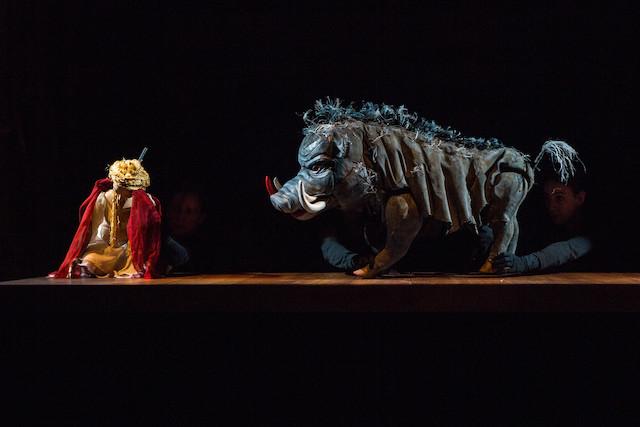
For those who haven’t immersed themselves in Shakespeare’s iambic pentameters, the story shows the goddess of love infuriated because the beautiful young Adonis is immune to her charms. Three Bunraku-style puppeteers operate Venus as she swoops and cavorts, at one point patting her buttock invitingly, at another putting her hands on her hips and stamping with frustration. #MeToo is yet to hit the puppet world, so where – with a human actor – her attitude might seem oppressive, here we can enjoy the joke of the goddess of love’s fury that Adonis is so disinterested in the qualities that define her. Frostily he refuses to succumb to her heatwave of desire, as he makes it clear that the only penetration that interests him involves spears and fleeing animals.
Lyndie Wright’s puppets – designed in collaboration with Jan Zalud, John Roberts, Stefan Fichert, Simon Auton and Jungmin Song – are fantastically expressive, not least the two horses, whose flicking ears and joyous gallops convey their somewhat more successful love story. The wonderful Steve Tiplady – a stalwart of the British puppetry scene ever since his regular appearances at Tom Morris’s Battersea Arts Centre – skilfully combines the styles of Bunraku and an Elizabethan court masque to create an aesthetic that’s as refined as it’s raunchy. Sometimes it’s the realism that beguiles, though the more symbolic moments are equally thrilling. The moment when the globe spins round at the top of the puppet theatre to reveal Death’s golden skull, with the sides of the arches becoming his skeletal arms, is a wonder of macabre humour.
The music, performed by guitarist Nick Lee, also contributes to the courtierly tone with its lute-like delicacy. The stylish score, alternating between skittishness and melancholy, incorporates the master of melancholy himself John Dowland along with such composers as John Blow – the Baroque composer who created his own Venus & Adonis for James II – and the Spanish composer Enriquez de Valderrábano.
These wonders are considerably heightened by Russell Beale’s narrative. His voice traces all the shades of wistfulness, longing, and comedic frustration needed to bring the story to full throbbing life. Sometimes he’s in on the joke with us, but just as often he’s channelling the emotions of the exquisite, complex world in front of us. It’s a masterclass in empathy that leaves us feeling far more for these objects of wood and paint then we might for the human stereotypes in at least half of today’s movies.






Add comment