Underground Railroad Game is scabrous theatre – in every sense. To start with, Jennifer Kidwell and Scott R Sheppard’s two-hander is as down and dirty as anything you’ll find on the London stage at the moment, with one sex scene that’s belly laugh-out-loud funny, another which creates a silence of unease that chills the house.
But it’s scabrous in the original sense, too, about a wound that doesn’t heal, the scab that has formed over it only precarious protection against the original hurt. That hurt, of course, is slavery, the legacy of which simply has not gone away for America, even a century and a half after the conflict that nominally brought it to an end.
It takes us to some places we really don’t want to go Over the course of its frenetic 75-minute action, Underground Railroad Game announces itself variously as “living history” and an “educational Civil War”. Its title comes from the network set up by sympathising abolitionists who organised transportation, from one safe house to the next, for slaves escaping from the South intent on making their way to Canada. That context provides the piece’s first scene, with Kidwell finding arranged respite on her journey in Sheppard’s barn, before he escorts her onwards, northwards, and actually across the Mason-Dixon line, the border between Confederate Maryland and Union Pennsylvania which in those days actually meant little: recapture and return was always a risk.
It’s a stylised scene, with a heightened simplicity that is abruptly cut into when the lights come up, revealing that it’s all taking place in the classroom of Hanover Middle School. And what’s going on is anything but simple: the two players are now Teacher Caroline and Teacher Stuart, who are preparing this elaborate "game" for their class – that’s us, the audience – to bring the Civil War back to life. There’s a nifty surprise that divides us into soldiers of the Union army, the Blues, and the Confederacy, the Grays, before the premise of the game is explained. 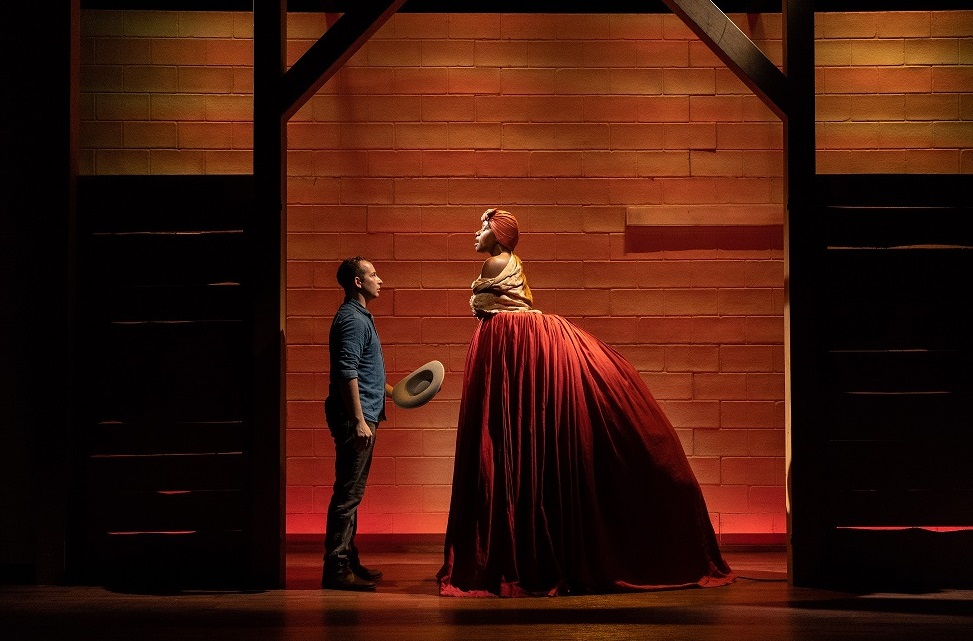 It’s as darkly absurd as you could imagine: the Unionists have to move black slave dolls around the school’s safe-house boxes, while the Confederates are out to capture the fugitives. Before your mind boggles at this instance of history repeating itself as farce, bear in mind that Sheppard really did play such a school game when he was a kid in Pennsylvania. There’s even a final count-off that offers that ultimate revisionist reward, reaffirming or rewriting history.
It’s very funny and very dark, played with enormous aplomb by its two principals, who extract every possible nuance of agility from their material. From then on Underground Railroad Game isn’t really theatre at all, rather a series of riffs, vignettes that play around its central theme, as well as developing the relationship between Caroline and Stuart in ways that reflect it. As the couple starts dating – a beautifully nimble piece of stage work in itself – their characters come to the fore, revealing her sassy confidence, his apologetic liberal gormlessness.
Stuart certainly gets to explore his fantasies. No surprise that sexuality is key among them, never more so than in the scene where She becomes a huge Mammy figure and He disappears under her ballooning skirts, her voice booming out in a parodic pleasuring of sex and song. Then the scene cuts effortlessly from such high theatricality to naturalism, as the lengths of dress segue into the tent in which the couple have been camping. A stream of such transformations follow, the mood veering between hilarity and extreme discomfort. You certainly won’t forget the final scene, in which a whole new kind of cruelty is played out, complete with nakedness that’s as prominent as, of course, the “n” word is throughout.
It’s hard to guess quite what Taibi Magar’s role as director amounts to when these two players carry the play off with such complete conviction, except to say there isn’t a single loose thread visible. Kidwell and Sheppard devised the piece for Philadelphia-based theatre company Lightning Rod Special and premiered it in New York in 2016, so their fluency in the work is total (among the accolades it has earned is a ranking on The New York Times’s “Top 25 Best American Plays in 25 Years” accorded earlier this year). Regardless of exactly who was involved in bringing it together – not to mention, how: It's so much more than any standard text – it's an experience that takes us to places we really don’t want to go, but with such livid theatrical brio that turning back is never an option. Underground Railroad Game has to be seen to be believed – and even then you won’t...