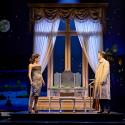
Those who find the Bard tough going – wasn't that one of Emma Rice's admissions back in the day? – should beat a path to The Two Noble Kinsmen, a late-career collaboration with John Fletcher that emerges as Shakespeare lite. Remembered (dimly) as the play that opened the Swan Theatre in Stratford-upon-Avon in 1986, the play tells of a bromance gone awry when competition for a woman gets in the way. Throw in Morris dancing, some colourful costumes and a burst of musicals-worthy vocals from Olivier Award-winner Matt Henry (Kinky Boots), and you've got a production that feels as if it will try anything on for size in order to nudge the play along.
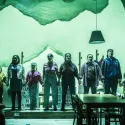
The director is Barrie Rutter in his first production since leaving Northern Broadsides, the company for which he directed the fairly intractable slice of Dryden esoterica, The Captive Queen, seen at the Globe's Sam Wanamaker Playhouse earlier this year. Able this time out not to have to appear in a play that he is also directing, Rutter here lends brio to a Chaucer-inspired tale that doesn't withstand undue scrutiny. A climactic death happens by authorial fiat, which seems to be the logic underpinning much of the text. In which case, a playgoer's best response is to let the evening's pleasures fall where they may, not least at that rare play with Shakespeare's name attached that comes in well under the 2-1/2 hour mark.  A difficult opening scene doesn't bode well (the actors' diction is off), and you can feel a collective head-scratching about to ensue.Things perk up with the arrival (as captives wheeled in on a trolley) of Arcite (Bryan Dick) and Palamon (Paul Stocker, his voice easily filling this tricky space), two of the kindly Theseus's more, um, matey prisoners. "We are one another's wife," Arcite rather unexpectedly remarks to his bestie, Palamon, but not so fast! Scarcely has Theseus's sister-in-law Emilia (Ellora Torchia) hoved into view before the men's bond turns to equally intense animosity. "Have I call'd thee friend?" asks Palamon, revising in an instant the gush that has come before, and Globe alum Stocker finds something both human and necessarily farcical in the lightning-fast change of tone. (pictured above, Dick and Stocker).
While Torchia's plaintive Emila (pictured below) dithers as to which of the nobles she prefers, Palamon comes under amorous siege from the Jailer's Daughter, a sort of Ophelia redux whom Francesca Mills plays with a furious energy that leaves no corner of the Globe's thrust stage unused. "I'm very cold," she bleats, followed minutes later by "I'm very hungry" – though what the character mostly turns out to be is very mad, sufficiently so that she mistakes as Palamon another man who couldn't look less like her beloved if he tried. She's also convinced that he has got 200 women pregnant, in which case I'm not sure I'd want to be conquest number 201.
 The play allows for a further study in male collegiality in the relationship between Jude Akuwudike's robust Theseus and the Pirithous of the aforementioned Henry, a supporting role that this gifted performer seizes upon as and when the character is allowed centre-stage. Henry would clearly raise what part of the (figurative, at the Globe) roof hadn't previously been lifted by the choreographer Ewan Wardrop's zesty dancing. I'm still puzzling out quite what Morris dancing has to do with the ancient Greeks, however refracted this tale may be through a medieval English legend. On the other hand, it's probably best not to let too much enquiry spoil the fun.