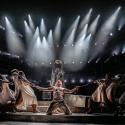
If your heart sinks every time a Shakespeare funny-man enters, here comes the RSC to put an unforced grin on your face. Its latest Feste is the real deal: an emcee with true comedic chops, abetted by a rising-star director who understands exactly how to exploit the innate comedy of both the play and its most anarchic spirit.
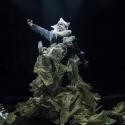
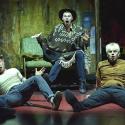
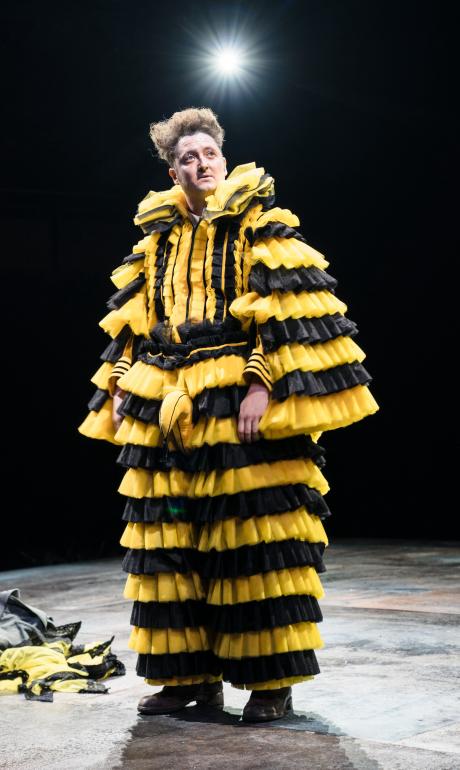
The actor playing Feste is sweet-voiced Michael Grady-Hall (pictured below, left), whom we first see descending from the flies on a wire, crooning into a microphone. His vertical shock of hair is by way of Eraserhead; his specs and facial gestures recall the much missed Viv Stanshall, chief Bonzo Dog. His character gets the most stage-time, and frankly I never wanted him to leave. Directing is Prasanna Puwanarajah, already a welcome face in the cast of many a classy TV drama. Now he is showing he can lend added lustre to a classic, as well as inject it with unusual spunk.
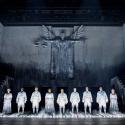
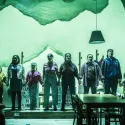
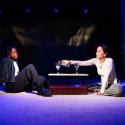
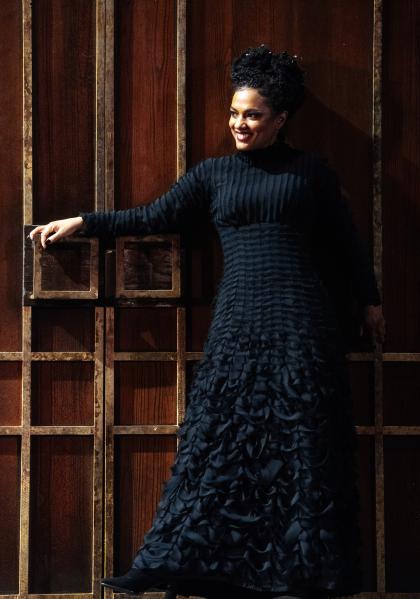
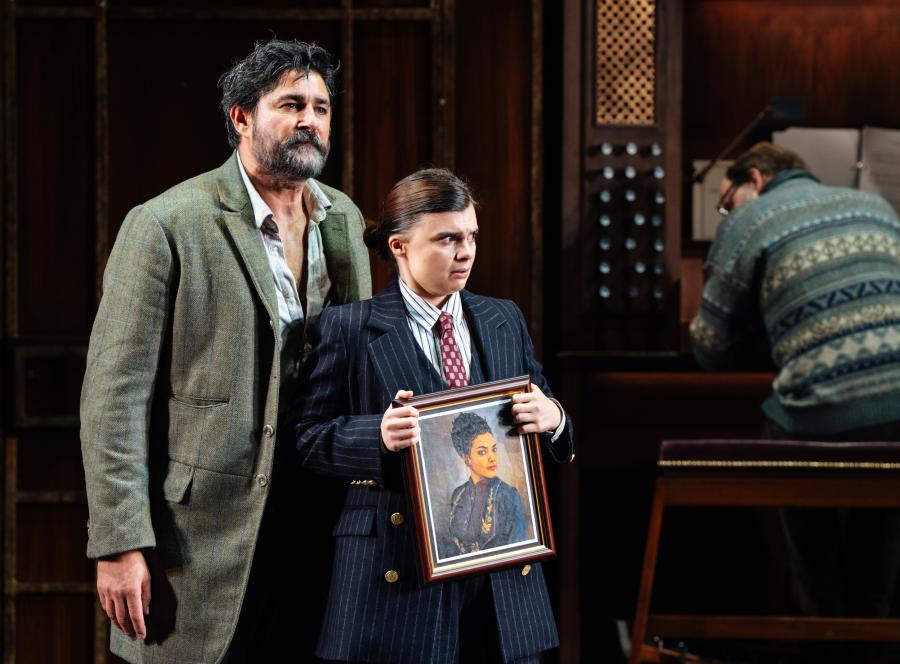
Puwanarajah has chosen his creative team wisely. James Cotterill supplies the distinctive look – a tribute to the quirky-murky world of Edward Gorey, a programme essay notes, permanently stuck in Victorian times, where hysterical women with mad up-dos inhabit empty wood-panelled rooms and lugubrious servants are standing by. Olivia (Freema Agyeman, pictured bottom) lives in one such home, though one of its walls contains an organ that’s fitfully played by a man in a fairisle sweater who regularly slumps on the keys under the weight of his comb-over. Above him, a forest of outsized pipes offers characters a place to hide.
The production is full of striking stage pictures from the outset. We arrive to find a man up a ladder painting the set (appropriately) yellow and black, next to a giant aperture through which a bedraggled, very wet Viola (Gwyneth Keyworth) will clamber post-shipwreck. Over at the abode of Duke Orsino (Daniel Monks), we see him reclining in purple-velvet casual gear on a grand piano, with a bank of roses covering most of the back wall behind him. Feste will slither down this bank, his bag making its own way down when he calls it; he then changes into a yellow and black frilly outfit that sports a banana as a codpiece. And so on.
Matching the outlandish visuals is a perfectly pitched score by Matt Maltese, played mostly on piano or pipe organ, that juggles vaudeville jollity with smooth ballads and dramatic organ chords. Feste still ends the piece with a tender version of “The Wind and the Rain”, to the usual lyrics, but the song could have been written for Thom Yorke.
None of this reworking gets in the way of the staples of the piece, the cross-dressing and hidden identities, and especially the ensnaring of Malvolio. Puwanarajah has cut the play’s more serious elements from the same cloth as the comic ones, so that Olivia, in particular, becomes a central part of the mayhem. Agyeman makes her nicely sassy and bossy, her self-imposed mourning for father and brother set aside. She is identifiably a close relative of the dissolute Sir Toby Belch.
Her household, too, is colourfully comic, not just Maria the scheming maid (excellent Danielle Henry) but characters with walk-on parts like the hilarious servant played by Charlotte O’Leary and the priest employed for the wedding ceremony (Emily Benjamin). In the scene where Cesario/Viola first visits Olivia to woo her on Orsino’s behalf, all the women stand veiled and bark out a unison sound as Viola passes them. It’s a small gesture, but striking, adding to the skewed vision of the whole.
The more serious sections of the text have been given the same thoughtful attention as the pratfalls. The lines aren’t delivered pat, as something memorised, but as sentiments and ideas the character is working on even as he or she speaks. It leads to what could seem like a loss of pace and the threat of overlong silences, but actually feels like real-life with recognisable thought processes about real emotions.
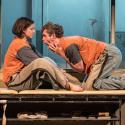
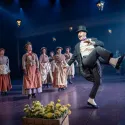
Then there are the dolts, Belch (Joplin Sibtain, pictured bottom with Gwyneth Keyworth), Sir Andrew Aguecheek (Demetri Goritsas) and Olivia’s overweening steward, Malvolio (Samuel West). Sibtain is an outstanding Belch, a big handsome man who doesn’t deliver a standard overweight clown but impresses as a believable sad drunk of uncertain address with a haphazard dress code. His departure here is almost as sad as Falstaff’s. And as Malvolio, West is horribly convincing, a weaselly functionary in middle management with a nasal twang and a squeak in his voice that makes it levitate an octave. The consonants are all there, but the vowels betray him.
His comeuppance is painful, even as his appearance is outrageously bizarre: no simple black ribbons tied around his yellow-stockinged legs for him but an outfit you sit and marvel at for its audacity. When later he icily swears revenge on the audience at the front of the stage, where previously Feste had been charming the front rows and playing catch with them, you register how well Puwanarajah has projected the totality of Shakespeare’s complex stage-world in this play.
This is a heartening evening out, where the atmosphere is almost pantomime-like and the complicity between players and audience becomes total. There are so many treasurable moments to take home with you – the crazed drunken “12 Days of Christmas” that Olivia’s household perform, Grady-Hall’s turn as a ventriloquist’s dummy, his reading of the letter that Malvolio, mad with rage, has sent his mistress, which he dutifully delivers as a stream of burbling anger. Extraordinary. Don’t miss.