Since his arrival about a decade ago, Dennis Kelly has proved himself to be a master of versatility. He has written in-yer-face shockers such as Osama the Hero and Orphans, elaborate experiments in theatre form such as Love and Money, sprawling epics including The Gods Weep, the paranoid fantasy Utopia for Channel 4 and the deliciously heartwarming Matilda the Musical. Now making his belated debut at the home of British new writing, the question is: which style will he adopt?
The answer is a bit of this and a bit of that in what must be the weirdest play of the year. The Ritual Slaughter of Gorge Mastromas is both experimental and a sprawling epic, but also a satire on the greed-is-good society. The story starts with the conception of Gorge in July 1972 during a bout of sex characterised by the indifference of both his parents. This inauspicious beginning continues as little Gorge goes to school, befriends a boy who grows into a victim of bullies, and then, as a teen, fails to get off with the girlfriend of his dreams.
Kelly explores the darkness that lurks inside most of us
Gorge, says Kelly, always has a choice. And he always chooses the safest path. Time and time again, he is offered the options of goodness and cowardice, until a fraught encounter with a Mephistophelian female entrepreneur, who asset-strips the company he is working for and claims to be able to stop time itself, teaches him that there is another way. Success in life can only be achieved by extreme ruthlessness and compulsive lying. Gorge formulates three golden rules of success — and puts them into practice.
As a satire on social attitudes and capitalist values this works well enough, but Kelly is not writing a piece of agitprop theatre. Instead he is exploring the darkness that lurks somewhere inside most of us, and which is sometimes given permission to take over the soul. At first a loser, Gorge changes completely and blossoms into a successful businessman as soon as he gets the nod from his hellish mentor. And although he is successful, he soon stumbles into a kind of Calvary which, as the play’s title implies, is a ritual self-destruction.
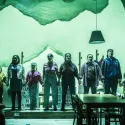
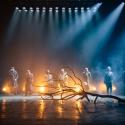
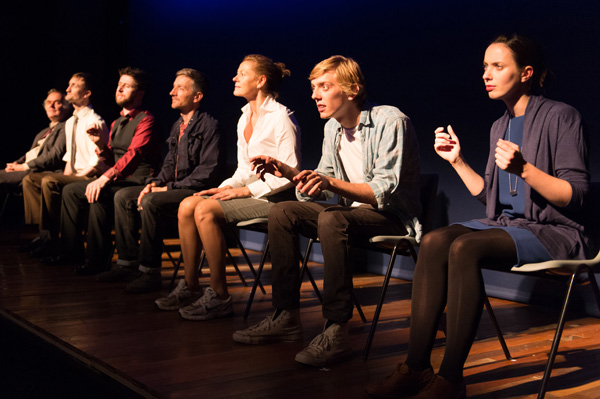 In the end it is family that destroys him, which implies that we live in a society where success has an irrational and inhuman aspect. To underline this, Kelly writes with a thrilling mixture of hilarious absurdism and excruciating embarrassment. The gripping first section is played by the entire company (pictured right) who between them narrate Gorge’s early life story. Then the play spreads out into more conventional scenes, with other actors occasionally arriving to comment on events or fill in some storytelling.
There’s a wry confidence in the writing, though it occasionally meanders and the play’s three-hour running time cries out for some trimming. Gradually, the darkness of the story infects the hilarity of the early scenes and a kind of sad nihilism spreads over Gorge’s crazy life. Kelly scorns a simple naturalistic account of contemporary existence and instead throws himself into the appalling, the paranoid and the tenebrous.The final scene is achingly devastating.
This is Vicky Featherstone’s first production as artistic director and the show throbs with a dark weirdness and a sinister, crepuscular atmosphere. As Gorge, Tom Brooke delivers a majestic performance, growing from creep into monster before our very eyes. Somehow he endows his character with enough shreds of humanity to keep us interested, and he is ably supported by a very hard-working cast: Pippa Haywood, Joshua James, Jonathan McGuinness, Aaron Monaghan, Kate O’Flynn and Alan Williams. I doubt if I will see a stranger play this year.