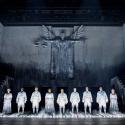
Aleksandr Solzhenitsyn was two years out of prison camp when he wrote The Love Girl and the Innocent. The experience of the eight years of hell that followed his sentence in July 1945 for anti-Soviet activities gave the play its subject, one which the writer treated with a distinctly personal touch. Released in 1953, he was living in internal exile in the wilds of Kazakhstan, working as a teacher; he had also begun to write, though in the utmost secrecy. In June 1955 he read the play to two friends, who themselves had also passed through the Stalinist gulag. During the reading, Solzhenitsyn would creep outside between scenes to check that nobody was listening in. He later remembered: “That night the life of the labour camps reappeared before us in all its vivid brutality.”
The next audience to hear the play, seven years later, would be a very different one, and the writer’s life had changed beyond recognition by then. Allowed to return to Moscow after Nikita Khrushchev’s 1956 Secret Speech acknowledging the true nature of the Stalinist regime, November 1962 had seen the momentous publication of Solzhenitsyn’s One Day in the Life of Ivan Denisovich, which brought the writer and his subject huge recognition, both at home and internationally.
The writer would later admit to his wife that it was his only camp infidelity
Moscow’s recently established ground-breaking Sovremmenik Theatre was another phenomenon of that historical moment’s new engagement with previously taboo subjects, and its dynamic director Oleg Yefremov was eager to stage Solzhenitsyn’s play. The author came to give a reading. DM Thomas’s biography recreates the scene: “Though members of the company found his reading somewhat hammy – and he, in his unstylish suit, looked like a dental technician, one actor said – the hardened professionals were very moved, and some were in tears after the first act.” But that staging would never become a reality, even though Solzhenitsyn petitioned for it through Khrushchev’s private secretary: the gates of reform has already been opened wide enough, and it was deemed not the appropriate time. Khrushchev’s ouster would soon bring the old days back.
Changing times aside, The Love Girl and the Innocent is as close to autobiography as anything Solzhenitsyn came to in his writing. The play’s hero, Nemov, is, like the dramatist, an army officer sent to the camps for an anti-Stalinist indiscretion, the "innocent" who strives to retain his personal morality in a venal world of moral compromises necessary for survival. Even if that survival is gauged by the standards embodied in the words, “You drop dead today, I drop dead tomorrow”. Alongside the brutality of the play's action, there's a darkly comic streak as well in the depiction of how the camp's various hierarchies actually work.
For Nemov, the only light in this darkness is Lyuba, the “love girl” of the title who finally must choose to trade herself to survive. His fated love for her in the play drew directly on Solzhenitsyn’s own experiences, a liaison early on in his prison time, in the identical context of a prison theatre group, with another prisoner, Anya Breslavskaya. The writer would later admit to his wife that it was his only camp infidelity, and we can surely hear the author’s despair in Nemov’s cry: “My wife’s 10 years away, a hundred fences of barbed wire away."
Solzhenitsyn’s play first reached the UK in 1965 as a BBC Play of the Month, directed by Alan Clarke, and isn’t staged that often. Matthew Dunster’s revival at Southwark Playhouse comes at a time when its theme resonates again. Production quota slavery continues in Russia’s penal colonies today, as imprisoned Pussy Riot member Nadezhda Tolokonnikova’s recent open letter chillingly reminded us: “I will not remain silent, resigned to watch as my fellow prisoners collapse under the strain of slavery-like conditions.” The harsh truth of Solzhenitsyn’s The Love Girl and the Innocent could hardly be expressed better.
The Love Girl and the Innocent at Southwark Playhouse from 10 October to 2 November