There was a jolting eco-themed work onstage in London recently, but sadly A Play for the Living in a Time of Extinction, a Headlong company collaboration with director Katie Mitchell and a number of international producing houses, wasn’t it.
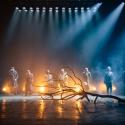
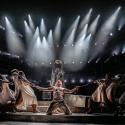
 The performance that jolted all who saw it was by Nederlands Dans Theater, whose NDT1 group brought to Sadler’s Wells Figures in Extinction [1.0], a powerful piece by Complicite’s Simon McBurney and the choreographer Crystal Pite. The dancers twisted their limbs and torsos into imitations of 12 of the now-lost species McBurney selected to read out from a list. Arms and hands became fish in weeds, a distorted body a twitching frog. The dancers’ attempts to resemble the animals evoked them, but simultaneously rammed home the realisation that human imitations are what we have left of them now. It’s a beautifully staged, painful piece, economically eloquent.
A Play for the Living in a Time of Extinction has an equally laudable eco-aim, but none of the incisiveness, sophistication or theatrical passion of NDT1’s work, qualities you expect from a pro like Mitchell. The aim is to create a touring theatre show with almost no carbon footprint, where each venue it visits puts the show’s elements together from scratch, to an agreed template. No fossil fuels are expended moving scenery and personnel around, no air miles notched up. The auditoriums go off-grid; the electricity for lighting and sound is supplied by 10 fixed bicycles pedalled continuously throughout.
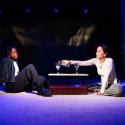
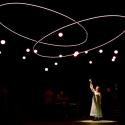
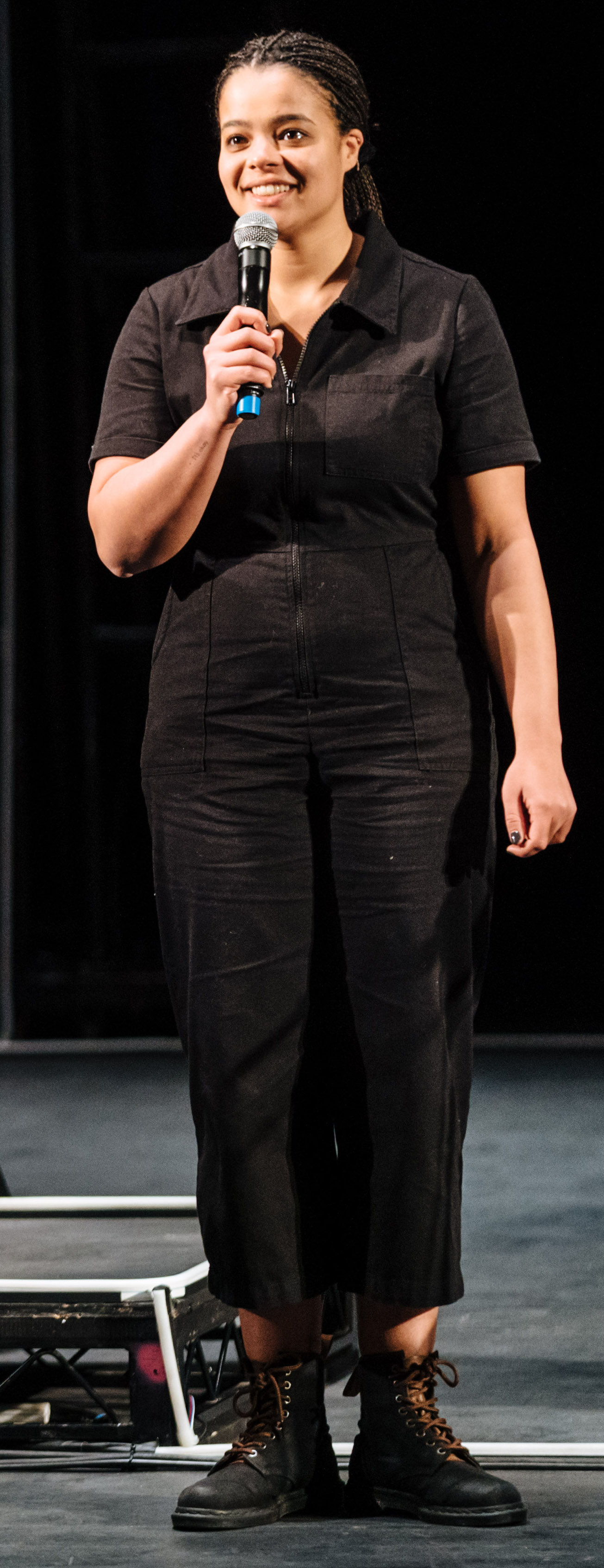
What to fill this ecologically pure void with? At the Barbican the answer Is a piece written by Miranda Rose Hall, featuring a “dramaturg” called Naomi, who enters, microphone in hand, to make a connection with the audience. She tells us she works for the Zero Emissions theatre company, whose leader, Zoe, can’t be there as her mother is dying in hospital. But the show must go on. So Naomi “reads” Zoe’s words from a script.
Except, we know Naomi is the actress Lydia West from It’s a Sin (it says so in the Barbican programme); there assumedly is no Zoe, our sympathy for her is misplaced and part of the connection between audience and performer has been muddied from the outset. If Naomi is an actress with a script, while acting as if she is an MC with a confessional bent, are we supposed to trust her as a reliable guide to all the information she reels out? I still can’t work out why this conceit was deemed to have any dramatic legs.
Apparently some audience members were comfortable enough with this phoney set-up to get onstage at Naomi’s request, so they could pretend to be trees. Some talked from their seats about a favourite body of water or special tree (or were these people, um, plants?)
Before it got too Music and Movement, Naomi did a countdown of the planet’s mass extinctions (we are in the midst of No 6). Except that wasn’t all the information she shared: she took off on weird personal tangents about her mother, her dead dog, the psychic she went to about her vision of a dead woman who turned out to be her grandmother, her increasing panic that the world’s little brown bats were all dying from a new fungal disease. The message was that death is very confusing and sad for the living, but especially for poor Naomi. There were some self-deprecating remarks in her script, too, but nowhere near enough to make you want to listen to her for an hour. (I started watching the valiant onstage signer instead. Great bat hands.)
I could just about see that Naomi’s naive burbling was supposed to be funny (it said so in the Barbican brochure), but it wasn’t, and it shouldn’t have been, unless the humour got the right dramatic result. But it didn’t. Perhaps we were supposed to register her response to the tragedies of human existence as deliberately over-emotive and inadequate, the frustrated reaction of a good-hearted young person. But she just seemed over-emotive and inadequate. And what did her fond memories of her old green dinosaur toy have to do with fighting climate change?
Patience was really tested when Naomi started intoning the word “mother” 30 times, to get across the number of generations there have been in the past thousand years: this would help us understand “human time”, not to be confused with the “deep time” of the universe, which takes a lot longer to effect change. (No kidding.) But this was as nothing to the seemingly endless slide show of endangered or lost species Naomi embarked on as a finale. Including those little brown bats.
After this, things went over the top into unbridled slush. Naomi ranted about the human choices the white European world has made that have caused all this eco-catastrophe, which she admits she is part of. I was half-expecting an effigy of a white male plutocrat to be brought on and burnt next. Instead, we got Naomi wishing Zoe’s (fictitious) mother a good death (oh, and all of us, too), followed by a large group arriving to sing an almost inaudible song about blessing life. Tragically, it was almost comic.
- A Play for the Living in a Time of Extinction at Barbican Theatre until April 29
- More theatre reviews on theartsdesk