If you weren’t sick when you arrived at Les Cerisiers, the private psychiatric hospital in this satiric early Sixties drama by Swiss playwright Friedrich Dürrenmatt, you probably would be by the time the institution had finished with you. Its all-female staff are either grotesque or pulchritudinous; and the latter category have a worrying tendency to wind up murdered.
The former comprise the sanitorium’s head, hunchbacked, hollow-eyed Dr Mathilde von Zahnd (Sophie Thompson), and her butch, helmet-haired right-hand nurse, Marta Boll (Joanna Brookes). Together with their ill-fated subordinates, in their tight-fitting, snowy, starched uniforms, they have the task of tending to just a trio of inmates. One thinks he is Sir Isaac Newton, another Albert Einstein. The third, Johann Wilhelm Möbius, believes he receives regular visitations from the fabled King Solomon. All three have a penchant for a spot of seduction, followed by a strategic strangling.
Identity is a slippery issue here, and motives are anything but pure
The play is rarely performed in Britain, and it makes a bold and striking piece of programming for director Josie Rourke’s first season as Donmar supremo. It has a surreal quality, with resonant absurdist echoes – its tone and its string of slayings recall in particular Ionesco’s The Lesson – and Rourke’s coolly elegant production is highly stylised. At its nucleus, this is a work about scientific responsibility, and about humanity’s double-sided capacity for genius and for self-destruction. Here, in a jaggedly arresting new version by Jack Thorne, it is often amusing, and sometimes unsettling – but emotionally, it remains remote.
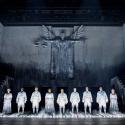
Robert Jones’ design offers a dazzling white room, its wall lined with padded doors and its clinical surface disturbed only by a stripe of sickly green, some scattered scarlet apples and the blood-red outline of the latest ministering angel to fall victim to one of the physicist patients. The killer on this occasion is Einstein (Paul Bhattacharjee), or at least a man who believes himself to be Albert – or does he? Identity is a slippery issue here, and motives are anything but pure. While Einstein saws away on his violin, murdering the Kreutzer Sonata, Newton (Justin Salinger) tosses the bruised apples into a wastebasket with a knowing expression, and baits the coroner (John Ramm) who has come to investigate Einstein’s crime.
 But it’s only when John Heffernan's Möbius (named after the German mathematician August Ferdinand Möbius) is confronted by his ex-wife (Miranda Raison, both pictured right) and his two strapping, lederhosen-clad, recorder-playing sons that really extravagant lunacy kicks in. His scene of hysteria drives his family away, but draws to his side the lovely and enamoured Nurse Monika (Raison again) who believes in his genius and his daily conferences with King Solomon, and wants to run away with him. It’s not, of course, a plan that ends well for her, or, as it turns out, for anyone.
Rourke draws smart, witty performances from her cast, and Raison especially excels, bringing a real wounded sense of despair to the fleeing wife and tenderness to the sensual would-be lover. But Dürrenmatt’s plot is as tortured as Möbius’s mind, and the writing arch; by the time the author is ready to hit us with his moral argument – forged in the Cold War, in the shadow of the atom bomb – we’re already slightly numbed by the collision between madness and sanity, by the multiple aliases, delusions and illusions, dubious intentions and casual killings. Stylish this certainly is; but it’s also sterile.