The latest transatlantic transfer is curiously esoteric, concerning as it does an obscure period in the lives of two great men: Laurence Olivier and Orson Welles. The centenary of the latter’s birth makes this an apt moment for the European premiere of Austin Pendleton’s Chicago-originating 2000 play, but its appeal may not extend beyond dedicated students of theatre history.
It’s 1960, and critic Kenneth Tynan (Edward Bennett) is determined to unite his beleaguered heroes, persuading the declining Welles (John Hodgkinson) to direct out-of-step Olivier (Adrian Lukis, pictured below) in Ionesco’s Rhinoceros at the Royal Court. This quixotic quest results, inevitably, in a giant clash of egos, fuelled by long-held resentments and rampant insecurity. Rehearsal ructions are rivalled by portentous tracking of medical conditions and domestic histrionics, with Olivier attempting to disentangle himself from unstable wife Vivien Leigh (Gina Bellman) in order to pursue co-star Joan Plowright (Louise Ford).
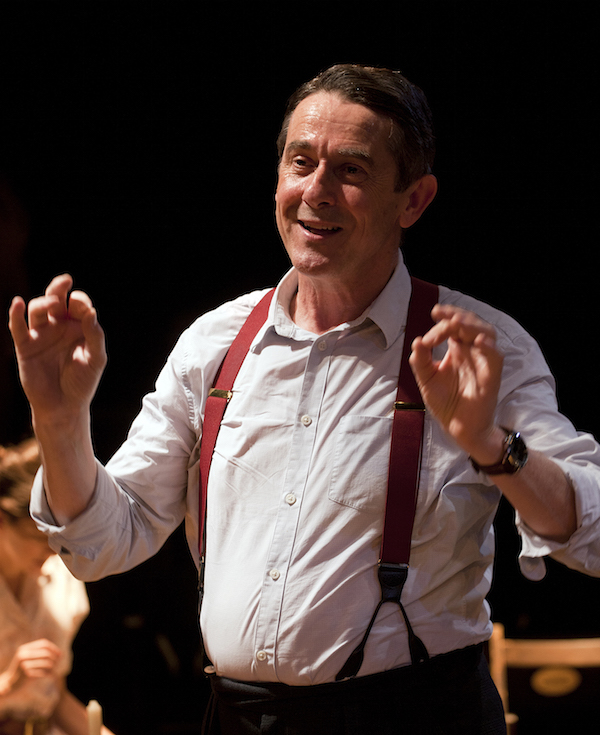 Pendleton makes a decent case for this moment as a significant crisis point. Welles, dogged by the legend of Citizen Kane, has lost final cut privileges after abandoning yet another project, while Olivier fears obsolescence – does he have a place in the new theatrical landscape? Leigh is associated with his classical acting past, Plowright with possible modernist reinvention. Helpfully clueless assistant Sean (Ciaran O’Brien) elicits swathes of information, preceded by a fourth-wall-breaking apology from Tynan, who regrets turning “that nice young man into a receptacle for exposition”.
The real Plowright has dismissed the play as largely fiction, and Pendleton freely admits to conflating, modifying and inventing, but the wealth of anecdotal detail lends it authenticity. Whether or not Olivier actually went to see Wesker’s Roots at the Court, marvelled at the gritty portrayal of poverty, then cut short his visit because Leigh was waiting outside in the idling Rolls-Royce, it’s a tale that informs our understanding of a man in limbo. Welles’s implosion may well have inspired Olivier to brave the trauma of revolution that the new era of drama represented.
The flagging, rotund Welles, meanwhile, can only identify with the rejected Falstaff – “I am old. I am old” – or with Rhinoceros’ everyman: “How could a man who has everything before him lose his way?” Hodgkinson nicely balances self-regard and self-pity, while Lukis sidesteps direct impersonation, but evokes elements of Olivier in his clipped delivery and image-conscious preening. Bellman’s manic depressive diva borders on caricature, but Ford’s eminently sensible Joan delights and Bennett effectively reveals Tynan’s boyish eagerness, though it’s a shame not to see more of the famously acidic wit.
Pendleton takes too long getting to the meat of the drama, and Alice Hamilton’s conservative in-the-round production lags. Still, there’s some interesting insight into the creative process, enjoyably catty barbs – Welles says of Olivier: “He thinks modern is anything this side of the 14th century” – and occasionally poignant exploration of the human tendency towards self-destruction, even as we proclaim a desperate need to survive.