Offbeat in more than just their rhythms, jazz musicians have always had an affinity to the extraordinary, living lives syncopated against the regular tread of society. Maybe it was the informality of their training, or the influence of brothels, bars and back streets that were their concert halls, but the likes of Buddy Bolden and Django Reinhardt have left a legacy of autobiography every bit as bold and unusual as their music. It is in this legacy that Alessandro Baricco’s fictional pianist Novecento claims his share, in a 90-minute monologue that riffs on the unlikely melody of his life to create a beautifully absurdist fable.
With a name – Danny Boodmann T D Lemon Novecento – gathered scavenger-like from the scraps of his environment, Baricco’s hero is a man shaped by his (lack of) experience. Born on transatlantic liner the Virginian, he travels the world for 32 years while never leaving the ship, because as a child he found in the piano a world of greater possibility. It’s an elegant conceit, and one whose claustrophobic setting is amply counterbalanced in the generous vision of Baricco’s text (translated here by Ann Goldstein).
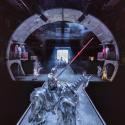
Exploiting the intimacy of Trafalgar Studios’ hundred-seat Studio Two, Paul Wills's set traps us down in the steel belly of the ship, chains slung sinew-like above and around us. It’s a space made for storytelling, and Mark Bonnar proves himself an engaging narrator – gaze roving, eyes rolling – but in a theatre in which it’s all too easy to feel dramatically assaulted, rarely misjudging the volume of his actions.
Speaking most often as Novecento’s trumpeter and friend Tim Tooney, the text sees Bonnar inhabit a series of characters, even engaging in passages of quick-fire dialogue. With cameos including the claustrophobic captain (“You’ll have noticed he lives on a lifeboat”), inscrutable, white-suited jazz legend Jelly Roll Morton, and the wife of a stockbroker with cold cream and tears running down her face, it’s a far cry from the narrowly inward vision suggested by monologue. With just the drop of a shoulder or the arch of his back, Bonnar shifts between personas, a bravura display of technique and dramatic stamina.
The many smaller anecdotes of Novecento’s life are clustered around two big set-pieces. A storm on the Virginian sees Tooney encounter the sea-legged Novecento for the first time; the image of the two men seated at the piano, “dancing with the storm”, as they slide and glide across the ballroom is one so extravagant as to demand the simplicity of this allusive staging. Similarly the musical “duel” with Jelly Roll Morton achieves impact without a single note being played (Olly Fox’s soundtrack remains stubbornly non-diegetic).
The refusal of Róisín McBrinn’s direction to engage with the literal is well judged, allowing the text the freedom it thrives off, yet the absence of music in the story of a musician does at times feel a little wilful – the elephant unaccountably absent from the circus in the room.
“When you don’t know what it is, it’s jazz.” Glorying in the polyphonic, elusive, anarchic nature of jazz, Baricco’s play sits in the undefined somewhere between poetry and prose. With the artlessness of its linear narrative belied by the flashes of the fantastic and uncanny, Novecento is a fable for the age of magic realism, an affectionate and humorous anthem to jazz, “The music that God dances to when no one is watching.”
- Novecento is at the Trafalgar Studios until 20 November
- The current season at the Donmar Warehouse
- Find Alessandro Baricco on Amazon