Bradford, once the worsted capital of the world, now employs fewer than 1,000 workers in the textile industry. Some of the disused mills have been transformed into tourist attractions – nearby Salts Mill has a huge collection of artwork by David Hockney and a posh bistro. Drummonds Mill has lain silent since closure, to be reopened temporarily for Freedom Studios’ production of The Mill – City of Dreams. Drummonds Mill is just north of the city centre. It’s a huge hulk of a building. You step carefully over the cobbles, and weeds, before being directed in through a back door by smiling security guards. The mill originally opened in 1862, closing for the last time in 2002. At the entrance, a huge banner announces that luxury flats are under development.
You sip wine in the foyer and watch a glossy promotional video for the long-promised redevelopment of Bradford city centre, a young Swedish property developer mingles with the crowds before showing us his vision – a swish reinvention of the derelict mill, complete with secure parking and free broadband. This is a promenade production, and closer inspection of the architects’ model reveals that the buildings are made from old card factory records. Soon, Frank the caretaker appears with a torch and leads us on a tour of the abandoned mill, introducing us on the way to three workers whose stories unfold over 90 minutes.
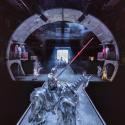
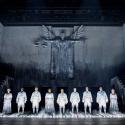
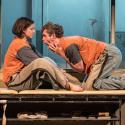
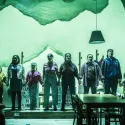
The space is thrilling – the first scene set in a room the size of a football pitch, with wool wound around the iron columns supporting the ceiling. Janek Schaefer’s sound installation is terrific – the noise of the mill at full tilt is deafening. As we move on, we’re introduced to Petro, Maria and Yakub, immigrants from Ukraine, Italy and Pakistan. Yakub, possessor of an engineering diploma, starts his Bradford life performing the lowliest of manual tasks. Maria’s lack of English initially separates her from her workmates, and Petro is haunted by his experiences as a child during wartime. It’s touching to see them pose for photos to send to distant families, wearing borrowed suits and watches and standing in front of artfully displayed cameras and radios.
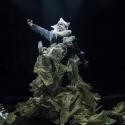
There’s the sense that, despite the monotony and drudgery of the work, mill life was stable and communal. Kim Heron’s Henrietta looks back at a life when things seemed easy – you signed up for a job at the mill, got married, and worked there for 40 years. Yakub’s son is reduced to aimlessly playing snooker, and a lonely Petro carves wooden angels to send back to Ukraine. Finally we arrive at the top of the mill – a breathtaking vaulted space, littered with detritus – bobbins, factory records, scraps of worsted. As the mill’s closure is announced, the threads wound around the pillars and attached to the floorboards are cut – symbolising the ending of an era when every Bradford inhabitant’s life was somehow connected to the textile industry. Anton the Swede gabbles about turning the space into penthouse apartments and we shuffle down the stairs feeling deeply melancholy.
Directors Madani Younis and Omar Elerian make bold, imaginative use of their environment. Their script, co-written with Jonathan Holmes, is not always subtle, but it tells its stories clearly and simply. Performances are consistently strong, particularly from Gabeen Khan as Yakub, but the real star is the extraordinary building, a charismatic, haunted, wondrous vault of a performance space.
 Book tickets for The Mill - City of Dreams