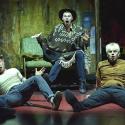
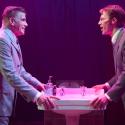
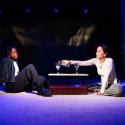
It's not easy these days to stay the course on stage, with one leading female character after another of late failing to make it to the final curtain. I'm thinking of such otherwise diverse heroines as Shakespeare's Juliet and Andrew Lloyd Webber's haunted soprano, Christine, as well as the fraught Fosca of Stephen Sondheim's Passion, who may just remain the last word in women snatched prematurely from the men in their midst. To that list can now be added Jenny Cavilleri, the music-minded 25-year-old at the eternally doomy heart of Love Story, a show whose subtitle could, in fact, be Love Never Dies - except that Jenny, as surely the entire world must already know, sadly does.
Nor does Howard Goodall's stage musical of the same Erich Segal novel that spawned the time-honoured Hollywood weepie - a movie, astonishingly, that is now 40 years old - waste much time getting to the grievous point. "What can you say?" the show asks at the very start about the hapless Jenny, the tough-talking piano enthusiast from the wrong side of the social tracks who no sooner is married to the blue-blooded Oliver Barrett IV before illness comes fatally to call. And the answer, across 100 uninterrupted minutes, is that you can't say a lot, actually, beyond remarking that she lived and loved and died. And made a mean gnocchi all the while singing up a storm.
Love Story was never exactly deep, and it hasn't become so here, despite the impressive pedigree of a creative team that includes the composer Howard Goodall in his first West End foray in over two decades. What is the same quintessentially English songsmith who brought a Cumbrian mining community to London's commercial corridors doing animating anew a celluloid romance that defined a generation and gave us that oft-quoted bromide, "Love means never having to say you're sorry"? Easy: displacing his gift for harmony and the occasional choral interlude to a landscape more usually associated with Lloyd Webber, who in fact produced The Hired Man all those years ago. (Those pining for the film's Oscar-winning theme by Francis Lai are given a teasing snippet during one of Jenny's spins at the piano.)
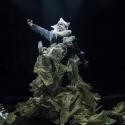
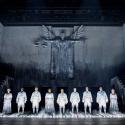
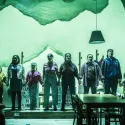
 The result is a tasteful, even tactful show forged from material that could easily have become kitsch. But in going down the art musical route, this Love Story also proves oddly unexciting; a little bit of vulgarity, as it happens, might have come in handy. The self-seriousness is there in the classical architecture of Peter McKintosh's set, which shifts from library to dining room to hospital as the narrative (and various props) warrant, and makes room towards the rear to house the able seven-person band. And it exists in a framing device to Stephen Clark's book that doesn't oversell Jenny's death for bathos but nor does it tell us much of particular interest about either her or Oliver, beyond the fact that she comes from a loving father but little money whereas he hails from mega-bucks and has an icicle for a dad. And barely does the topic of their own kids hove into view before the Grim Reaper makes an unwelcome appearance.
One can imagine Love Story having an extended life in regional theatre and on the American stock and amateur circuit, though I doubt there's enough substance to the actual story to make a go of it in the increasingly parlous waters of Broadway. (These days, a familiar title will only take you so far either side of the Atlantic: look at the imminent fade-out of Flashdance.) And though this musical's prevailing restraint - scenic and otherwise - marks a change amidst our age of the ersatz blockbuster, neither Jenny nor Oliver nor their compare-and-contrast dads move sufficiently beyond the stereotypical to elicit much beyond a sympathetic nod. There was more at stake in five minutes of the recently departed Passion than there is throughout this entire show. (Interestingly, Love Story's lead producer, stage star Michael Ball, led the original West End company of Passion in 1996.)
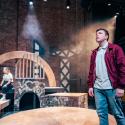
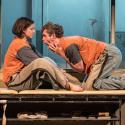
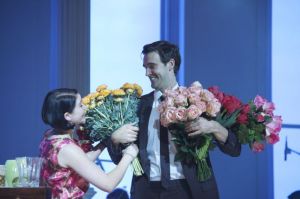
Love Story feels like a two-hander despite boasting a cast of 12, and the lion's share of the vocalising inevitably goes to Emma Williams and Michael Xavier (pictured above right, on a productive day for Interflora) in the defining roles. The two are attractive, personable talents and play winningly separately and together, even if their courtship is glossed over as quickly as her death to the extent that the chinks in Jenny's feisty, outspoken armour have to be taken as a given since they go undramatised. (It's probably a mistake to have her twice spoken of as a "bitch".) More fully at ease with the accent, Xavier impresses as a legal eagle who lands a girl capable of both quoting Shakespeare and preparing penne, the latter of which prompts a crowd-pleasing number from Jenny honouring pasta in all its full potential. (Not since Lia Williams cooked a meal in real time for Michael Gambon in David Hare's Skylight has spaghetti made such an onstage, um, stir.)
In some alternate, cheesier take on this same tale, the piece would come to rest on very much the sort of father/son embrace that Rachel Kavanaugh's staging scrupulously avoids, just as Jenny is denied the full-throttle Violetta-style salve one might expect - in any case, it's Donizetti, not Verdi, who gets mentioned in passing. Come the musical's finish, we return to where we began and to the question of what you can say of someone who died so young. I think I'd start with a simple "I'm sorry", followed in this case by "I wish I knew".
- Love Story is at the Duchess Theatre, London until 26 February, 2011
- Find Howard Goodall on Amazon
- Find the 1970 Ryan O'Neal/Ali MacGraw film on Amazon