You have to hand it to Felicity Kendal: this ever-game actress is fearless about treading in the footsteps of the British theatre's grandes dames. In 2006, she starred on the West End quite creditably in Amy's View, inheriting a part originated on both sides of the Atlantic by Judi Dench. And here Kendal is at that ongoing West End incubator, the Menier Chocolate Factory, reviving the 1987 play, Lettice and Lovage, that the late Peter Shaffer wrote as an extravagant bouquet for his beloved Maggie Smith. The flowers on this occasion, alas, are starting to wilt.
The problem partly rests with the play itself, an extended confection in three acts that badly needs the high-style flourish of someone like Smith to see it through some very serious padding and peculiar plotting. (The third act in narrative terms doesn't stand up to scrutiny.) But Kendal in any case seems oddly suited to its demands, from one's first glimpse of her unflattering Shirley MacLaine-style wig to the actress's effortful way with lines that need to spring unbidden from the reckless imagination of the fantasist that is Lettice Douffet. Those in attendance at Shaff'er's highly affecting memorial service earlier this year on the Olivier stage of the National Theatre got a glimpse of Smith in resplendent form briefly revisiting the role for which she won a 1990 Tony.
But whereas one could imagine the delicious Eve Best, say, in time steering what is at heart an essentially camp two-hander (with other roles dropped in for reactive purposes), so larger-than-life a part sits oddly with the eternally kittenish Kendal.
 After a while, I began wondering how Trevor Nunn's stuttering production might have worked if Kendal had swapped roles with her co-star, Maureen Lipman, here inheriting Margaret Tyzack's original part as Lettice's adversary-turned-ally, Lotte Schoen. Lipman, in fact, possesses the signature style that a role like Lettice sorely needs if the play is to seem more than a distaff caprice from a playwright who spent most of his storied career focusing on the dynamics of older and younger men (Equus and Amadeus, for starters), not two middle-aged women who may or may not have fallen in love.
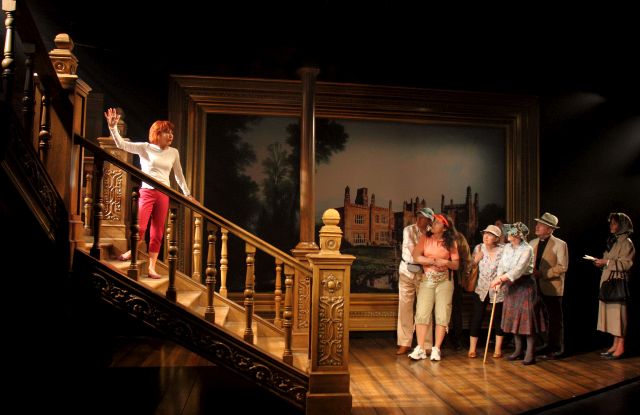
This production, interestingly, hints rather more strongly than Michael Blakemore's London and New York premiere ever did at the extent of the deepening bond between Lettice and Lotte, who first meet when Lotte appears unexpectedly to take issue with the increasingly florid tours that Lettice is leading of the wonderfully-named Fustian House. The opening sequence is a comic banquet that allows Lettice to effect ever more outrageous variations on the misdeeds perpetrated on and around the central staircase (pictured above) of the Wiltshire stately home that also, of course, represents Lettice's place of employment. So when the scene shifts to Lotte's office and Lettice's inevitable dismissal for trafficking in, yes, fake news, you would assume the two women to be forever daggers drawn.
 But no. Shaffer next takes us to Lettice's Earl's Court flat, to which Lotte arrives proffering something resembling a heart beneath her crisply half-Teutonic facade. What ensues is a rapport forged in drunkenness and strengthened by the ladies' shared lamentation for the architecture of contemporary London, a cranky posture that acquires ironic piquancy from a production of this play staged in the shadow of the Shard. In another context, a pair so devoted to public destructiion – they'd quite like to blow these edifices to smithereens – might result in a joint sectioning, though not here. Instead, Shaffer's ending (rewritten following the London opening) finds the women following a shared if presumably more peaceful path and toasting the audience in the process to sweeten the deal.
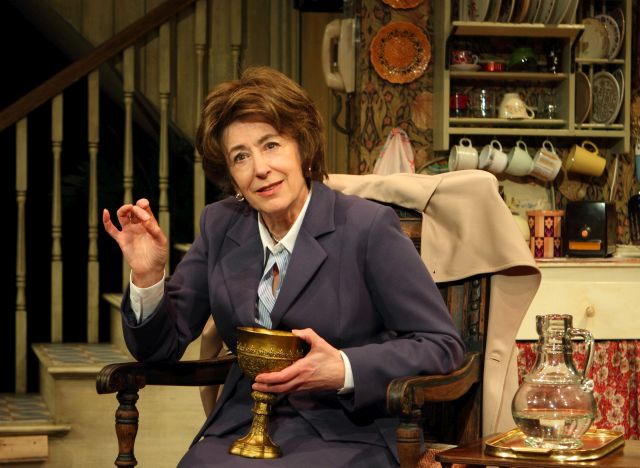
Whether this all strikes you as enchanting or tosh will vary from person to person, but Smith had a canny enough comic instinct to silence all cavils. Kendal, by contrast, growls a sizable chunk of her lines, leaving Lipman's Lotte (pictured above) to extol the virtues of "spunk" and to drift in and away from a German accent. The production in general feels as if it still needs bedding in: Sam Dastor as a solicitor brought in belatedly and then swiftly dispatched wasn't the only one who seemed a bit shaky on his lines. Robert Jones's set cleverly effects its own commentary on the shifting urban landscape, but the fact remains that a play repulsed by the word "mere" now feels precisely that. "Enlarge! Enliven! Enlighten!", Lettice insists, and not for the first time such exhortations begin at home.