Yasmin Reza’s God of Carnage (2008), like her British megahit, 1994’s Art, is not strictly a comedy. The French dramatist likes to create gladiatorial spaces disguised as chic living-rooms, where the professional classes slug it out, chewing their way through all manner of pieties and prejudices to reach some kind of climactic end point.
In this country, we tend to think that’s a pretty funny thing to do. So Art ran for six years in the West End, with multiple casts playing for laughs the perceived pseudery of the three men onstage who were hotly debating the true value of art. How very Gallic.
God of Carnage proved less of a laughing matter. (It is typically billed as a “dark comedy”.) Transposed into British accents, in ithe director Matthew Warchus's opening West End production, the piece played as a parable of the innate savagery of the so-called civilised West (in 2008, that meant primarily white middle-class), a breed represented by two couples whose tamped-down emotions gradually explode under duress when they meet to discuss their children’s fight. Ralph Fiennes excelled as a supercilious lawyer dealing with his child’s bad behaviour while trying to head off the corporate crisis developing on the other end of his mobile phone.
Now comes the Lyric Hammersmith’s version, which looks right – the set features a giant bendy standard lamp, white low sofas and plush pouffes, tulips in glass vases, deco cocktail trolley – but is played rather differently. This cast has just one white character, Michael (Michael Hutson), who is a domestic hardware wholesaler. He is married to Veronica (Freema Agyeman), who has written a study of the civilisation of Sheba and a book about Darfur and works part-time in an art bookshop. Straight away, the march of time has left its mark. In 2008, white Veronica’s interest in things African came across as potentially posey and virtue-signalling. Now, with a woman of colour playing the role, the satirical sting has gone out of this detail, and the vicious comedy has been refocused as a knockabout comedy of manners.
The couple’s 11-year-old son Bruno has lost two teeth, hit with a stick by the son of their visitors, lawyer Alan (Ariyon Bakare), Bluetooth receiver in ear, and his wife Annette (Dinita Gohil), who works in wealth management. An agreement on how to handle the boys’ fight must be arrived at.
Directed by Nicholai La Barrie, the production starts promisingly. Within minutes, Bakare’s Alan is doing some lawyerly bristling at Veronica’s use of the word “armed” to describe his son; "furnished with a stick" is preferred. The mood is civil but wary. Agyeman also shows her claws early, a clearly capable woman but with emphatic opinions, whereas Gohil’s Annette is more mild-mannered at this stage.
Buzzing around them all is Hutson’s Michael, a nerdy type with a nervous laugh and a touch of Mr Bean. It’s quite a change from more macho portrayals of the character – played on Broadway by a menacing James Gandolfini, no less, and in the first London cast by a testy Ken Stott – but it works. When Annette becomes fixated on the revelation that Michael has thrown his children’s hamster out of the house to fend for itself, tired of the noise it was making, you sense that Michael's jitteriness might well lead to overwhelming impatience with a pet. And when he applauds his son for being in a gang, it’s the stance of a weedy kid who needs to feel the support of others around him rather than the natural preference of a bully. His wife, unsurprisingly, seems to be the dominant parent here, though Agyeman plays this suit too readily and unguardedly; her Veronica is all outrage and not enough subtlety.
Alan’s comportment, too, has undergone a sea change. Bakare makes him bluff and noisy, a big man almost falling out of his suit; even his phone rings in an intrusively loud way. He does not try that hard to take his important calls discreetly, which you might expect a high-flying lawyer to do. Only when Veronica offers him some home-made clafoutis and espresso, and later Michael plies him with some rare white rum, does he start to mellow. Eventually, drunk and despairing, he even whimpers.
Alan has to answer his phone every three minutes as the drug company he represents tries to deal with the significant PR problems it is having with a drug called Antril, whose side effects are proving life-changing. The comedy of the situation is nicely compounded when Michael gets persistent calls too – from his elderly mother, who is having to take a new cocktail of drugs, one of them Antril.
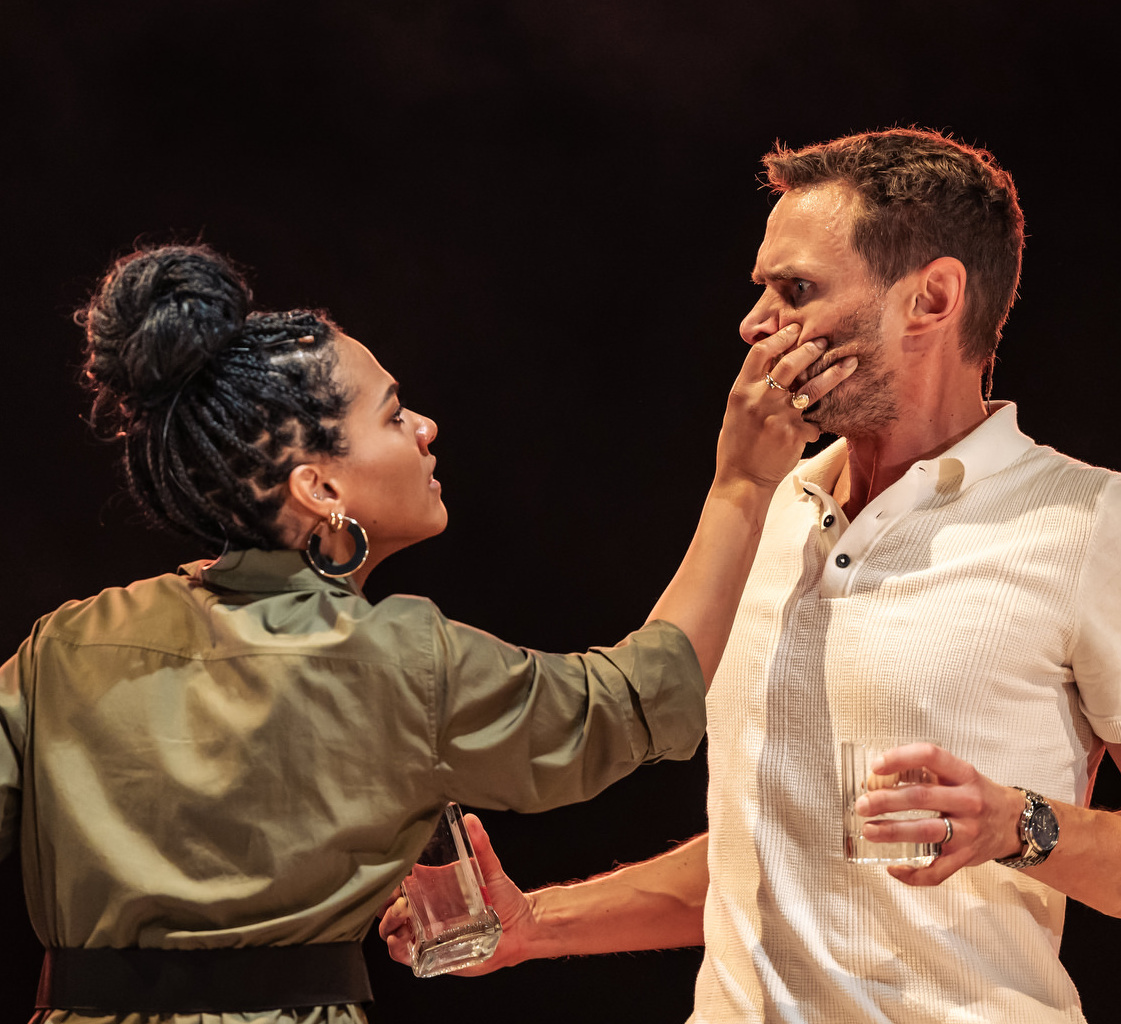 This level of humour suits the cast well, as does the slapstick when Annette is suddenly sick all over her hosts’ coffee table, with its stack of valuable art books, or when she finally snaps and throws Alan’s two phones into vases of flowers: a nice realistic touch, the two phones.
What is less convincing is the verbal savagery the characters descend into as they probe each other’s weak points, form temporary alliances (such as the women uniting in opposition to Michael’s hamster ejection) and reveal what they really think about the world, themselves and each other. The tone here is consistently broad and loud, nuance has been abandoned. When Alan is finally reduced to unleashing his unreconstructed male chauvinism, calling women creatures who should shut up and stay home, the savagery feels designed for comedic effect, but there isn’t any real danger in it.
The shape of the play has remained as usual – the inflating to bursting point of the characters' baser instincts, followed by their drunken collapse and an attempt at regrouping. But although it’s still entertaining, this version doesn’t feel nearly shocking enough. These people have taken the filter that usually keeps anti-social emotions in check and ripped it away, revealing the god of carnage – chaos – underneath, but the resolution of events feels more like a farce where all the characters have gone back behind the right doors.