"I’m not a number, I’m not a grade, and I’m not a failure." The 17-year-old girl stands in front of the small class, who gaze at her goggle-eyed. "A robot factory. That’s all you’ve got here." The teacher’s response is caustically admiring. "Why are you here, Alisha, if that’s what you’re capable of? Why didn’t you do that last year?" This is the school - not so much of hard knocks as of tough skins – for those who have been treated badly by the world, and have a strong suspicion that things won’t get much better. Richard Molloy’s Every Day I Make Greatness Happen in Hampstead Theatre's downstairs studio takes us into a class where three teenagers – Iman, Kareem and Alisha - are resitting their GCSE English in six weeks' time. "That is a mountain, people," declares Miss Murphy witheringly at the start. "You need to start climbing."
The formula of a teacher helping recalcitrant teenage charges explore their potential has proved a potent dramatic format in everything from The Prime of Miss Jean Brodie to The History Boys. Richard Molloy’s often laugh-out-loud funny drama, however, is not a tale of inspiration so much as a thinly veiled attack on a system where even the teachers are in despair about making something of their lives.
 This may sound depressing, but there is a live-wire immediacy to the production throughout, from the moment Josh Zaré’s hilariously introverted Iman shambles onto the stage, shoulders hunched, hips jolting – a startled ostrich in slow motion. This masterclass in teenage self-consciousness is quickly upstaged by Moe Bar-El’s strutting Kareem (main picture), who bursts into the classroom stoked with illusory self-confidence, an alpha-male who swiftly asserts himself by taunting Iman about the sexual prowess of his mother.
The authenticity of the performances in Alice Hamilton’s acerbic production plays a huge part in the evening’s success – the recognising gasps, whoops and giggles from the teens in the audience on press night showed the actors hitting their mark. The arrival of Sofia Barclay’s streetwise, rebellious Alisha sets up a high-octane love-triangle between her, Iman, and Kareem which is never less than gripping. At one point, when one of her admirers commits an act of terrible sabotage on the other, a teen could clearly be heard whispering in delighted horror, "he’s a bitch!"
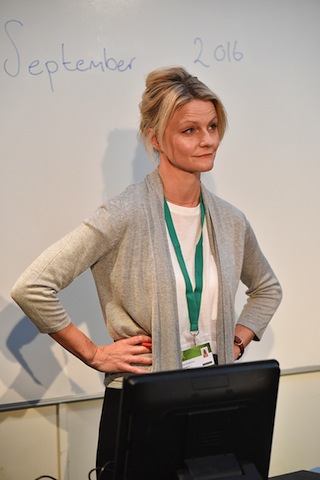
Susan Stanley’s world-weary, sharp-tongued Miss Murphy (Pictured above right) is every bit as provocatively entertaining as the rest of the cast, with her fondness for the f-word and occasionally unorthodox methods of enforcing discipline. But – and there is a but – despite the intelligence and sparkiness of the evening, overall it doesn’t entirely convince. What we have here is something that feels like an early draft of what could be a very good drama. Clues are dropped throughout that each character has a hinterland, but Molloy never quite succeeds in fusing that with the dynamic interplay of what we see in the classroom.
There is also the sense that he could have gone further in what is partly a political attack on the current state of the education system. Molloy, a teacher himself, clearly knows his stuff. Yet at a time when we are seeing headlines almost weekly about everything from the mental health crisis in schools due to exam and curriculum changes, to debilitating teacher shortages, this seems merely to graze the surface.
It’s of course difficult to balance lively authentic dialogue with an exploration of "issues", and the production should be commended for the energy with which it whips along. Stanley’s Miss Murphy deserves particular praise for the way in which she simultaneously conveys exasperated humour and exhaustion, taut as a rubber band that will snap if it’s pulled in slightly the wrong direction. Her character is hindered by the fact that she rarely appears to follow through on the fairly obvious emotional clues her pupils are dropping as to why they might have failed their GCSEs the year before. The idea, for instance, that she would be completely unaware that one pupil’s father had killed himself – in a class of three – stretches credibility.
It’s frustrating to give Every Day I Make Greatness Happen essentially a "could do better" review, since it does what it does so incredibly well. The actors – not least Zaré - clearly have great futures ahead of them, and the demanding teen audience never seemed in any doubt that they were having a good time. Molloy needs to be encouraged to follow his convictions even further. We are at a critical point in terms of the education debate, and this isn’t (yet?) a drama that satisfyingly tackles the important questions that raises.
- Every Day I Make Greatness Happen runs at Hampstead Theatre Downstairs till 20 Ocober 2018
- More theatre reviews on theartsdesk
@Hallibee1