Duchess of Malfi, King's Head Theatre

Bodies pile up, stock markets crash - it can only be Webster in the 1980s

share this article

Duchess of Malfi, King's Head Theatre
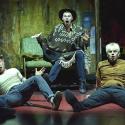
Have Your Cake Theatre has a mission to 'demonstrate that the big themes have never gone away', and an Eighties stab at John Webster's Duchess of Malfi (if you'll pardon the pun) is their opening salvo.

The plot certainly has immortal, immoral themes: incestuous jealousy, royal connivings, a bought conscience. And setting the show in 1981, the year of that ill-starred Charles and Di match, is bound to stir up its own memories, although I'm guessing Prince Andrew never had the designs on Charles that Ferdinand has for this widowed sister.

It is the horrific intensity of this one plot - brother loves sister, sister loves servant, brother has absolutely everyone killed - playing out in one grim arc (rather than an atomised, many-legged plot) which makes the play so compelling. We see a spiral of debasement in which conscience is spelled C-A-S-H.

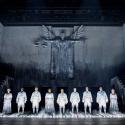
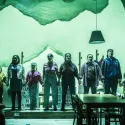
Director Imogen Russell Williams (full disclosure: we were at university together) applies some very interesting ideas to this scenario, most notably in the least noticeable place. The two mute staff who effect purposefully prolonged scene changes and function as spies, doctors and murderers within the play are the silent functionaries of the state, carrying out the Prince's wishes without compunction. Russell Williams is warning us against the complicity which kills. At least the hired hand, Bosola (naturally - as a criminal - he's Scottish), eventually comes to question his actions - these factota do not.

The text of the play, adapted for the modern ear by Bryony Markwick, really lifts off during Bosola's soliloquies, where she provides him with a poetry of her own. Elsewhere, the paparazzi and greed-is-good mentality filter through into questions of earning and worth, which Russell Williams bring out in flashbulbs and radio extracts.

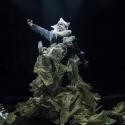
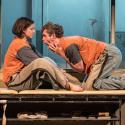
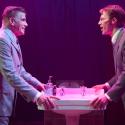
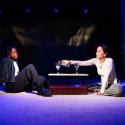
Damian Christian-Howard as the beloved and twice-dispatched servant Anthony was an eager inamorato last night, while Katherine Gwen Pons as the Duchess made you feel her pain - and there is a lot of it. Tim Macavoy as Prince Ferdinand (hiss!) was quite extraordinary as he hid behind screens and turned into a wolf in his grief.

King's Head Theatre, Islington, until Sunday
Add comment

The content of this field is kept private and will not be shown publicly.
Name that you would like to appear as the author of the comment

rating

0

explore topics

share this article

Help secure the future of arts journalism

In this era of algorithmic recommendation, opaquely sponsored content and AI slop, theartsdesk’s mission to preserve real journalistic and critical values has never been more important.

If you like what you see here, please join us 
in this mission.

Subscribing to the site will help us in our coming 
redesign and expansion.


If you do this before the 31st August this will be at our guaranteed founder’s rate: 
your subs will never increase again.

Subscribe now for £5 per month. 
or yearly for just £40.

Or if you simply want to support us with a one-off donation, you can do so here.

more theatre

New play about love and loneliness in London has terrific gender and genre fluidity
Not everything works but, with this unbreakable musical, it doesn't need to
Simon Stone's latest reversioning of a classic is a muddled misfire
Lots of innovative ideas, but we need to hear the line readings clearly
Eurovision star Sam Ryder is made for the title role, while Drew McOnie’s choreography makes us feel the delirium
Chloë Moss’s new drama is a nerve-fraying example of telephonic tension
Carrie Cracknell’s splendid revival of Stoppard’s masterwork transfers with its magic intact
Transatlantic tensions are diffused through alcohol, sex, and the etiquette of hot dogs
New play about domestic abuse adopts a radical form that works - up to a point
Adrian Lester’s spiky, swaggering hero is the apex predator in this linguistic ecosystem
American playwright Rajiv Joseph’s account of Serbian political assassins really rocks