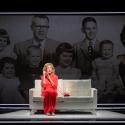
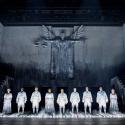
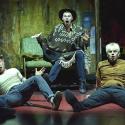
Robert Icke is an expert in corporate tragedy. I don’t mean that in a bad way - just that he has a penchant for taking classics (Hamlet, The Oresteia, Mary Stuart) and transporting them, with the help of designer Hildegard Bechtler, to the frosted-glass doors and pale wood of the boardroom. The Doctor, his 2019 swan song at the Almeida Theatre now transferred to the Duke of York’s Theatre, is an adaptation of a 1912 play by Austrian writer Arthur Schnitzler. It’s a sharp-tongued vivisection of identity politics, anchored by an astonishing lead performance from Juliet Stevenson.
Like all good tragic heroes, Ruth Wolff (Stevenson, pictured below) is first seen at the height of her powers. She’s the director of an institute trying to find a cure for dementia; they’re about to open a new building, years in the making. She can see what her (male) colleagues can’t, reading a person instantly with what another doctor refers to as her “Jedi powers”. “I am crystal-clear,” she says, her voice cutting through the noise around her to deliver the objective truth. Or, at least, her version of it.
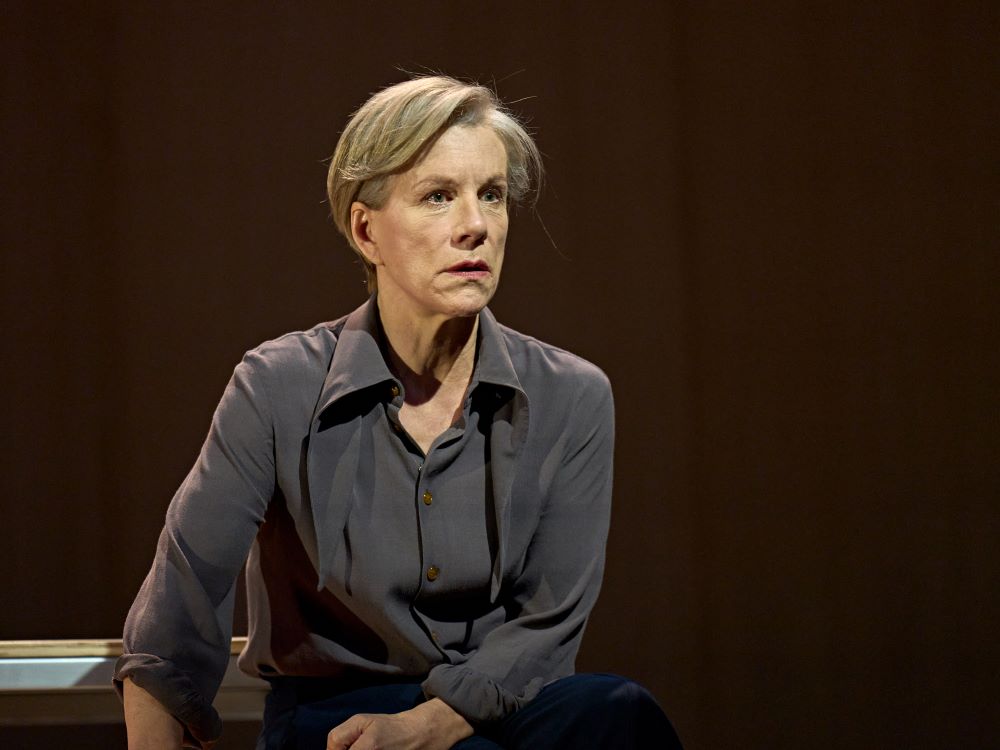 The inciting incident is remarkably similar to Schnitzler’s original. A Jewish doctor refuses a Catholic priest access to a teenager who has had a botched abortion. Ruth thinks the priest’s presence will alert the girl to her imminent death, and bars the door. But the argument escalates, and the girl dies panicking. The key differences are that Ruth is a woman, and Jewish by background, not by religion. Icke’s version of the priest, though played by a white actor (John Mackay), is Black. As the hospital’s head of PR (Mariah Louca) notes, the “optics” aren’t good.
Despite the urging of her bullish deputy (Naomi Wirthner), Ruth refuses to apologise. Within a day, the situation spirals out of control. Ruth’s colleagues split into warring factions. Her car is vandalised. All the while, she insists that she has done nothing wrong. She is a doctor – she had a duty to her patient. Even as Ruth’s power wanes, Stevenson commands the stage, an actor at the top of her game. Her Ruth is at once achingly brittle and totally unbreakable.
Icke and revival director Anthony Almeida stress Ruth’s experience of constant surveillance. In a TV interview, she is seated with her back to us, a live camera feed zoomed in on her face as she answers questions from a panel of experts in various fields. It’s like we’re being interrogated along with her. At one point, Stevenson sprints around Bechtler’s semicircle of smooth nondescript wood like it’s an arena or a cage, desperate to escape the millions of eyes watching her.
Which is easier for her than for some, of course. One of the panellists, a researcher into unconscious bias (Sabrina Wu, making an excellent stage debut), points out that Ruth has the freedom to reject the boxes that society wants to put her in – unlike people of colour, or poor people. This is a good point, but it comes a bit late in Icke’s reasoning. The writing is liable to get tangled up in its own conflicting arguments, especially towards the end of the first half, when the action seems to writhe out of even the two directors’ control. 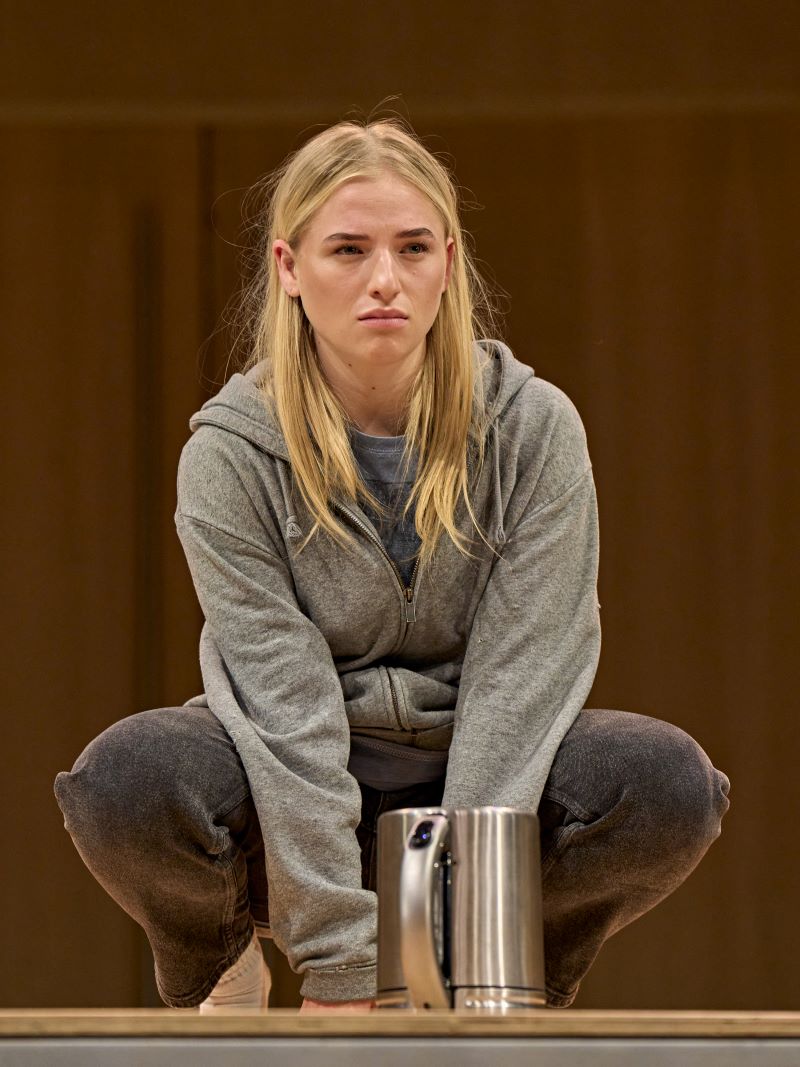 The scenes at Ruth’s house offer a welcome respite from the endless medical and philosophical jargon that get thrown around in the debate over her actions. She confesses her doubts to her partner Charlie (Juliet Garricks), and to Sami (Matilda Tucker, pictured right), a local teenager who comes by to do her homework. It’s revealed late-on that Sami is transgender, which is a bit out of left field. The decision to cast actors from ethnic backgrounds different from their characters can make it feel like Icke is constantly trying to pull the rug out from under us. But maybe that’s the point – we don’t know Sami very well, so why should we be allowed to know a significant fact about her from her first line?
The play’s title allows Ruth what she wants: to be seen as only her profession, her qualifications, the trust that her patients place in her to help them. But she mentions to Charlie that she wishes she could tell her colleagues about their relationship. She doesn’t seem afraid of a homophobic backlash – only of opening up, of mixing the human with the doctor. The problem is that doctors are human, and their decisions are always affected by who they are. Just like everybody else.