Ben Butley is poisonous, spiteful, a bully, a sadist and a snob. So how does Simon Gray, who created his titular anti-hero in 1971, ensure that an audience can endure his company? He equips him with the kind of lacerating verbal dexterity that makes you catch your breath, appalled and a little awed all at once. And in Lindsay Posner’s fine revival, this nasty, sad, desperate piece of work who, as a lecturer in a London university English department, gets plenty of opportunity to inflict his wit on the soft young sensibilities of eager undergraduates, is played with bilious aplomb by Dominic West. You dislike him, often violently; but you can’t tear your eyes away from him.
West’s Butley arrives on Peter McKintosh’s dingy, book-crammed office set to begin what will be an unusually hellish day. His wife Anne has recently left him, taking with her their baby daughter. He’s raddled, boozy and bad-tempered. He sends students who come tapping at the door in the hope of a tutorial unceremoniously packing; and, on the arrival of Joseph – once Butley’s student and protégé, now an aspirant assistant lecturer – he gets stuck into the one thing that amuses him and offers temporary distraction from his own misery: baiting, belittling and tormenting everyone around him.
'He is an emotional infant, yet, great though is his terror of being alone, he is incapable of intimacy'
TS Eliot is often referenced as, in sly allusion to the classical structure of Gray’s drama, is Aristotle. But Butley himself is equally absorbed by Beatrix Potter and the doggerel of nursery rhyme, of which he delivers numerous nuggets in supercilious and patronising tones. He is an emotional infant, as dependent on others as is his own little child; yet, great though his terror is of being alone, he is incapable of genuine intimacy. Anne having departed, he has moved Joseph, his former flatmate, back into what was the marital home. Joseph is gay, and is involved with a northern publisher; whether his connection with Butley is, or ever has been, other than platonic is unclear, but what’s unmistakable is Butley’s ferocious jealousy of Joseph’s new relationship. His consumption of others could be termed vampiric, except that he’d spit out in revulsion the blood he’d just sucked from his victims. And the bitter taste grows stronger and more repugnant with the news that not only is Anne to remarry – to a man Butley considers the dullest in London, but nevertheless relies on for occasional society – but a female colleague, Edna, for whom he has little more than contempt, is about to become a published author. His disgust with it all, and indeed with his entire life, pours forth in a torrent of exquisitely phrased, shudder-inducingly savage abuse.
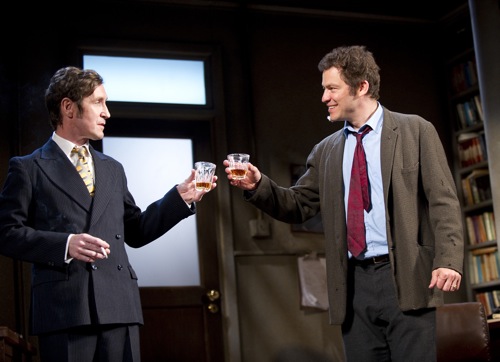 West is an impressive presence, diabolically gleeful, rueful and helplessly enraged by turns, his glowering expression breaking frequently into a lupine grin. He’s well matched by Martin Hutson as Joseph, who, harried though he is, holds far more of the cards in their vicious game than it at first appears. And the single scene in which Butley confronts Reg, Joseph’s partner played with cool, menacing stillness by Paul McGann (pictured above, with West), is utterly riveting.
Elsewhere the writing is less effective, with underwritten students flitting through and Amanda Drew struggling to make much of the character of Anne, endowed with little more in the way of personality than a terse, waspish weariness. Penny Downie as Edna hasn’t much more to work with, though she does convey a rather romantic love of learning and literature and a sense of dreams of passion long since set aside. And for all its acerbic skill, the play seems slight. Still, it’s a glittering demonstration of the way in which intellectual brilliance can co-exist with emotional inarticulacy, and if all that glitters isn’t gold, it’s hard to resist so much dark sparkle.
 Book tickets for