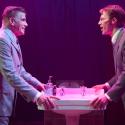
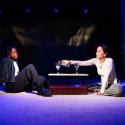
The title refers to a line in Henry VI, Part III: the future Richard III boasts that midwives cried, "Oh Jesus bless us, he is born with teeth", a sign of both his monstrosity and his readiness to snarl and bite.
Modern technological analysis suggests that the three Henry VI plays might well have been written by Shakespeare in collaboration with Marlowe, an idea which started American playwright Liz Duffy Adams on an imaginary journey into their possible relationship, set against the dangerous world of Elizabethan politics. "Born with teeth" is both a phrase the collaborators might have enjoyed creating and an indication of Marlowe's desire to gobble up everything that life has to offer.
The resulting compact two-hander begins with a scene of torture as both men dangle on ropes from the rafters. Shakespeare steps forward to assure us that that didn't happen – but that it might have. This is a police state; there are spies everywhere and being a poet can be dangerous, exposing. When the two meet to begin writing, they agree they will not let imagination be constrained by "sources"; this is no history lesson. Ms Adams has made her position clear: her piece too is fiction. And despite the sinister backdrop, it is mostly fun.
 The play proper opens in 1591. Both men are 27 years old, both writing for the stage. Shakespeare is also an actor, married and with a family in Stratford, while Marlowe, a Cambridge graduate, has been enticed into the lucrative world of espionage on behalf of the Crown and has travelled to the Netherlands and France seeking out Catholic sympathisers. Marlowe is the more famous, the more glamorous of the two, a subversive and a celebrity whose over-reaching heroes – Tamburlaine and Faustus – are often taken to be versions of their creator. Shakespeare has barely begun his writing career, although – according to this script – he has already completed Titus Andronicus, The Comedy of Errors and The Taming of the Shrew.
While Marlowe continues to play a dangerous game over the next two years, using influential friends, including Robert Cecil, and being used by them, Shakespeare is more judicious. He survives to write over 30 more plays. Marlowe is dead at 29.
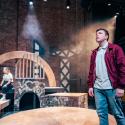
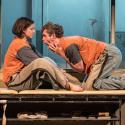
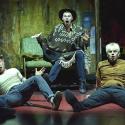
Adams enjoys playing with the known and unknown and, under Daniel Evans' spirited direction, Ncuti Gatwa as Marlowe and Edward Bluemel as Shakespeare grab every opportunity to explore their versions of these fascinating, contradictory characters. Gatwa (Sex Education, Dr Who and the National's cross-dressing Algernon in The Importance of Being Earnest, pictured below) is perfect casting for the swaggering, confident, outrageous and uncompromising Marlowe. As Shakespeare Bluemel (also Sex Education, The Lady Jane and A Discovery of Witches, pictured above) is a fitting contrast, but much more than a foil, less experienced in the ways of the world, admiring of Marlowe's brilliance and fame, more cautious but just as clever. As they work, Marlowe's secret life seeps into his creative one: is Shakespeare a covert Catholic? Might he be recruited to Marlowe's secret business?
They rib each other, wrestle (with words and bodies), joke and flirt. Mutual attraction, sexiness, underlies every aspect of their relationship. This may well have been the case. Marlowe was quoted as saying that anyone who did not love tobacco and boys was a fool. Shakespeare addressed sonnets to a young man and the queerness in his work has been convincingly analysed by Will Tosh in his prize-winning book Straight Acting.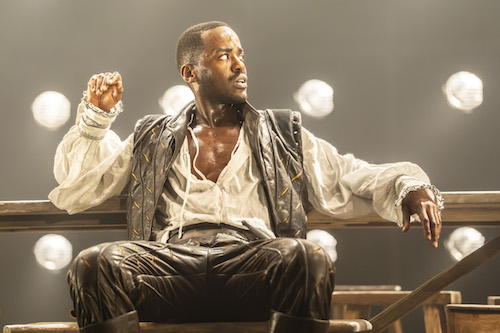 The final scene, set on the day of Marlowe's violent death and unexpectedly involving Shakespeare, is the most difficult to fit into known facts, but then there is little that we can be sure of. That Marlowe would want to work with Shakespeare to expose him as a Catholic in the first place seems unlikely but, on the other hand, we don't know why the star was apparently willing to collaborate with the beginner.
Adams has said that the Belarus Free Theatre's Burning Doors was as much an inspiration as the more obvious story. She is interested in the cause of – and often barriers to – artistic freedom now as well as in Elizabethan England. This is echoed in designer Joanna Scotcher's set, the stage surrounded by banks of lights that might suggest interrogation as well as theatricality, and her costumes combining punk materials with Tudor shapes. This Royal Shakespeare Company premiere in the West End (in collaboration with Playful Productions and Elizabeth Williams), is the first for some time. It links the "in-house" playwright with contemporary concerns while being entirely theatrical fantasy.