Boy meets girl; girl and boy fall in love; boy loses girl. In true bohemian fashion, La bohème can lay its operatic head anywhere from Paris to Peshawar, in any era from 90s punk to the Belle Epoque, and still make sense. What matters are the emotions; do we believe in the relationship between Rodolfo and Mimi, the camaraderie between Rodolfo and his friends? Stephen Barlow’s new production for Opera Holland Park may relocate the action rather unexpectedly, but what emerges both fresh and familiar is a love story between two people who couldn’t care less what city or what age they find themselves in – they only see each other.
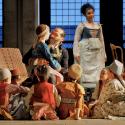
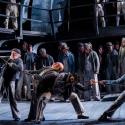
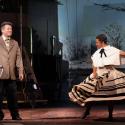
Bucking a trend for contemporary bohèmes, Barlow instead looks back in time for his setting, alighting on the 16th century. If it’s a shock to see farthingales instead of flares, a tavern in place of the Café Momus, then it’s one that quickly subsides, and a context that makes sense of so many of the opera’s smaller details – that business with the candles, the hand-to-mouth artistic existence, the lack of medical intervention.
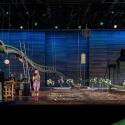
 But setting aside, Barlow plays things very straight indeed. This is a production that puts opera before director, as solidly handsome as Andrew D Edwards’s sets, and infinitely revivable (are you listening, ENO?). If it lacks that indefinable alchemical something that transforms excellent into outstanding then it’s a small lack, especially given the vocal quality on show.
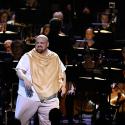
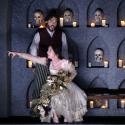
Because it’s really all about the voices here. Soprano Anna Patalong makes a delicious Mimì. There are no sharp edges on a voice that pours itself generously into every phrase, and a lovely darkness to the tone colouring that suit her unusually sober, serious heroine. There’s little of the glibly flirtatious in her interactions with Shaun Dixon’s Rodolfo (pictured above with Patalong), and the candle scene is all innocence, rather than a knowing seduction routine. Dixon too, though temporally wayward, occasionally surging forwards or pulling back without warning, has proper Italianate vocal swagger and no little brilliance. Just occasionally a little pushed, and taking some time to settle initially, his is a voice that still feels under construction, but what a thing it’s going to be when complete.
Barlow’s light-touch direction could do with being a little more interventionist with the young bohemians. Their horseplay is so decorous as to be barely believable, and we miss the comedy of the Benoit episode (though David Wolozko makes much of the physical comedy of his character). Coupled with some smaller voices (Frederick Long’s Schaunard especially) the whole feels a little under-projected, both dramatically and vocally. The pay-off is the final scene, where sudden tenderness and restraint feels less jarring than it would against a more rambunctious opening.
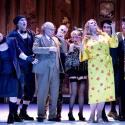
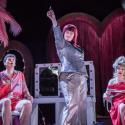
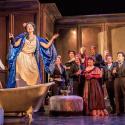
 Apart from some 16th-century style “special effects” (I shan’t spoil the surprise), the opera’s comedy is largely relocated to Elin Pritchard’s larger-than-life Musetta and her relationship with Marcello (beautifully sung by Andrew Finden). Theatricality meets stolid good nature here, and it’s a dynamic that makes a marvel of the Momus episode, crowned with an extrovert “Quando m’en vo”, and helps soften the latter sparring.
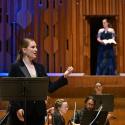
Matthew Waldren conducts an account that’s brisk rather than indulgent, occasionally weighting the orchestra a little too heavily in the balance with the stage. On opening night there was some instrumental scrappiness, which doubtless will settle as the run progresses. The OHP Chorus sing superbly for him – further proof that this year’s line-up is an exceptionally strong one.
This bohème is definitely the crowd-pleaser it was designed to be – a necessary piece of romantic consolation after the bitterness and brutality of Iris. The latter production will stay longer in the memory, but it’s the former that will stay in repertoire.