

Liberated from Pushkin’s salons, ballrooms and bedrooms, Barrie Kosky’s Eugene Onegin bursts out into nature. Tatyana and Olga lounge in the long grass stealing heavy fingerfuls of jam straight from the jar; party-guests run through the trees with flaming torches, dancing wildly, barefoot; after the harvest groups gather on the lawn with picnics and games. This is a world apart, the hot, hazy, endless summer of first love – an intense, but unreliable memory.
First seen at Berlin’s Komische Oper in 2016, and later at the Edinburgh Festival, this turn-of-the-century Onegin with its echoes of DH Lawrence and Hartley, is Tatyana’s story. There’s a sense of unreality to this gilded world of Rebecca Ringst’s sets, tellingly lit by Franck Evin, and by the time we arrive at the Letter Scene we realise why.
As the spotlight closes round Tatyana, turf still under foot, we realise that we’re seeing a remembered snapshot of a moment – the imprint of emotions tangled up with place. That teenage encounter, the sudden boldness, the transgressive freedom, is forever rooted in the Larin garden. Act III briefly banishes the memory, covering the ground with formal rugs, enclosing the space. But even here grass spills over the edges, and it takes only a momentary encounter between Tatyana and Onegin for civilisation to fall away and return us once again to the garden and to that summer.
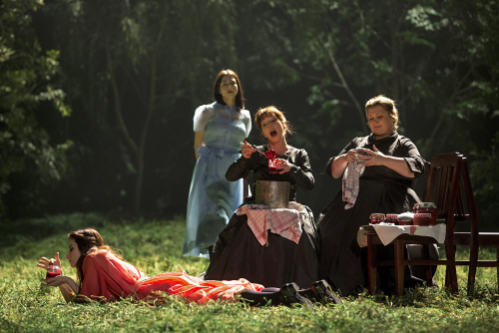 The strength of Kosky’s production is its emotional and atmospheric clarity. Tatyana’s humiliation during Triquet’s birthday serenade and her calm assurance during Gremin’s aria; the sensuality of the opening jam-making scene with its metaphorically loaded jars, setting us up for the unexpected erotic charge of the final encounter between Tatyana and Onegin.
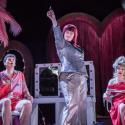
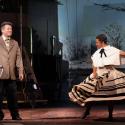
The arc is beautifully shaped by Asmik Grigorian (pictured above with Karolina Gumos, Christiane Oertel and Margarita Nekrasova). Rarely absent from the stage, the Lithuanian soprano (Female Singer of the Year at the 2019 International Opera Awards) finds Tatyana’s vulnerable, passionate awkwardness but also her dignity. The physical detail of the performance – hands twisting restlessly behind her back even while she’s rooted to the spot, an empty smile quickly smoothing over Onegin’s rudeness, even as her own hopes are shattered – offers a wonderful counterpoint to the dream-like, soft-focus atmosphere of all around. 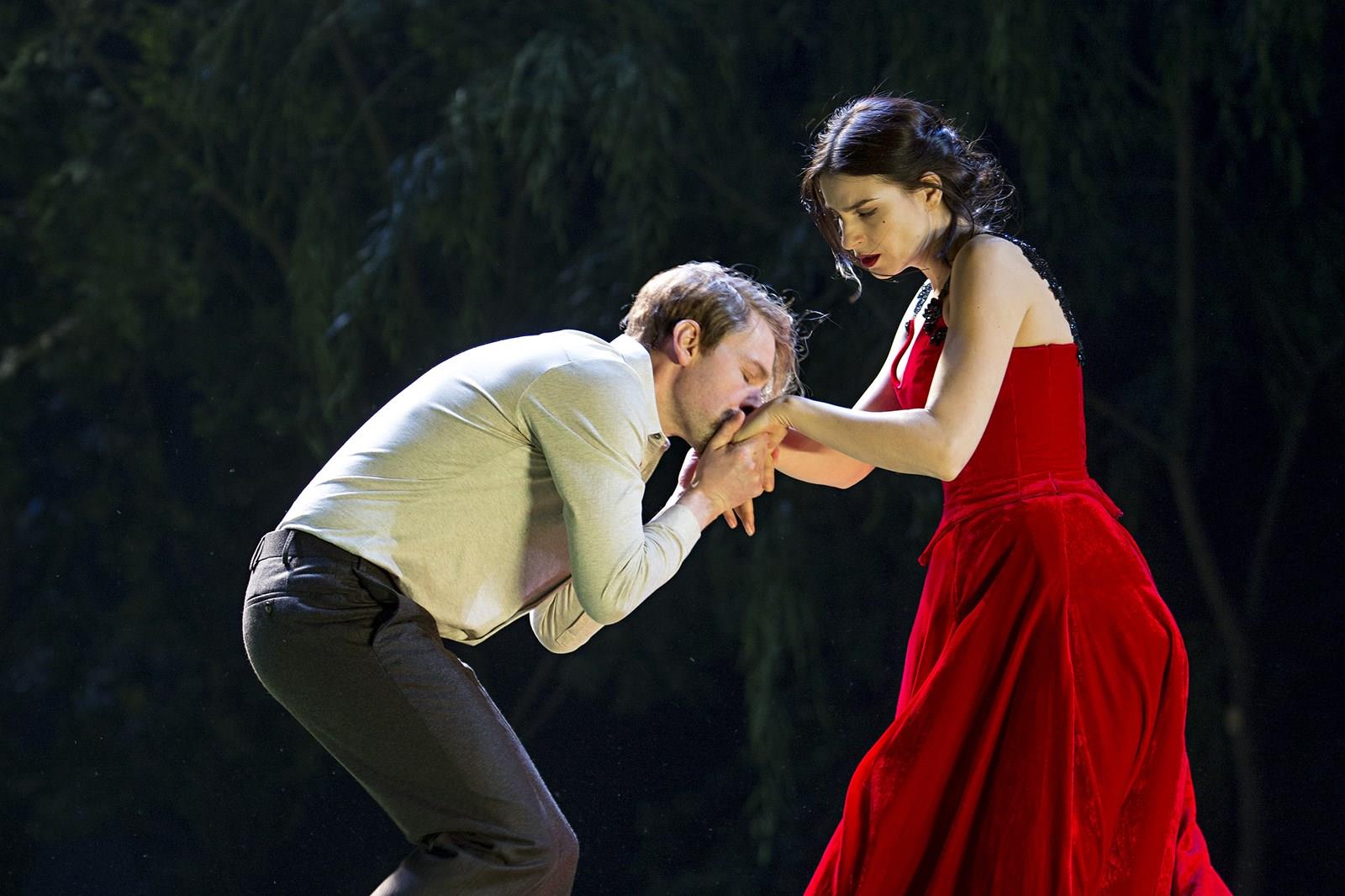 Kosky’s updated setting strips away any risk of kitsch. There are no smiling gaggles of peasants (no peasants at all, in fact), the flattened-out hierarchy exposing Onegin’s snobbery in even greater relief. Young and raffishly handsome, Gunter Papendell (pictured above with Grigorian) breezes in with easy charm, unaware of the damage he is doing, but enjoying his power. His taut baritone is a good match for Aleš Briscein’s small, vibrant tenor, swelling into greater weight in his Act II aria. Both, however, are foils to Grigorian’s molasses-dark soprano, round, even and glowing right to the top of the voice – richest in duet with Karolina Gumos’s generous-toned Olga.
This isn’t a perfect performance musically. Chorus and pit part ways a few times under conductor Henrik Nánási, and the cellos have one rather unfortunate moment, but the thrust of the thing is undeniable. It’s Kosky who drives this, attentive to every emotional current through the score, but it’s Grigorian – a Tatyana of dreams – who carries it home.
Watch the Komische Oper's Eugene Onegin on OperaVision (here via YouTube)


Add comment