

A proper production of Così fan tutte should make you feel as if the script for a barrel-scraping Carry On film has been hi-jacked by Shakespeare and Chekhov – working as a team. The story is so silly (even nasty), the music so sublime. When, in Oliver Platt’s production for Opera Holland Park, Eleanor Dennis’s Fiordiligi jumps on the furniture to proclaim her devotion to her absent betrothed as a visiting “Albanian” tries to woo her, we stand, as usual, just a hair’s breadth away from utter farce. Then she sings “Come scoglio”, a hymn to steadfastness and constancy that soars above its knockabout setting like a star above a swamp.
On holiday in Naples, the sisters from Ferrara, Fiordiligi and Dorabella, have bid farewell to their fiancés Guglielmo and Ferrando after the sleazy old schemer Don Alfonso has arranged for the pair of pranksters to return in disguise as exotic “Albanians” in order to test the ladies’ virtue. Alfonso’s farewell trio with the two sopranos triggers a low-down intrigue that lurches between pantomime, absurdity and (for many critics, from the 19th century on) outright misogyny. Così Fan Tutte – dames, they’re all the same, ready despite all their virtue-signalling to jump into the arms and beds of the first (turbaned and mustachioed) stud to roll along. Yet that trio, "Soave sia il vento", will surely usher the souls of the blessed into whatever paradise may await us. The plot, and Da Ponte’s libretto, weaves a tissue of lies, stunts and frauds. Mozart, impossibly, makes these ditzes, jocks and stirrers sing it all into absolute truth.
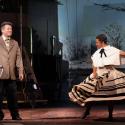
With its rococo decorations, sun-dappled, flower-strewn garden rooms and warm summer shades, Oliver Platt’s production has a relaxed, even old-fashioned ambience. That initially hints at a genial, irony-free perspective on opera’s ultimate problem comedy. The action sometimes contracts to the suspicion-filled white room where Alfonso’s ruse plays out, sometimes expands to occupy the whole vast width of the Holland Park stage. The robust ranks of the Opera Holland Park chorus supply the colourful (and tuneful) Neapolitan street life. In Alyson Cummins’s design, this picturesque loveliness sets a sort of trap. There are serpents gliding through this Mediterranean garden. 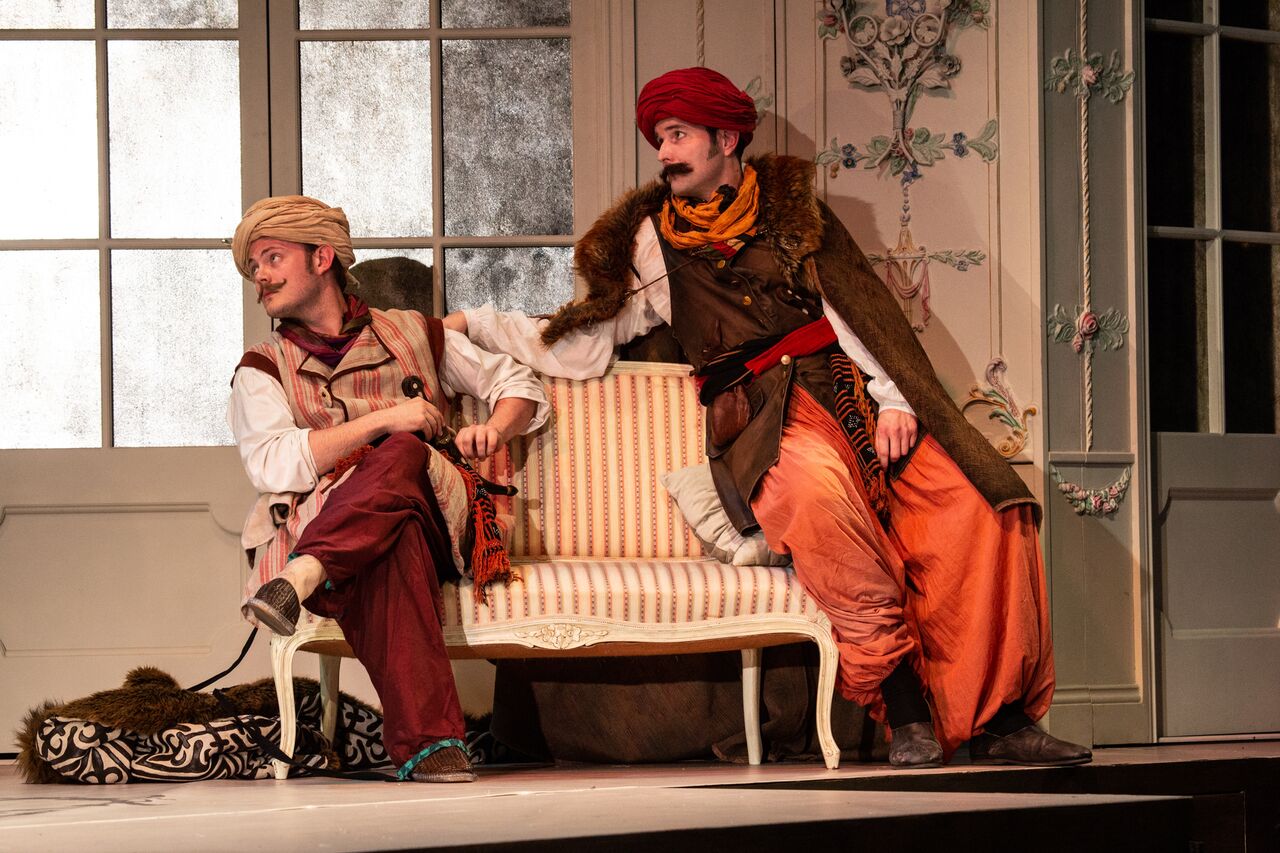 As the “Albanians”, Nicholas Lester as Guglielmo and Nick Pritchard as Ferrando (pictured above by Ali Wright) swagger around in the traditional “oriental” fancy dress. The sisters – Eleanor Dennis’s Fiordiligi, Kitty Whately’s Dorabella – flounce and purr as Georgian belles who could have stepped from a Gainsborough frame. At first, the bitter, mirthless Cosìs of some recent directors feel a long sea voyage away. Uniformly strong, a young cast balances larks with grace as the ever-changing score demands. Dennis brings a fine dramatic presence to her shattering soliloquy "Per pietà". The honey-voiced Pritchard commands some show-stealing moments in Act II – not least in the duet with Fiordiligi, "Fra gli amplessi", as the lads’s game of “get off with your mate’s girlfriend” deepens into music of exquisite, excruciating ambiguity.
Kitty Whately’s Dorabella finds rich hues of perplexity and darkness in the (supposedly) flightier sister’s role. As Despina, the megalomaniac maidservant who conspires with Alfonso, Sarah Tynan (pictured below by Robert Workman with Peter Coleman-Wright) has an agility and assurance – especially when in disguise as doctor and lawyer – that reveal the character’s sinister as well as charming side. Mordant, even rasping, Peter Coleman-Wright’s Alfonso rightly sounds more cynical roué than Enlightenment-era “philosopher”. So much of Così rests on the nuanced symmetries and reflections of the score, as duets, trios and even sestets match, augment or sometimes cancel out each other. For all its comeliness, Platt’s staging made that implacable internal logic – the critic Edward Said even speaks of Mozart’s “cold mastery” – clearly visible. 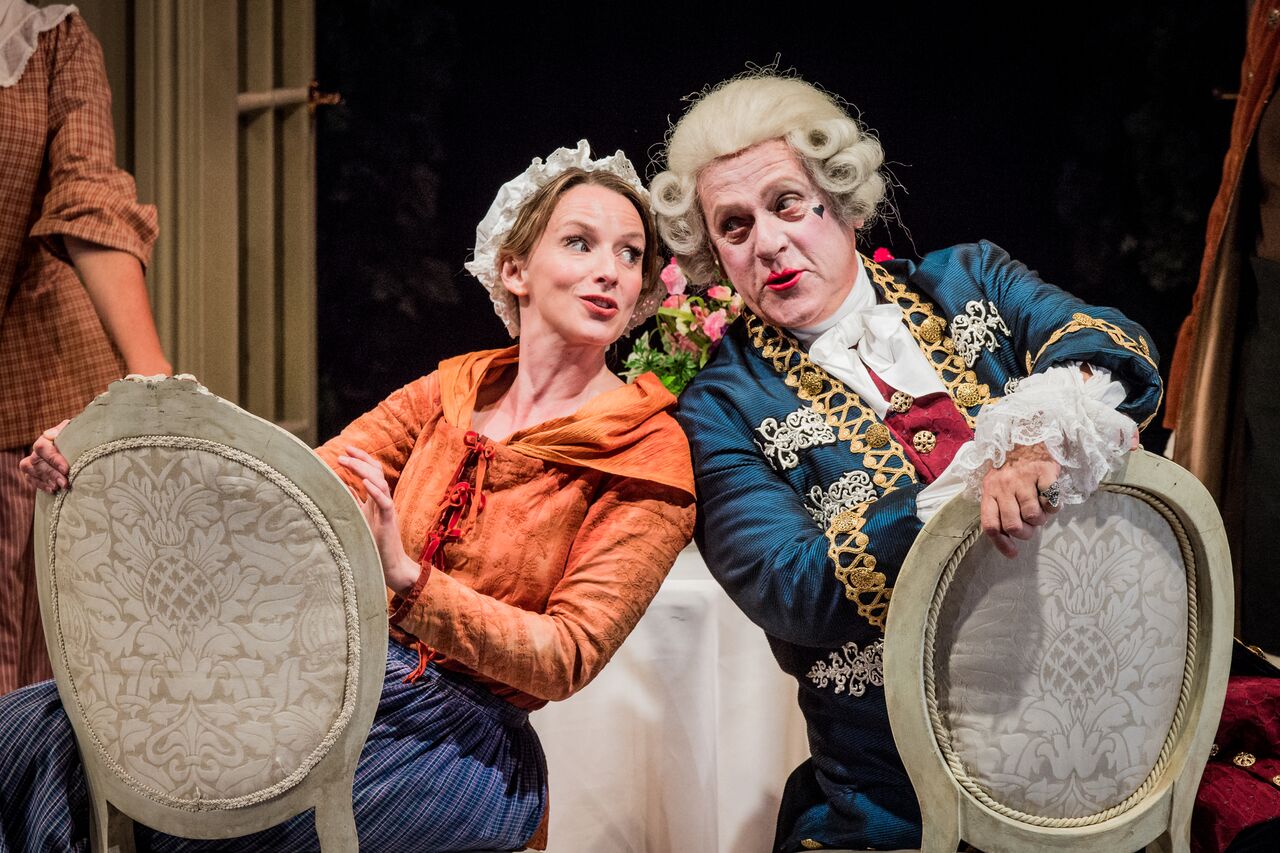 Step by step, trick by trick, the tone darkens, both emotionally and (as night falls over Holland Park and candles illuminate the boudoirs and gardens of Naples) physically as well. Virtually no staging today can ever swallow whole the fanciful finale of Così, with the duped girls meekly accepting their fate as guinea-pigs for Alfonso’s abusive experiments. Platt duly tweaks the closing scene in ways that (for me) recalled the revisionist endings we now expect in Shakespeare’s The Taming of the Shrew.
Brisk and sharp, Dane Lam’s conducting steered the City of London Sinfonia away from the romantic yearning that can smother some performances. He grasps that Mozart layers this uniquely bittersweet sound-world – how does he do it? – with so much pathos, melancholy, anguish even, that it needs no bossy over-emphasis. On the surface, this Così rocks no boats and will win few plaudits for sheer originality. Yet, as the Holland Park peacocks added their own eerie embellishments and the evening’s promised thunder stayed away, it needed no gimmicks. The storms within the music had already struck with their heart-breaking, life-changing force.
Add comment