Lotte Lenya, Ute Lemper, Marianne Faithful, Teresa Stratas, Cathy Berberian, Dawn Upshaw, Brigitte Fassbaender, Louis Armstrong, Lou Reed, Tom Waits, Sting, Frank Sinatra, Nina Simone, Ella Fitzgerald. It would be difficult to imagine a more varied list of interpreters of just one composer’s work, but this is only a small selection of the artists who have performed and recorded Weill’s music.
But what is it about Weill’s work that is so universally appealing, and so adaptable, making as much sense sung by Tom Waits as it does by Ella Fitzgerald or Anne Sofie von Otter?
I’ve been drawn to Weill’s work since I first heard it at the age of about 15 (23 years ago), and I think this broad appeal stems from the deep humanity in his music. He writes about the human condition, the struggle to make sense of life, the sides of life that can’t make sense. Weill, a German Jew in the 1920s, spent much of his life searching for meaning, and for a place to belong. He was forced to flee his home and seek exile in Paris, face-to-face with big questions. Perhaps the fact that he wrote about society, and belonging, and love, so openly and beautifully is what draws so many to his music. It’s visceral, honest, and not always pretty. We can all relate to that.
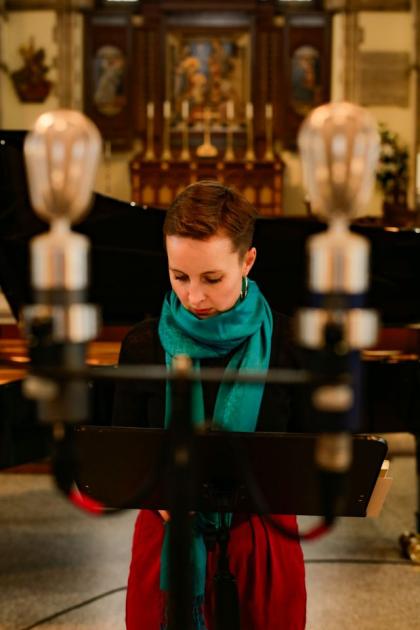
It’s more than that, of course. The sound world and musical style Weill creates transcends musical genre. It is neither musical theatre nor jazz nor classical nor art song, but somewhere in between, encompassing all of these genres. It straddles so many styles, and countries, giving it a universal appeal that will last the ages, and cleverly existing above the simple confinements of genre. Weill’s music refuses to be contained in a neatly packaged box, much like Weill himself. He forces us to see things in a much more nuanced way, cleverly conveying a wider message about how humans could exist more peacefully without the divisive measures we impose, which only serve to further aggravate tensions and deepen the self-created canyons between us.
And now onto those melodies… surely the key ingredient to a successful song. Weill had an astonishing gift for melodies, especially in his most wistful, dreamy songs. I’m thinking of "Youkali" in particular right now, which is the centrepiece for my entire album – that haunting, painfully beautiful melody set to an hypnotic tango. The chorus melody of "September Song" has always moved me in the deepest way, and then the seductive, sensual, dangerously chromatic and snake-like chorus melody of the Barbarasong. Weill certainly knew how to use a melody for maximum effect, and would almost invariably set the melody on top of something dry, repetitive, heartbeat-like. Surely these extraordinary melodies hold much of the appeal of Weill’s music. They get under your skin; at least they’ve certainly made their way under mine.
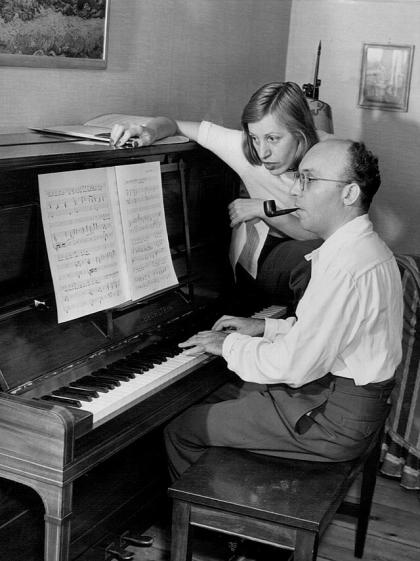
Weill’s adaptability continued to show itself when writing music for such a variety of singers, sometimes through choice, sometimes necessity (pictured right with Lotte Lenya, 1942). He showed us that his music was for a broad spectrum of people to perform and to consume, perhaps being one of the most inclusive composers we’ve ever known. The gritty, 60-cigarettes-a-day sound of Lotte Lenya is closely associated with Weill, of course, but he also wrote for some exceptionally beautiful, classically trained voices, including that of Lys Gauty when he was living in Paris. His muses were far more varied than one might expect.
I was a very keen jazz singer as a young woman, and it was from this angle that I first came to know Weill’s music. In later years, partly inspired by my wonderful mother, who used to sing Weill’s songs at home and in local concerts, I discovered the enormous variety of his output, and then explored some of his more classical songs. The exquisite "Je ne t’aime pas" and "Youkali" (both written for the aforementioned Gauty) have become pillars of my musical life, and they are songs to which I return again and again.
I wrote my university dissertation on Weill, as my love for his work grew ever stronger, and I began to see how much of a genius he really was, and how admirable a person he was for continuing to create art that kept him relevant, popular and ultimately, employed. In the face of extraordinary adversity and tragedy, Weill was the ultimate chameleon, musically and linguistically shape-shifting his way from Germany to France, and then onto America.
Katie Bray’s In Search of Youkali: Songs of Kurt Weill on Chandos will be launched at Fidelio Café on Friday 9 January 2026