

A leftfield, Tony-winning phenomenon on Broadway, Cole Escola’s comedy comes to London very much living up to the hype. This is a gloriously eccentric, rude, riotous marvel – laugh-out loud and daft as a brush.
While many regard the current White House as a mad house, Escola’s naughty revisionism goes back in time to debunk one of the country’s most genuinely revered presidents. But the chief focus of this breezy 80-minute play is the first lady, Mary Todd Lincoln.
History has been unkind to Mary, often highlighting her extravagant spending, dark moods and institutionalisation. Cole certainly launches into her personality all guns blazing – this Mary is very, very stupid and a roaring alcoholic, with grandiose delusions of being a cabaret star; and yet there’s pathos in her boredom, frustration and dreams; and, despite its frivolity, the play offers an increasingly sympathetic, and cunning case for Mary’s emancipation.
Taking the central role himself, in June this year Escola became the first non-binary actor to win a Tony Award (Sam Pinkleton winning for his direction). At the Trafalgar, fellow American and rising star Mason Alexander Park, also non-binary, takes over. And following their stand-out performances in Jamie Lloyd’s recent Shakespearean double, The Tempest (as Ariel) and Much Ado About Nothing, Park knocks Mary out of the park.
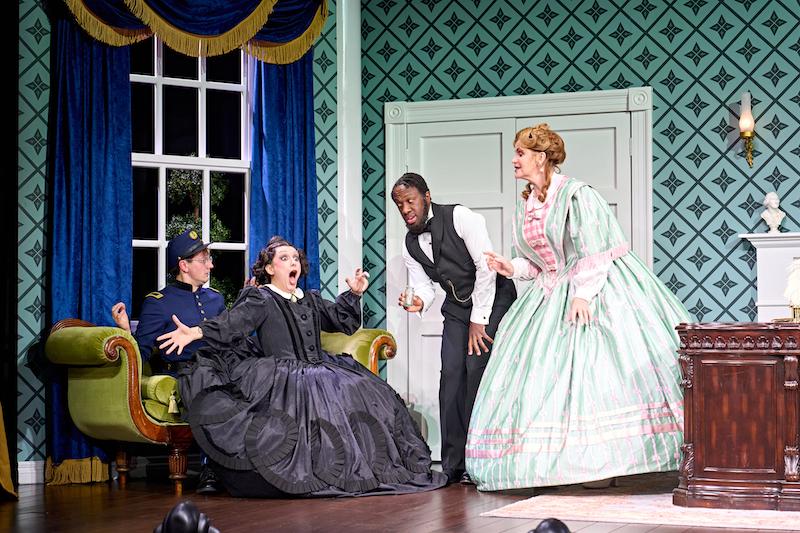
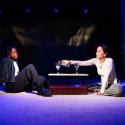
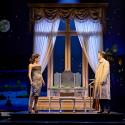
It opens with Lincoln (in the credits as “Mary’s husband” and played with relish by Giles Terera) in the first of many anxious crises. His young military assistant, Simon (Oliver Stockley, pictured above, left, with Park, Terera and Kate O'Donnell) assumes it’s because of the latest news from the Civil War. Not at all, groans the Pres, it’s his wife, who’s on a drunken rampage in search of booze. While he does his best to hide the bottle, Mary is tenacious in (literally) sniffing it out.
With her funereal black hoop-skirt gown, dark ringlets with a crazy bun on top, and tendency to snarl at anyone around her, there’s something fearsome, if not demonic in this first lady; at the same time, a camp showgirl is just bursting to express herself.
The marital disgust is mutual, as Mary questions why she ever married the “bastard pig”. The answer to that may be in her memory (perhaps not entirely accurate) that they fell in love at the cabaret. As her husband keeps her a virtual prisoner at home, afraid she may damage his reputation, Mary recalls her days as a “rather well-known, niche cabaret legend” and longs for a return to the stage and her “madcap melodies”.
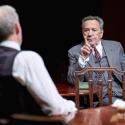
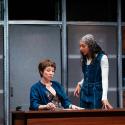
This Lincoln is far from an "Honest Abe". Not only is he lusting after his soldiers, particularly Simon, but he falsely convinces Mary that he’s planning a serious career for her in the more legitimate theatre, even hiring an acting coach (Dino Fetscher, pictured below, with Park) to prepare her. The teacher’s identity and his eventual role in Mary’s future are just two of the many brilliant surprises in store.
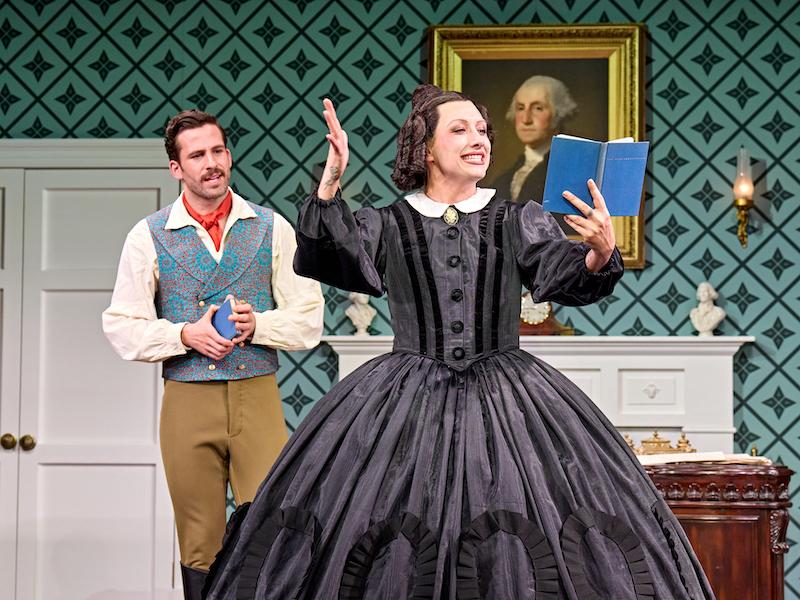
Most of the action takes place in the president’s office, with a portrait of George Washington on the wall, which Mary addresses as “mother”. The father of the nation would have been scandalised at the amorous misadventures taking place on and under the desk, or the first lady guzzling paint thinner, or the much-maligned chaperone made to wear a sack over her head, or at the sheer idiocy on display.
“We’re at war!” cries Lincoln after his wife’s latest distraction. “With who”, she asks. “The South!” he replies. “The south of what?” When the teacher tries to introduce Mary to subtext, as a way of understanding her Shakespearean lines, she takes that to mean the characters are inbred, before offering an interpretation of Miranda in The Tempest that beggars belief.
As immediately signalled by the set design’s pair of double doors (all the better for the many dramatic entrances and exits) and the sudden reveal of Mary’s polka dot bloomers, Oh Mary! is pure farce – broad, irreverent, vulgar, slapstick and frequently laugh-out loud. Pinkleton directs with deftness and glee, and the whole cast attack the silliness for all its worth.
The physical comedy is particularly notable, highlights being Mary’s desperate efforts to prise open her husband’s desk in search of hidden liquor, and her sudden vertigo when standing on top of the same desk, moving through some torturous manoeuvres to get herself back to the floor, just a foot away.
It’s a bravura comic performance by Park, who makes Mary at once monstrous and pathetic, and entirely compelling – one moment spitting out dialogue with venom, the next exhibiting a silent comic’s facial expression and physical dexterity; throw in the great singing voice we heard in their Shakespearean roles, and it really is an all-round treat.
Their co-stars match them step for step. Terera is a hoot as Mary’s closeted husband, whose many fulsome bouts of prayer, asking God to forgive and quell his sexual desires, are shown to be completely hollow by one fabulous reveal. And Fetscher plays the teacher, delightfully, as a sort of pantomime prince on loan, a rather plaintive fellow who is savaged by both Mr and Mrs.
Add comment