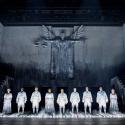
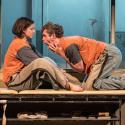
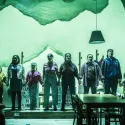
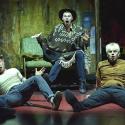
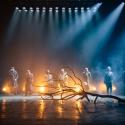
Lost Lear, Traverse Theatre ★★★★
A rehearsal room; a tense preparation session for a production of King Lear, provocatively gender-swapped; a troublesome diva in the title role; and a near-silent understudy barely able to contribute.
Dan Colley’s compelling ensemble piece has a big twist early on, then several further shifts in emphasis and direction that keep the audience guessing throughout, and which also force a reappraisal of everything you’ve just seen. But his central conceit offers apparently endless – and often contradictory – insights. Iconic Irish actor Joy is in a care home, where her treatment – or, more correctly, the staged reality she’s been immersed in – is a perpetual series of rehearsals for a production of King Lear that will never happen. It’s the only way to preserve her stability, contentment and fragile grip on reality, explains her director/co-actor/therapist Liam – even if it’s a reality that’s itself based on faulty memories. And into that staged reality steps her estranged son, invited to contribute to her treatment, even if he seems less than convinced by the whole endeavour.
Indeed, audiences too might find it hard to believe that any care home would go to such elaborate, costly lengths for a single dementia patient, however starry she is, thereby undermining the alternative-reality premise on which Colley’s play rests. But that aside, it’s a fruitful idea that quickly sends up questions of filial loyalty, madness, reality versus artifice, and deep-rooted fear to often mind-bending effect.
Lost Lear, however, is a play in which exposition is all, and in which little happens once its initial set-up has been thoroughly explored. Its development is in terms of layers or resonance and meaning, rather than simply events, but that leaves the show feeling slightly monolithic in its content. It’s quite the intellectual ride all the same, one in which multiple versions of reality and points of view jostle for attention, and one that gratifyingly refuses to side with any of them.
Venetia Bowe as Joy is a strident but fragile presence, while Manus Halligan captures director/therapist Liam’s mix of patronising superiority and boyish excitement excellently. Colley’s own direction is calm and appropriately clinical, teasing apart the show’s levels of reality beautifully, while Andrew Clancy’s set – complete with live overhead projector backdrop work and close-up camera for some of the key figures – is sparse but effective.
Lost Lear is a show whose cerebral, literary gymnastics arguably dilute its emotional impact, but it delivers a forceful punch in the gut nonetheless.
- Until 24 August
 Consumed, Traverse Theatre ★★★★
If Dan Colley throws an unexpected reality shift into Lost Lear’s early stages, that’s nothing compared with the world-shattering cataclysm that detonates towards the end of Karis Kelly’s shocking and guffaw-inducing Consumed. But the less said about that the better. Up until then, Kelly’s barbed, razor-sharp four-hander throws us into the 90th birthday party from hell in small-town Northern Ireland, as pottering, neurotic Gilly hosts a celebration lunch for her mother, foul-mouthed, take-no-prisoners Eileen, to which she’s invited her seldom-seen daughter Jenny and grand-daughter Muireann from across the water in England. As insults are traded, motives questioned and put-downs lobbed, familial ties are stretched way beyond breaking point, and what began as brutally funny repartee inexorably transforms into something far darker.
Kelly captures the unforgiving cut and thrust of family dialogue deftly, but also manages to weave in questions of generational trauma and complicity that become more pronounced as the mood gradually darkens. Her pacing is excellent, and her shifts from subject to subject seldom lose sight of the four richly drawn women seated around the kitchen table in Lily Arnold’s beautifully detailed, naturalistic set. Julia Dearden is gleeful as the demonic matriarch, too old to care what anyone thinks of what she says, while Andrea Irvine’s Gilly is deliciously unnerving in her ceaseless requests and expectations. Caoimhe Farren cavorts across the stage as free-thinking Jenny, while Muireann Ní Fhaogáin blends blustering confidence and fragile neediness as the teenage Muireann. Director Katie Posner ensures quickfire exchanges but enough breath for Kelly’s verbal daggers to hit their marks, and navigates the writer’s ambitious themes with smoothness and agility.
And that world-shattering cataclysm? For me, it stretched credulity too far, before snapping it entirely – and it also exploded Kelly’s carefully woven tapestry of unforgiving humour into tatters. Others may disagree. In any case, it serves to re-emphasise the show’s historical context beyond any doubt, and as a reminder of the decades of unspoken angst lurking behind every family’s exchanges.
- Until 24 August