

Yorgos Lanthimos continues to navigate a highly distinctive, daring, one might even say sly path for himself. After attracting more mainstream audiences with his crowd-pleasing period romp The Favourite, and the gothic feminist fable Poor Things, he now returns to the bleak, discomforting and strange worldview of his earlier films.
And for the more recent fans, the uninitiated to the director’s roots, Kinds of Kindness may be something of a shock.
Regardless, it’s very refreshing to see a filmmaker mix it up in this way, finding ways of realising his sensibility in different degrees of intensity and accessibility. Much of it relates to his choice of writers. By teaming again with Efthimis Filioppou, the co-writer of his weird wave Greek films and his first two English-language ones, Lanthimos returns to his most challenging fare.
The adage “you’ve got to be cruel to be kind” (derived from Hamlet, and look how that ended) is in full force here; put another way, the film’s title is loaded with irony. Filmed on location in New Orleans, it comprises three different stories, connected by the same group of actors playing different roles, and by a general theme, of the tension between the desires for control and free will. In each, dominating characters manipulate, coerce and subdue others, their victims willingly subjugated, until their wish for even a little freedom challenges the perverse equilibrium. 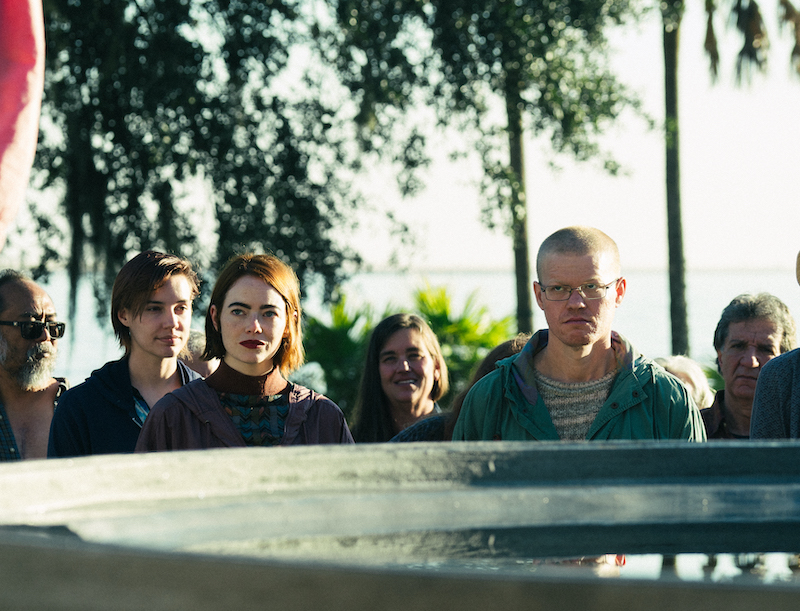 Like many great directors, Lanthimos has now assembled a terrific ensemble of collaborators, on both sides of the camera. On screen, this again features his muse, Emma Stone, Willem Dafoe, Margaret Qualley and Joe Alwyn, all from previous films, along with Lanthimos newcomers Jesse Plemons (pictured above, centre, with Stone) and Hong Chau. All these actors have something naturally edgy and off-kilter in their personas, making them perfect for what’s in store.
In the first, and strongest story, Plemons plays Robert, a dour chap with a vague, richly rewarded job as a businessman, whose entire life – his choice of wife (Chau), home, what he eats and drinks, when the couple have sex, the fact that they don’t have children – is controlled completely by his boss, Raymond (Dafoe), who also, occasionally, enjoys sexual liaisons with his charge. There’s no explanation as to how this arrangement came into being, but a suggestion that Raymond has a similar hold over most of the people in his orbit, including his own wife, Vivien (Qualley). When Robert finally draws a line – at the instruction to kill a stranger – and is dropped by his benefactor and master, his dependency comes into sharp focus.
In the next Plemons is Daniel, a police officer who is first seen grieving the loss at sea of his scientist wife Liz (Stone). When she miraculously returns, rather than feeling overjoyed, Daniel begins to suspect that the woman before him is not actually his wife. Whether he’s deluded, or not, the now psychotic cop challenges Liz to demonstrate her devotion in frightening ways.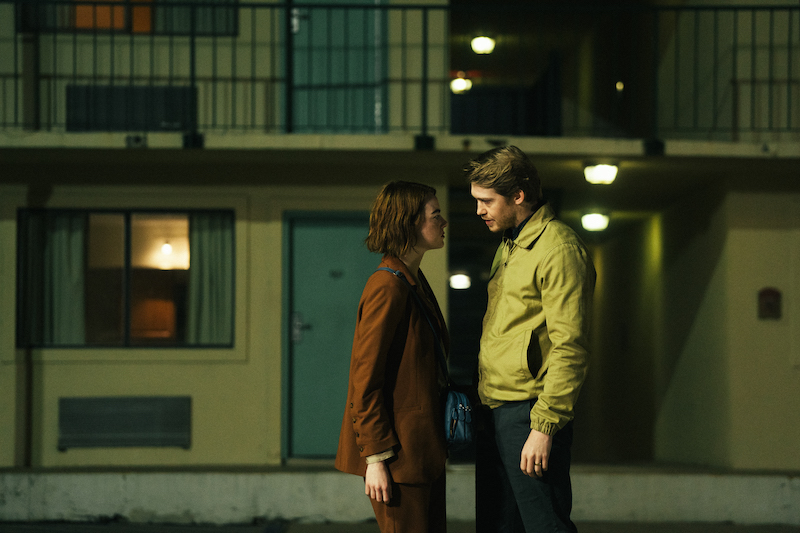 Finally, Stone is Emily, a woman who has left her husband Joseph (Alwyn, pictured above with Stone) and child to join a creepy cult led by Omi (Dafoe) and Aka (Chau) that is obsessed with bodily fluids and routinely half kills its members in a locked sauna to excise ‘contaminated’ water from their bodies. Emily and Andrew (Plemons) are charged with finding the cult’s dreamed-of spiritual totem, a woman with supposed powers to raise the dead. While dedicated to her task, Emily’s thoughts of her child – and Joseph’s vilely orchestrated attempt to win her back – threaten her place within the cult.
As writers, Lanthimos and Filioppou take familiar societal structures and dynamics and present them in their darkest, most extremely harmful iterations; a path epitomised by their breakthrough film, Dogtooth, and its grown-up siblings trapped in childhood by their controlling father. With their dialogue demanding a kind of anaemic, distracted delivery, the result can feel like a cross between Robert Bresson and David Lynch.
Kinds of Kindness certainly has Lynchian shards of wacky wit, whether the diabolical Raymond’s choice of gifts to Robert and his wife (one of John McEnroe’s tantrum-smashed rackets, the helmet worn by Ayrton Senna when he died), Stone’s brilliant monologue, as Liz, recounting the dream that led to her being addicted to chocolate, a family ‘home video’ that comprises swinger sex, or the killer punchline of Emily’s search for the elusive saint.
At the same time, the film would benefit from even more humour to balance the extremes to which Lanthimos will go to create his atmosphere of unease. Characters are drugged, raped and ostracised; a woman has her pregnancies chemically aborted without her knowledge, believing she’s having miscarriages; another feeds part of herself to someone she wants to please. The three stories are designed to belong in a unified world, and it’s one that is persistently nasty and cruel; and, at nearly three hours, that can become wearing.
Nevertheless, it’s presented with great relish and style, beautifully shot by Robbie Ryan (Oscar-nominated for both The Favourite and Poor Things) and acted with conviction. Plemons is particularly outstanding: pathetic and vulnerable as the corporate slave, chilling as the cop (slightly reminiscent of his racist policeman in Civil War); Dafoe, so sweet as the mad scientist in Poor Things, exudes the menace of his early career; Qualley is promoted from an inchoate experiment in Poor Things to a quartet of solid supporting parts (including twins), and Stone is dependably excellent, especially on Emily’s rollercoaster journey towards cult acceptance.











Add comment