Imagine for a moment that you are at, say, the Derby. It’s pretty good. But then in flies Pegasus, the mythical winged horse. What happens?
We need to talk about these rare moments of almost inexplicable magic in concerts, because unless I’m massively mistaken, that is one crucial factor that keeps us going to them. Perhaps you’ve witnessed one. Something happens. Some might say that a spirit descends. An atmosphere comes to surround us and we all sense it, musicians and audience alike, and we lose ourselves in it together. Welcome to Milton Court’s evening with the Doric String Quartet and pianist Benjamin Grosvenor, with a spot of Chopin.
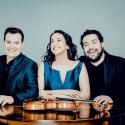
The evening began pleasantly enough with the Doric Quartet in the Schubert Quartettsatz. This fast-rising young ensemble looks as if it has stepped straight out of an Ian McEwan novel. Earnest, stylish and intense, they offset one another in the ensemble with an engaging flexibility and minute attention to detail, painting the music with vivid contrasting colours that – though ever so slightly verging towards mannerism – remains thoroughly memorable. Perhaps it’s a quirk of the acoustic, but I found myself occasional wishing for a larger, sweeter tone from first violin Alex Redington, who sometimes sounded underpowered beside the powerful tenor of cellist John Myerscough and the dark, characterful contralto of violist Hélène Clément (who plays Frank Bridge and Benjamin Britten’s viola, no less. The four, with Ying Xue second from left, pictured below by George Garnier). 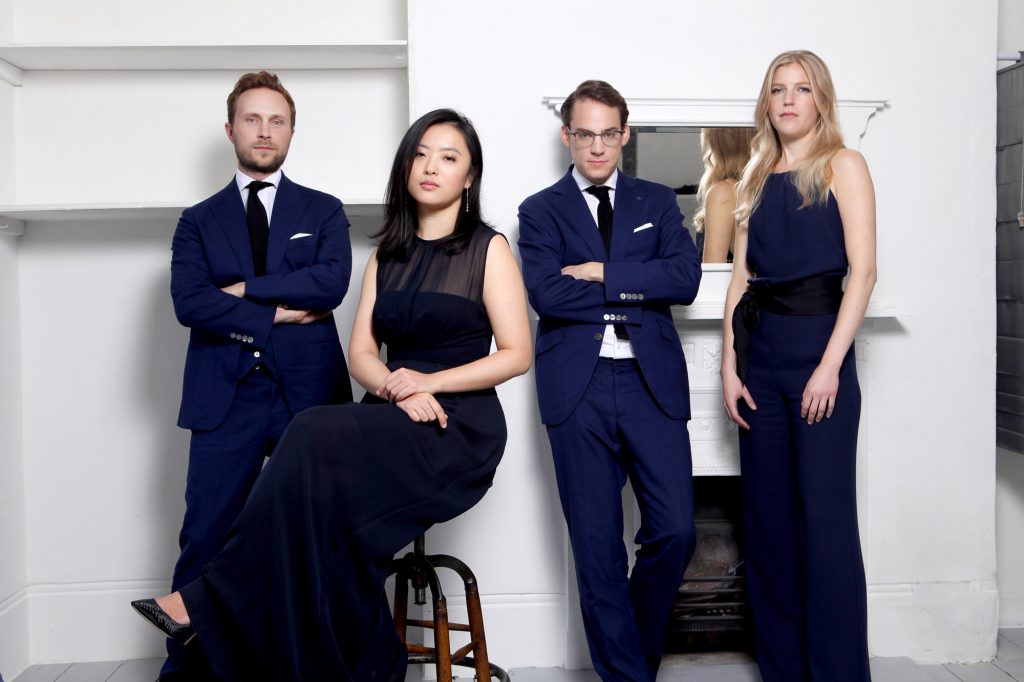 But then, hello Pegasus. The pianist Benjamin Grosvenor joined the ensemble for the rest of the concert, first with a rare performance of Chopin’s Piano Concerto No 1 in a chamber version (arranged by whom we are not told, but available sheet music is by Kevin Kenner and Krzysztof Dombek), the quartet augmented by double bassist Laurène Durantel. Soon Grosvenor’s playing, which has deepened, darkened and matured with the years, seemed to hold the strings in a generous embrace that lifted the entire ensemble towards a whole new kind of stratosphere.
The concerto, often denigrated for its orchestration, in some ways suffers little from the transfer. The downside is that it remains utterly a concerto. The strings provide a kind of sonic halo, illuminating the background to the soloist’s brilliance; it’s not an equal chamber music partnership, yet the soloist is tucked away behind the quintet, scarcely visible but for a blur of rapidly moving hands. On the other hand, the leaner texture means that one can hear aspects of the concerto that might go unnoticed notice in a larger, soupier soundworld; and for the soloist who can – and Grosvenor can, and did – there’s the opportunity to run with the passagework like Usain Bolt yet have every note sound with absolute clarity.
Besides that extraordinary facility, Grosvenor is blessed with an almost operatically open and expressive tone that suits Chopin’s melodies to literal perfection. It was in the "Romanze" slow movement that that extraordinary magic took over, with Grosvenor’s piano singing like Chopin’s first love Konstancja Gładkowska, while the quintet, seemingly blissing out, became wholly as one in the flow alongside him.
Finally Grosvenor and the Dorics returned to play Fauré’s Piano Quintet No 1 in D minor – a work often neglected beside the French composer’s more chewable piano quartets and his later, more mystical-sounding second quintet. Premiered to remarkable acclaim in 1906, it is an intimate, rather ineffable work, its extreme technical challenges serving the unusual cause of modesty and reflectiveness. Here Grosvenor proved to be an ideal Fauré pianist – effortless waterfalls of notes, shining tone and no nonsense – and the ensemble came fully into its own, the quartet’s penchant for colouristic variety making the most of Fauré’s blend of high energy, harmonic sleight-of-hand and silken charm. This was, to put it mildly, a night to remember.